
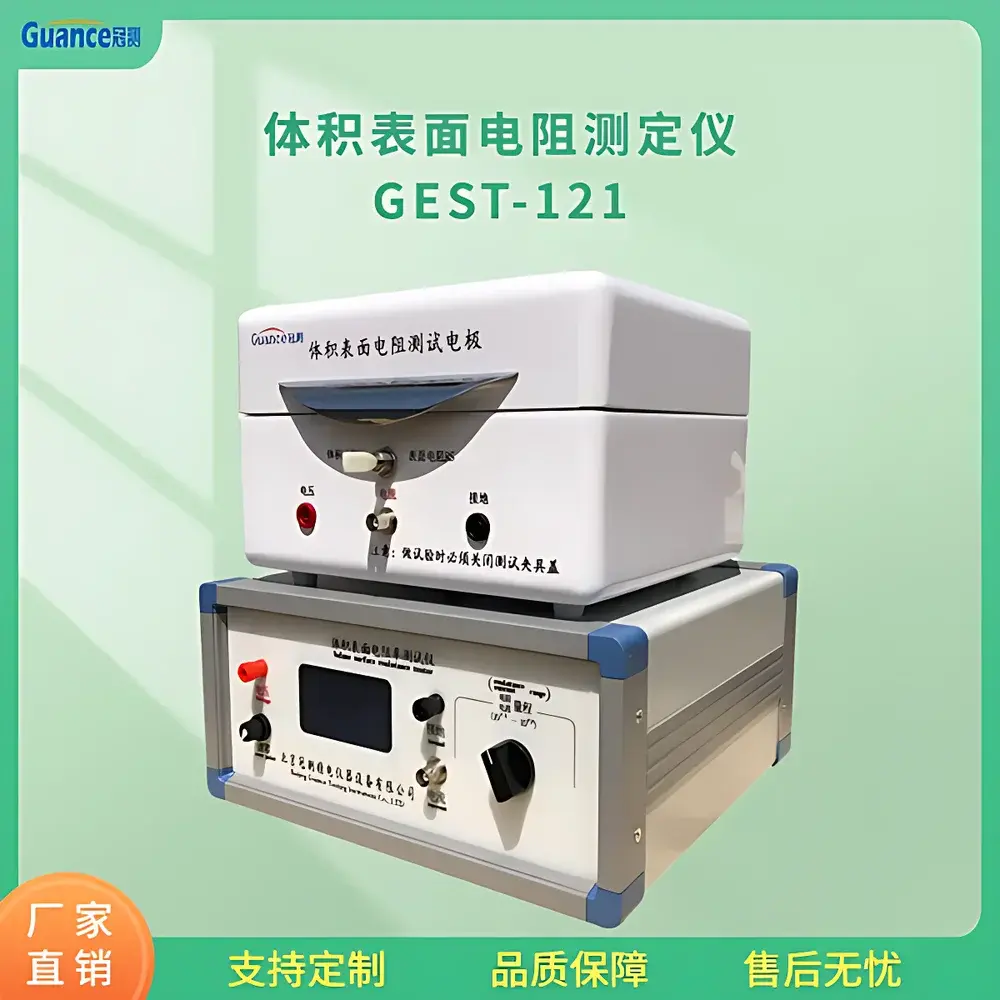
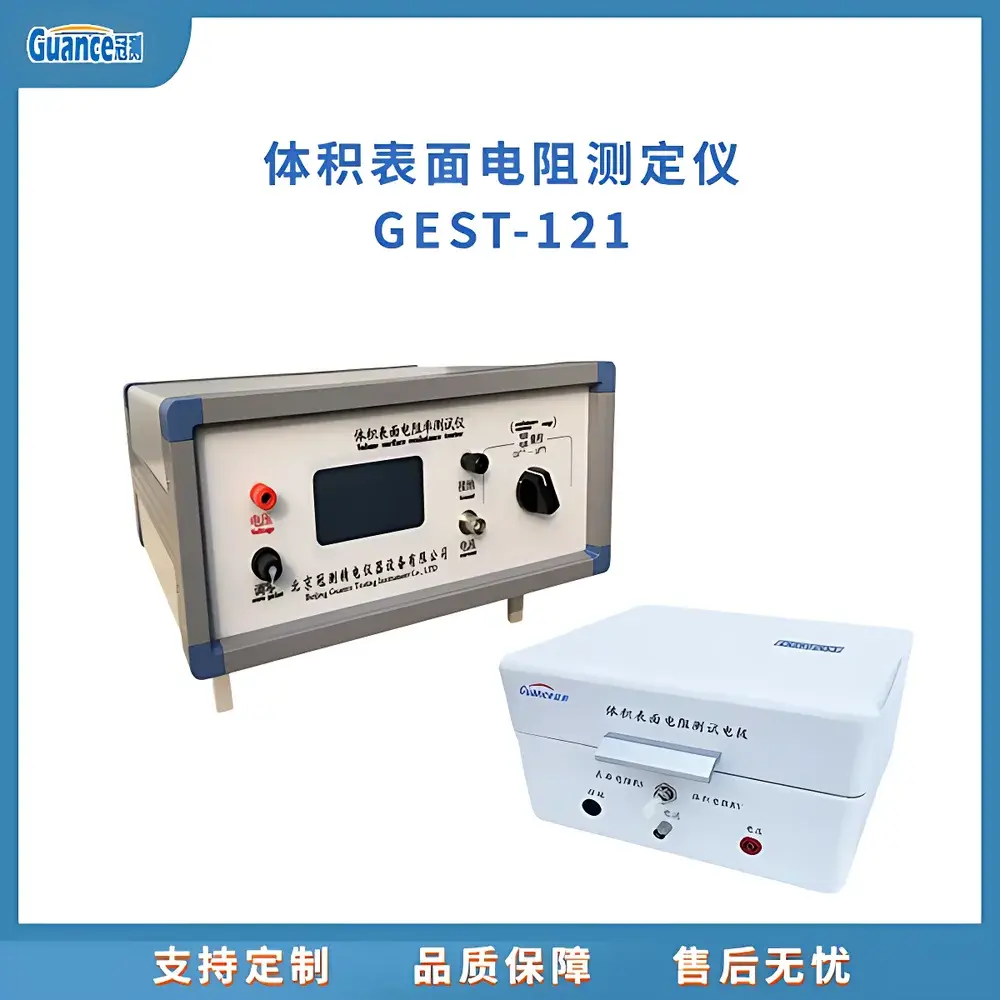
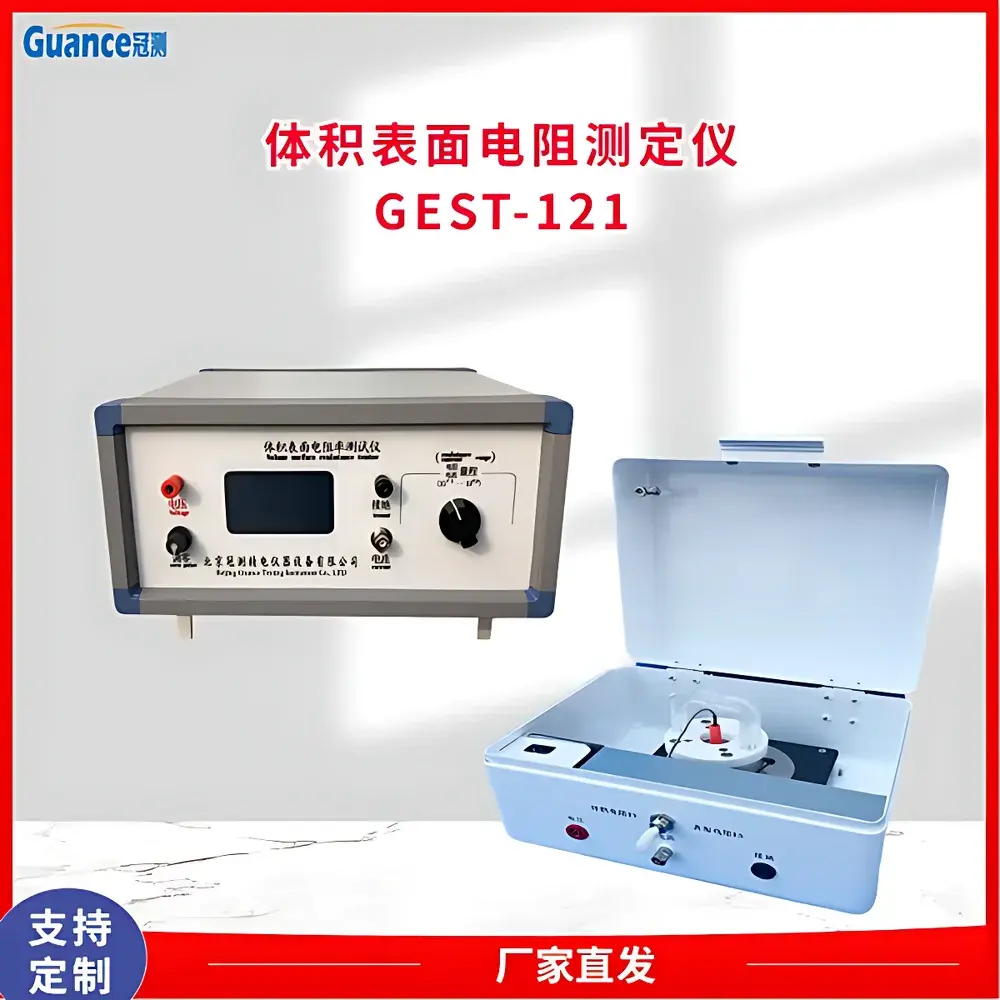
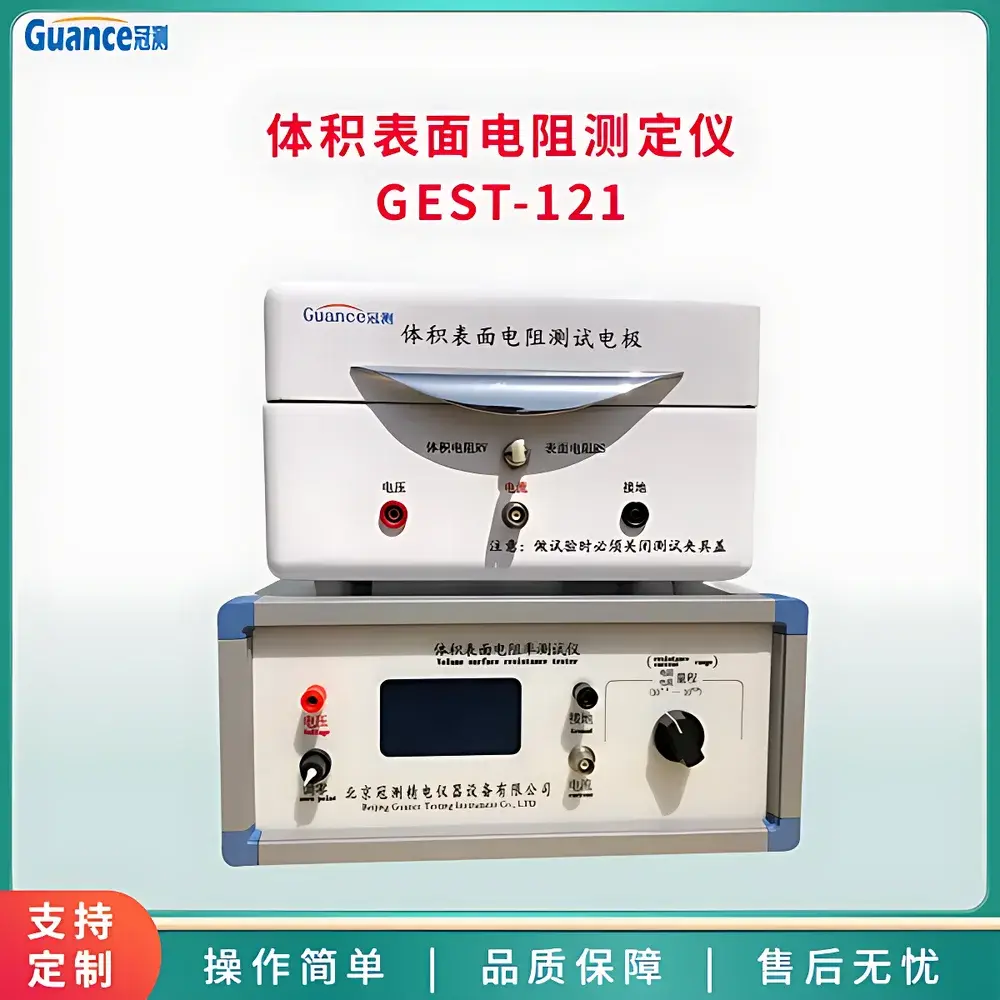
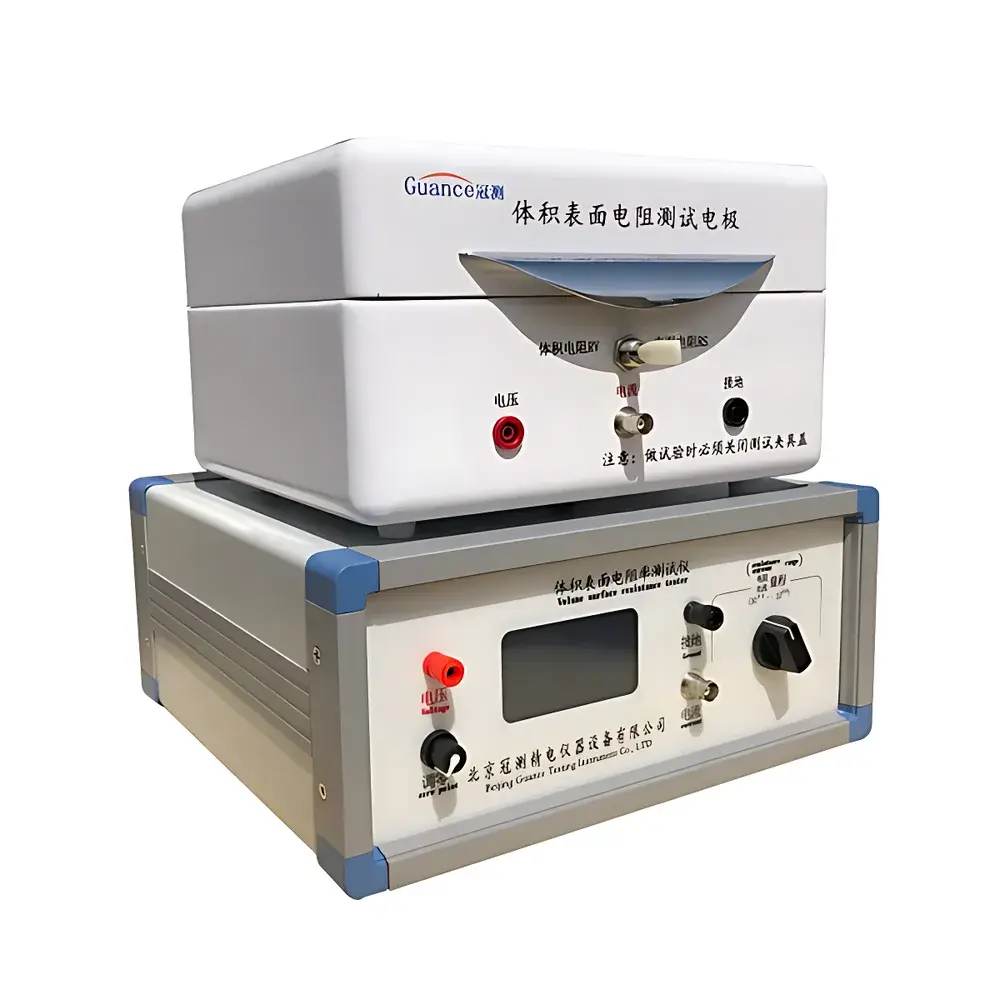
GuanCe Instruments GEST-1214 Volume & Surface Resistivity Tester
| Brand | GuanCe Instruments |
|---|---|
| Model | GEST-1214 |
| Resistance Range | 1×10⁴ Ω to 1×10¹⁸ Ω |
| Current Range | 1×10⁻¹⁶ A to 2×10⁻⁴ A |
| Test Voltages | 10 V, 50 V, 100 V, 250 V, 500 V, 1000 V |
| Accuracy | ±1% (≤1×10¹⁰ Ω), ±5–10% (>1×10¹⁰ Ω) |
| Display | Digital LCD |
| Power Supply | 220 V AC / 50 Hz |
| Power Consumption | 100 W |
| Dimensions (L×W×H) | 300 mm × 300 mm × 150 mm |
| Weight | ~5 kg |
| Standard Electrode | Three-electrode system for solid samples ≥80 mm diameter |
| Compliance | Designed for ASTM D257, IEC 62631-3-1, GB/T 1410, ISO 3915 |
Overview
The GuanCe Instruments GEST-1214 Volume & Surface Resistivity Tester is a precision electrometric instrument engineered for high-impedance DC resistance measurement in insulating and electrostatic-dissipative materials. It operates on the principle of constant-voltage DC biasing combined with guarded current measurement, enabling accurate determination of volume resistivity (ρ), surface resistivity (σ), and insulation resistance (Rins) in accordance with standardized test methodologies. The instrument employs a guarded triaxial measurement architecture to minimize leakage current errors and enhance measurement stability—critical when evaluating ultra-high-resistivity materials (up to 1×10¹⁸ Ω). Its modular electrode interface supports rapid configuration for diverse sample geometries and physical states, including rigid solids, flexible films, powders, liquids, and pastes—making it suitable for R&D laboratories, quality control environments, and metrology institutes requiring traceable, repeatable resistivity data.
Key Features
- Ultra-wide resistance measurement range: 1×10⁴ Ω to 1×10¹⁸ Ω, covering low-conductivity polymers, ceramics, elastomers, and advanced dielectrics
- Programmable DC test voltages: 10 V, 50 V, 100 V, 250 V, 500 V, and 1000 V—compliant with voltage selection requirements in ASTM D257 and IEC 62631-3-1
- High-sensitivity picoammeter circuitry with current resolution down to 1×10⁻¹⁶ A, enabling reliable measurement of extremely low conduction currents
- Digital LCD display with real-time resistance, current, and voltage readouts; auto-ranging and manual range selection modes
- Integrated three-electrode fixture (standard) optimized for disc-shaped solid specimens ≥80 mm in diameter—designed to eliminate edge effects and ensure uniform field distribution per ASTM D257 Annex A3
- Expandable electrode ecosystem: optional two-electrode cells for liquids, concentric ring electrodes for surface resistivity, powder compression cells, and liquid bath electrodes
- Robust electromagnetic shielding and guarded input stage to suppress environmental noise and parasitic leakage paths
- Compliance-ready design: supports audit-trail-capable operation when paired with external logging software; hardware architecture aligns with GLP/GMP documentation prerequisites
Sample Compatibility & Compliance
The GEST-1214 accommodates heterogeneous sample forms without mechanical or electrical modification: rigid plastics and rubber blocks, thin polymer films (<25 µm), granular powders (e.g., carbon-black-filled composites), conductive inks, antistatic coatings, and ionically conductive solutions. Its electrode interchangeability ensures adherence to material-specific test configurations defined in ISO 3915 (conductive plastics), GB/T 1410 (general solid insulators), and IEC 61340-2-3 (electrostatics in electronics). All measurements are referenced to NIST-traceable calibration standards. The instrument’s electrical safety design conforms to IEC 61010-1 for laboratory equipment, and its test methodology satisfies requirements for certification reporting under UL 746C, ANSI/ESD S20.20, and EN 100015-1.
Software & Data Management
While the GEST-1214 operates as a standalone benchtop instrument with local display and manual control, it features an RS-232 serial interface (optional USB-to-serial adapter) for integration into automated test systems. Raw measurement data—including timestamped resistance, applied voltage, measured current, and user-defined sample ID—can be streamed to host PCs running LabVIEW, Python-based acquisition scripts, or proprietary QC databases. When used in regulated environments, the system supports 21 CFR Part 11-compliant data handling when paired with validated third-party software that implements electronic signatures, audit trails, and role-based access control. Export formats include CSV and ASCII text for direct import into statistical process control (SPC) platforms or LIMS.
Applications
- Volume resistivity characterization of aerospace-grade polyimides and ceramic matrix composites for high-voltage insulation validation
- Surface resistivity mapping of ESD-safe work surfaces, cleanroom flooring, and static-dissipative packaging materials per ANSI/ESD STM11.11
- Quality assurance testing of antistatic additives in injection-molded automotive interior components
- Resistivity profiling of photoresist layers and dielectric thin films during semiconductor process development
- Research-grade dark current analysis of photodiodes and organic photovoltaic (OPV) devices under controlled bias conditions
- Comparative evaluation of nanofiller dispersion homogeneity in conductive polymer nanocomposites via spatially resolved resistivity scans
FAQ
What standards does the GEST-1214 support for resistivity testing?
It is configured to meet ASTM D257, IEC 62631-3-1, ISO 3915, GB/T 1410, and IEC 61340-2-3—covering both volume and surface resistivity measurement protocols.
Can the instrument measure resistivity of powders or pastes?
Yes—via optional powder compression electrodes or conductive gel-contact cells, enabling bulk resistivity assessment of filled thermoplastics, battery electrode slurries, and conductive adhesives.
Is calibration traceable to national standards?
All factory calibrations are performed using Keysight-certified high-resistance standards traceable to NIST; calibration certificates include uncertainty budgets and verification against primary reference resistors.
Does the GEST-1214 support automated testing sequences?
Through its RS-232 interface and SCPI-compatible command set, it integrates with programmable source-measure units (SMUs) and test sequencers for unattended multi-sample campaigns.
How is guarding implemented to ensure measurement integrity?
The instrument uses a driven-guard topology around the high-impedance input node, actively maintaining the guard potential at the same voltage as the sense line—thereby eliminating insulator surface leakage and cable dielectric absorption errors.



