
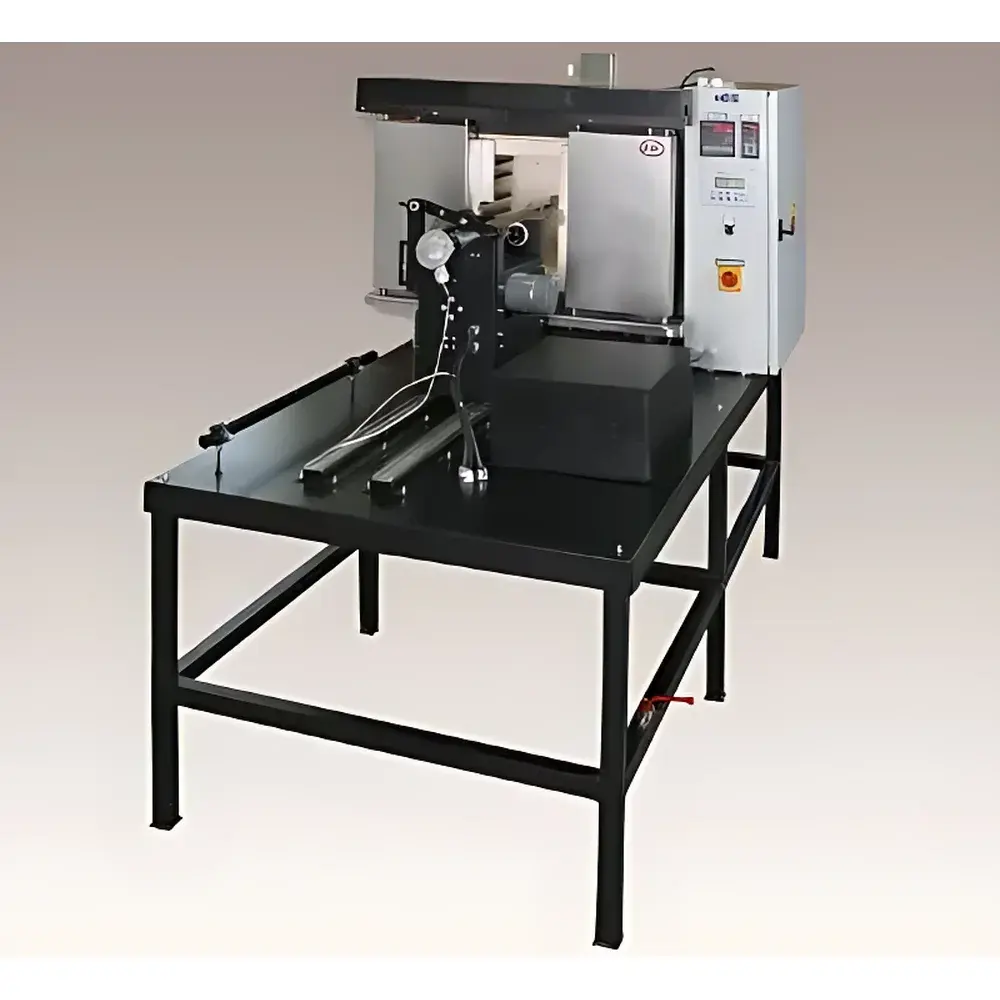
LAC KR 30/12 Rotating Retort Calcination Furnace
| Brand | LAC |
|---|---|
| Origin | Czech Republic |
| Model | KR 30/12 |
| Maximum Temperature | 1200 °C |
| Chamber Volume | 31 L |
| Internal Dimensions | 310 × 310 × 310 mm |
| External Dimensions | 1000 × 1600 × 2100 mm |
| Power Rating | 3.5 kW |
| Weight | 155 kg |
| Voltage | 230 V |
| Heating Type | Resistance wire (NiCr) embedded in lightweight refractory bricks |
| Retort Material | Fused quartz |
| Retort Drive | PLC-controlled rotary-sliding mechanism |
| Temperature Sensor | S-type thermocouple (Pt10Rh–Pt) |
| Control System | Industrial PLC with real-time clock, 30 programmable profiles (up to 15 segments each) |
| Insulation | Multi-layer — mineral fiber mat + silicate board + lightweight insulating brick |
| Exhaust | Injector-type fan integrated with retort aeration system |
| Safety Compliance | CE-marked, designed per EN 61000-6-2 (EMC immunity) and EN 61000-6-4 (EMC emission), meets general lab safety requirements for Class II electrical equipment |
Overview
The LAC KR 30/12 is a precision-engineered rotating retort calcination furnace designed for controlled thermal processing of laboratory-scale samples under inert or reactive atmospheres. Unlike conventional static muffle furnaces, the KR series employs a horizontally mounted, motor-driven fused quartz retort that rotates continuously during heating—ensuring uniform thermal exposure, enhanced mass transfer, and minimized thermal gradients across solid batches. Its operation is grounded in solid-state heat transfer principles combined with dynamic gas exchange via injector-assisted aeration, making it especially suitable for applications where stoichiometric control, volatile byproduct removal, and reproducible phase transformation are critical—such as the calcination of titanium dioxide precursors, lithium-ion cathode materials, metal oxides, and catalyst supports. The furnace operates up to 1200 °C using NiCr resistance windings embedded within grooved lightweight refractory bricks, supported by a triple-layer insulation architecture to ensure both energy efficiency and thermal stability.
Key Features
- PLC-controlled rotating retort mechanism enabling continuous, programmable rotation speed (0–10 rpm adjustable) for homogenized sample exposure
- Integrated injector-type exhaust fan providing directed airflow into the retort chamber—effectively removing corrosive volatiles (e.g., Cl⁻, SOₓ, NOₓ) before they contact heating elements
- Dual thermocouple configuration: one S-type sensor monitors furnace chamber temperature; a second batch-inserted thermocouple provides direct in-situ measurement inside the retort
- Industrial-grade control interface with real-time clock functionality—supports delayed start, multi-step ramp-soak-hold profiles (up to 15 segments per program), and storage of 30 independent thermal protocols
- Robust stainless steel outer jacket with frameless bent-sheet construction—optimized for mechanical durability, corrosion resistance, and long-term dimensional stability
- Semiconductor relay switching—eliminates contact arcing, reduces electromagnetic interference (EMI), and extends service life compared to electromechanical relays
- Modular insulation system comprising mineral fiber mat, silicate board, and low-density insulating brick—achieving rapid heat-up (typical <60 min to 1000 °C) and low standby power consumption
Sample Compatibility & Compliance
The KR 30/12 accommodates cylindrical quartz retorts (standard Ø80 × L600 mm, custom sizes available) and is compatible with powders, granules, pellets, and coated substrates up to 3 kg per batch. It supports inert (N₂, Ar), reducing (H₂/N₂), oxidizing (air, O₂), and mildly corrosive atmospheres—provided appropriate gas flow control and exhaust scrubbing are implemented externally. While not certified for hazardous area use (ATEX/IECEx), the furnace complies with CE directives for electromagnetic compatibility (EN 61000-6-2/6-4) and low-voltage safety (EN 61000-3-2). Its design facilitates alignment with GLP documentation practices, including audit-ready parameter logging (time-stamped temperature, rotation status, program ID) when interfaced with external data acquisition systems.
Software & Data Management
The built-in PLC controller does not feature Ethernet or USB connectivity but provides RS-485 Modbus RTU output for integration into centralized lab automation networks. All thermal programs—including segment duration, target temperature, ramp rate, hold time, and rotation activation—are stored non-volatilely and retain settings after power loss. Event logs (e.g., overtemperature alarms, door interlock triggers, program completion) are timestamped and viewable on the front-panel LCD. For regulatory environments requiring electronic records, third-party SCADA or LabVIEW-based acquisition can capture real-time temperature and rotation data with 21 CFR Part 11-compliant audit trails when paired with validated drivers and secure authentication.
Applications
- Calcination of TiO₂ precursor hydrates to anatase/rutile phases for pigment development
- Thermal decomposition of metal nitrates and carbonates in battery material synthesis (e.g., NMC, LFP)
- Activation of heterogeneous catalysts (e.g., Ni/Al₂O₃, Co-Mo/SiO₂) under controlled gas flow
- Removal of organic binders from ceramic green bodies prior to sintering
- Oxidative annealing of thin-film coatings on silicon wafers or metallic substrates
- Gravimetric analysis of volatile content in geological or pharmaceutical samples (ASTM E1131, ISO 11358)
FAQ
What atmosphere types can be used with the KR 30/12?
The furnace supports ambient air, inert gases (N₂, Ar), and reducing mixtures (e.g., 5% H₂ in N₂) via optional gas inlet ports. Corrosive or halogenated atmospheres require external scrubbing due to quartz retort limitations.
Is the quartz retort included with the standard configuration?
Yes—the standard delivery includes one fused quartz retort (Ø80 × 600 mm) mounted on the rotary-sliding mechanism.
Can the furnace be operated without rotation?
Yes. Rotation is programmable per thermal step; individual segments may be configured for static or dynamic operation.
Does the system support remote monitoring or data export?
Native remote access is not provided, but RS-485 Modbus RTU enables integration with industrial HMIs or PC-based DAQ systems for real-time monitoring and CSV log export.
What maintenance intervals are recommended for long-term reliability?
Inspect retort integrity and door seal compression every 200 operating hours; verify thermocouple calibration annually or per ISO/IEC 17025 internal procedure.



