
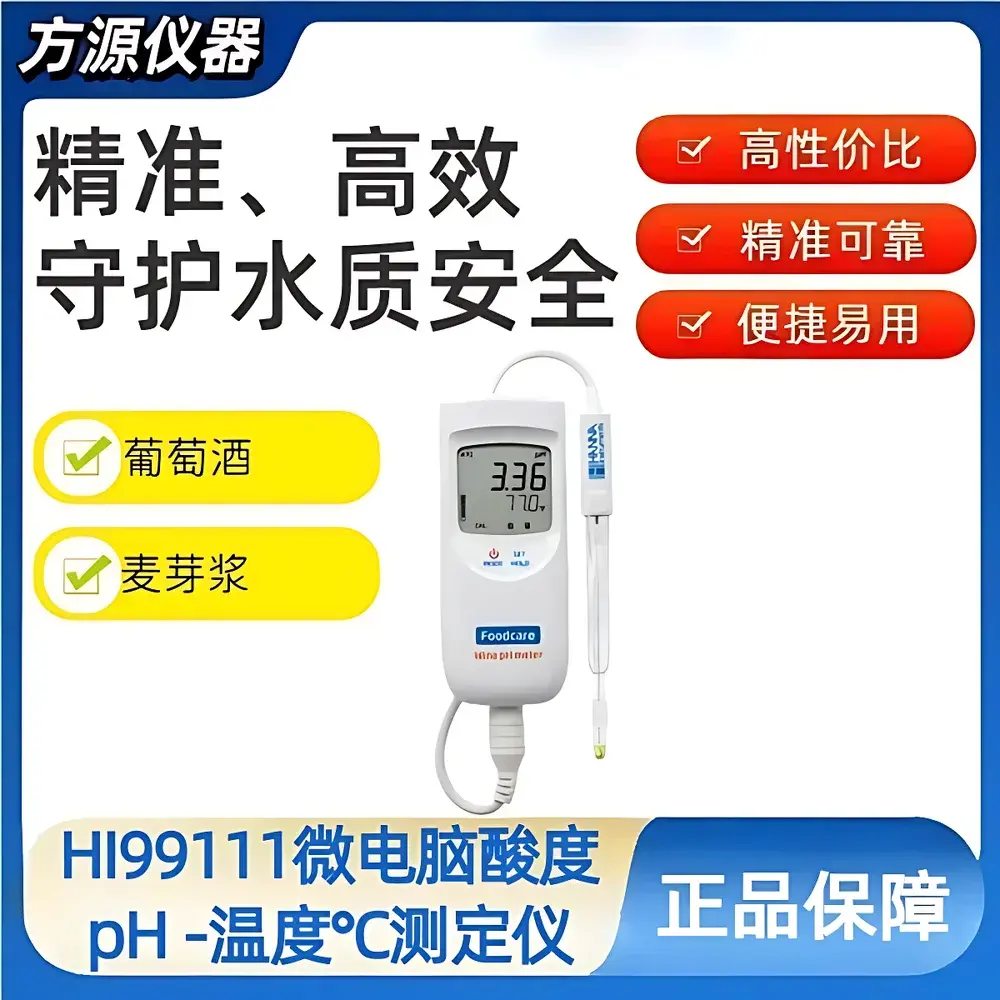
Hanna HI99111 Portable pH and Temperature Meter for Wine Industry
| Brand | Hanna Instruments |
|---|---|
| Origin | Italy |
| Model | HI99111 |
| Instrument Type | Portable |
| Parameter Type | Single-parameter (pH & °C) |
| Measurement Range | -2.00 to 16.00 pH |
| Resolution | 0.01 pH / 0.1°C |
| Accuracy | ±0.02 pH / ±0.5°C (up to 60°C) |
| pH-mV Range | ±825 mV |
| pH-mV Resolution | 1 mV |
| pH-mV Accuracy | ±1 mV |
| Temperature Range | -5.0 to 105.0°C |
| IP Rating | IP67 |
| Electrode | HI10483 refillable spherical glass pH electrode with integrated amplifier and thermistor |
| Calibration | Automatic 1- or 2-point, with built-in buffer sets (4.01/7.01/10.01 pH and 4.01/6.86/9.18 pH) |
| Power | 3×1.5 V AAA batteries |
| Auto-off | After 8 minutes of inactivity |
| Dimensions | 154 × 63 × 30 mm |
| Weight | 196 g |
Overview
The Hanna HI99111 is a purpose-engineered portable pH and temperature meter designed specifically for rigorous quality control and process monitoring in the wine, juice, malt mash, and broader food production sectors. It operates on the fundamental principle of potentiometric measurement: detecting the electrochemical potential difference between a pH-sensitive glass membrane electrode and a stable reference system, then converting this voltage into a calibrated pH value using the Nernst equation. Integrated automatic temperature compensation (ATC) ensures accuracy across wide thermal ranges (-5.0 to 105.0°C), critical for samples such as fermenting must, barrel-aged wines, and post-fermentation stabilizations where temperature fluctuates significantly. Its extended pH range (-2.00 to 16.00) accommodates highly acidic grape musts and alkaline cleaning solutions used in CIP systems—enabling a single instrument to serve both production and sanitation verification workflows. The device complies with FDA’s Food Safety Modernization Act (FSMA) requirements for recordable, traceable, and validated measurement practices in food-grade environments.
Key Features
- True dual-range pH measurement: selectable 0.1 pH or 0.01 pH resolution with ±0.02 pH accuracy at 25°C, certified per ISO 8655 and ASTM E2064 guidelines for volumetric and electrochemical instrumentation.
- Sensor Check™ diagnostic function: real-time electrode health assessment via impedance and asymmetry voltage diagnostics—provides immediate feedback on membrane hydration, junction flow, and reference stability without requiring calibration interruption.
- HI10483 integrated electrode: refillable spherical glass sensing tip with built-in solid-state amplifier and NTC thermistor; DIN waterproof quick-connect interface ensures repeatable electrical contact and eliminates signal noise in humid cellar environments.
- Stability indicator: dynamic “lock” icon disappears only when readings meet internal convergence criteria (±0.01 pH over 3 seconds), ensuring data integrity before recording or export.
- HOLD function: freezes display values for manual transcription or photographic documentation under variable lighting conditions common in tank rooms and lab benches.
- BEPS (Battery Error Prevention System): low-battery warning (flashing battery icon at <5% charge) prevents drift-induced inaccuracies during extended field use—critical for multi-vat sampling campaigns.
- IP67-rated enclosure: dust-tight and submersible up to 1 m for 30 minutes—validated per IEC 60529—making it suitable for wet processing floors, rinsing stations, and outdoor vineyard mobile labs.
Sample Compatibility & Compliance
The HI99111 is optimized for low-ionic-strength, high-polyphenol matrices typical of unfiltered wine, cloudy must, and lees suspensions. Its spherical glass tip minimizes clogging from tartrate crystals and yeast debris, while the open-junction reference design resists fouling by organic residues. All included calibration and cleaning reagents (HI700635 wine deposit cleaner and HI700636 wine stain remover) are formulated to restore electrode performance without damaging hydrated glass membranes or silver/silver chloride reference elements. The instrument meets GLP-relevant operational standards: ATC algorithm adheres to DIN 19265 for temperature-dependent slope correction; calibration memory retains date/time-stamped buffer IDs and deviation logs for audit readiness. While not inherently 21 CFR Part 11 compliant, its data output protocol supports integration with validated LIMS platforms when paired with optional RS232 or Bluetooth modules (sold separately).
Software & Data Management
Data capture is streamlined via intuitive two-button navigation—no menu diving required for routine measurements. All calibration events (date, time, buffer ID, slope %, offset mV) are stored internally with timestamping. While the base unit lacks onboard memory or USB export, its analog output and optional serial interface enable direct connection to industrial PLCs, SCADA systems, or laboratory notebooks equipped with RS232-to-USB adapters. For regulated environments, users may implement external validation protocols: documented calibration SOPs referencing NIST-traceable buffers (HI700300 series), electrode maintenance logs aligned with USP cleanliness expectations, and periodic inter-laboratory verification against master reference meters.
Applications
- Pre-fermentation must analysis: rapid pH screening to guide SO₂ dosing and predict microbial stability.
- Malolactic fermentation monitoring: tracking pH shifts indicative of bacterial activity and acid degradation kinetics.
- Post-fermentation stabilization: verifying final pH prior to cold stabilization or fining agent addition.
- Cleaning-in-place (CIP) validation: measuring rinse water pH to confirm neutralization of caustic or acidic sanitizers.
- Barrel and tank sanitation audits: assessing residual alkalinity or acidity on stainless steel surfaces after cleaning cycles.
- Research & development: comparative pH profiling across varietals, harvest times, and maceration regimes under controlled thermal conditions.
FAQ
What makes the HI99111 suitable for wine-specific applications?
Its extended pH range, spherical glass electrode geometry, and dedicated cleaning reagents address the unique challenges of polyphenol-rich, particulate-laden wine matrices—minimizing drift and junction clogging.
Does the HI99111 support GLP-compliant documentation?
Yes—calibration history with timestamps and buffer IDs is retained internally; when integrated with external logging software, full audit trails meeting GLP Annex 11 requirements can be generated.
Can the HI10483 electrode be used with other Hanna meters?
Yes—the HI10483 uses standard DIN connectors and is compatible with all Hanna instruments supporting that interface, including the HI98107, HI98190, and HI98191 series.
How often should the electrode be cleaned and refilled?
Clean after each sample batch using HI700635/HI700636; refill electrolyte weekly or before any critical measurement session to maintain junction potential stability.
Is temperature compensation fully automatic?
Yes—ATC is continuous and active across the full -5.0 to 105.0°C range, using the embedded thermistor in the HI10483 probe to dynamically adjust slope and offset calculations.





