
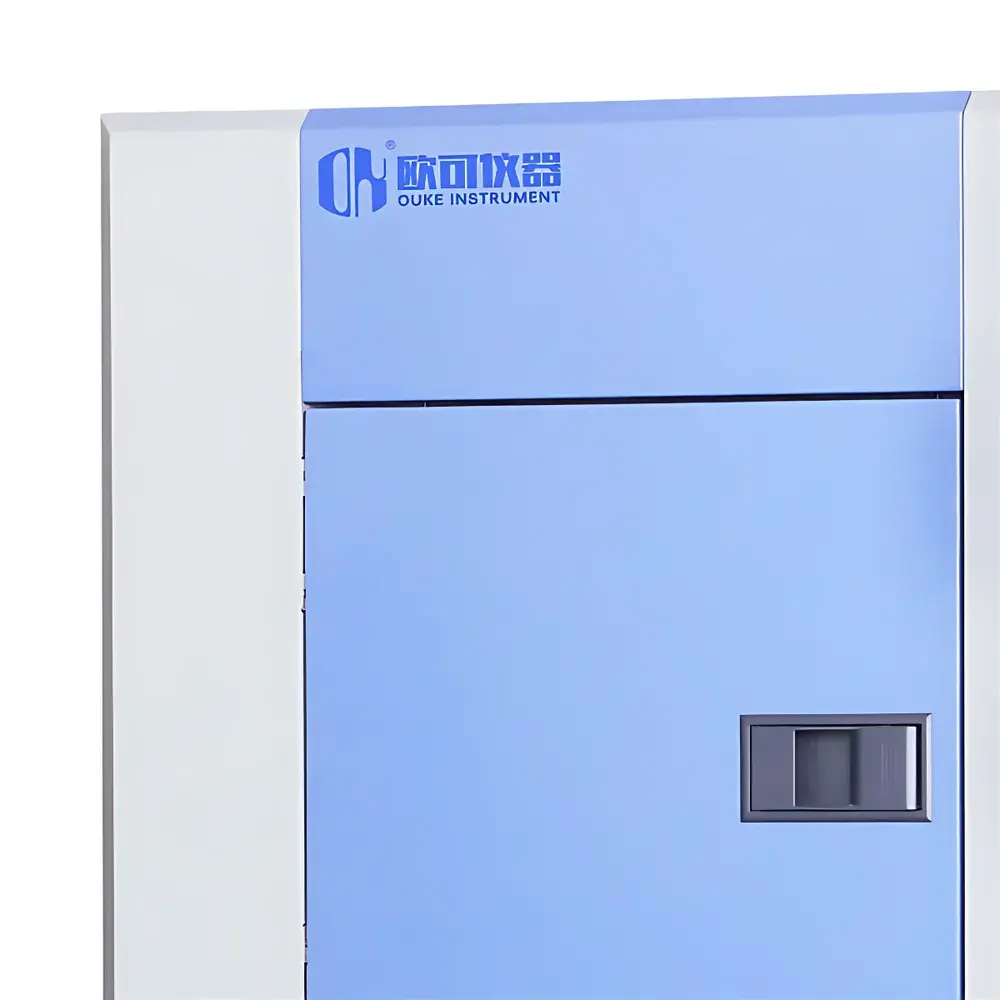
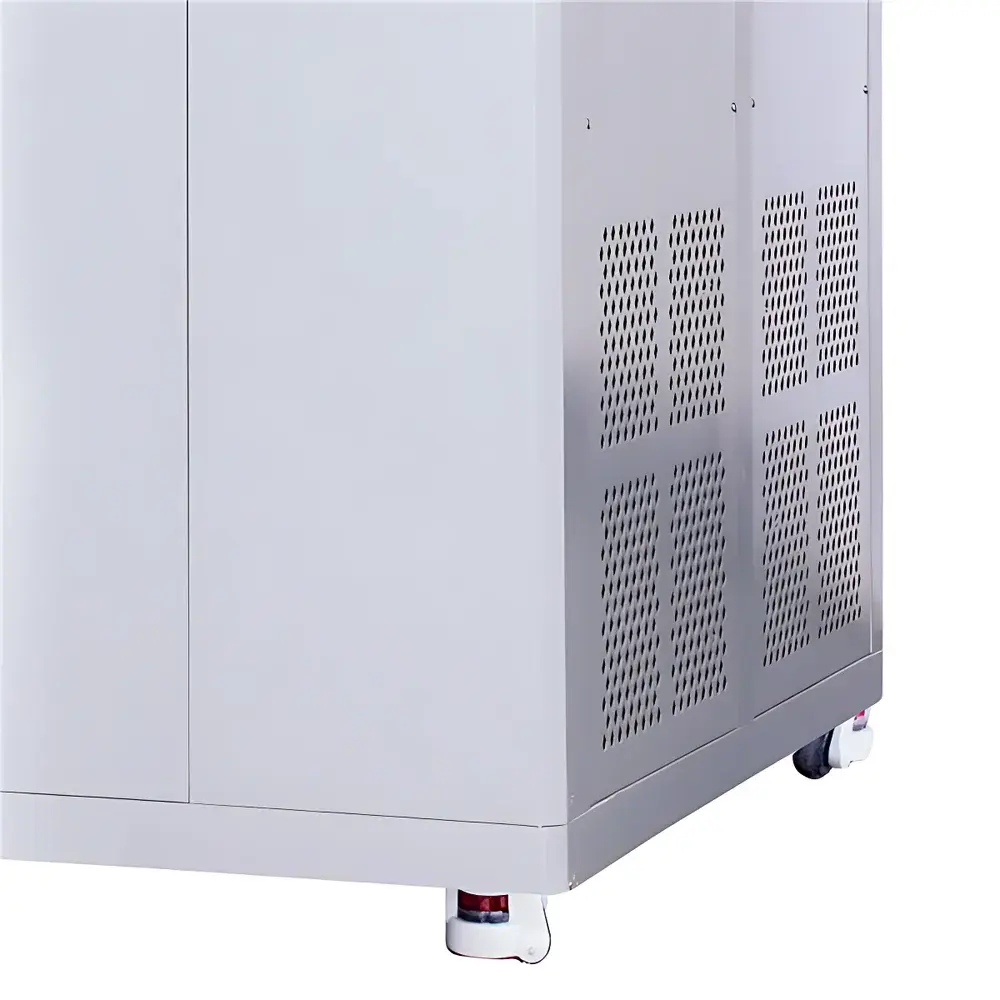
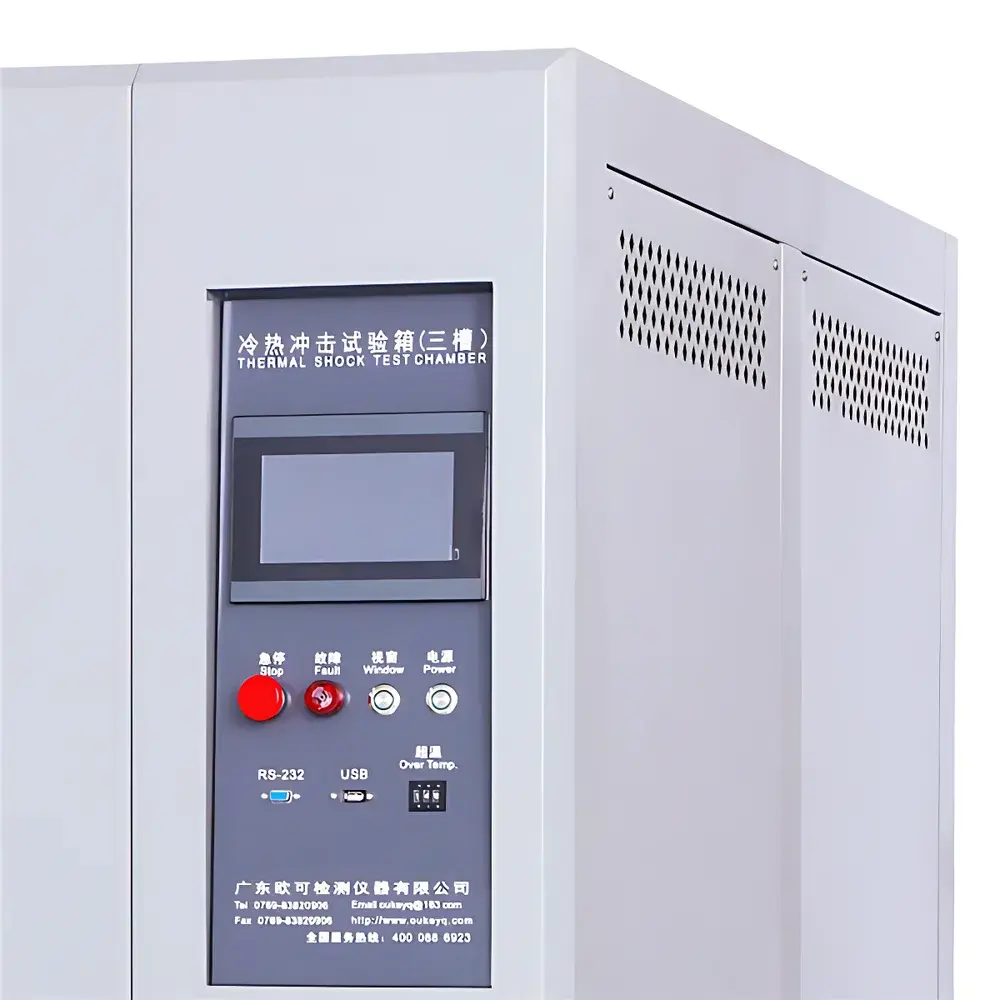
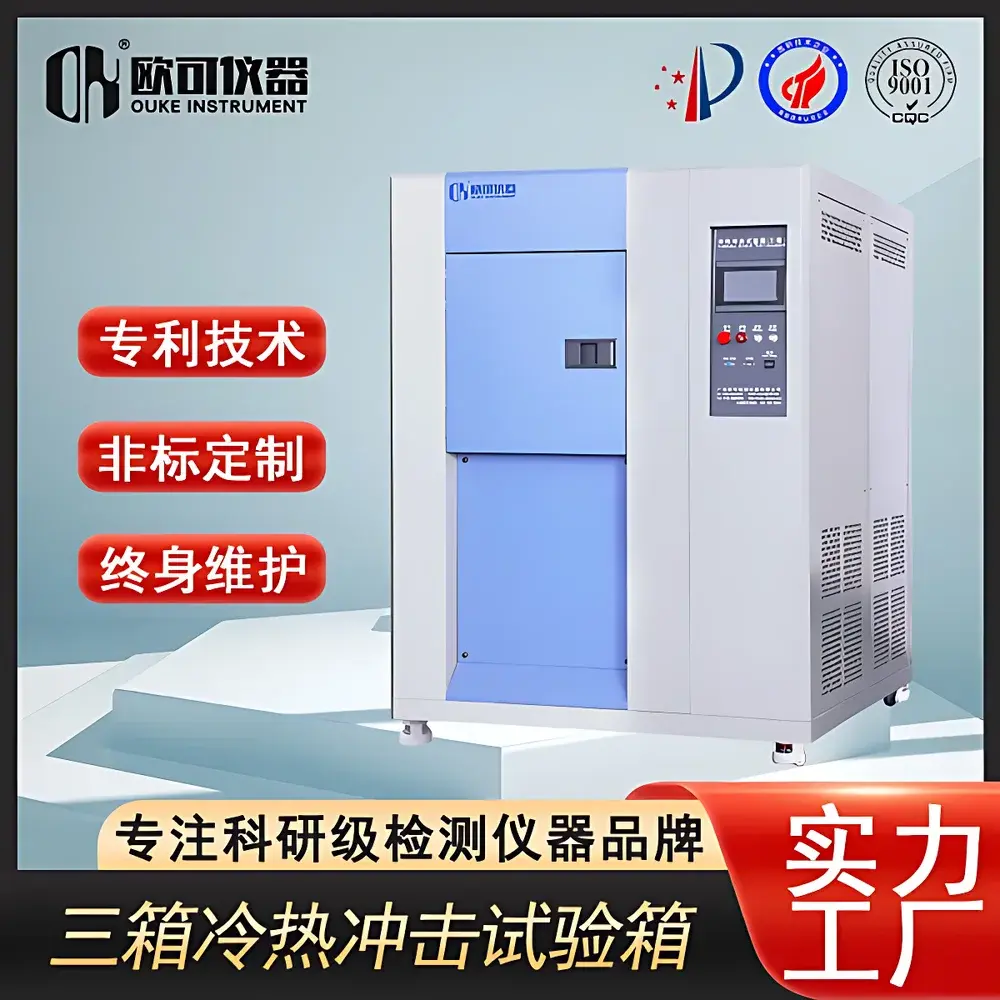
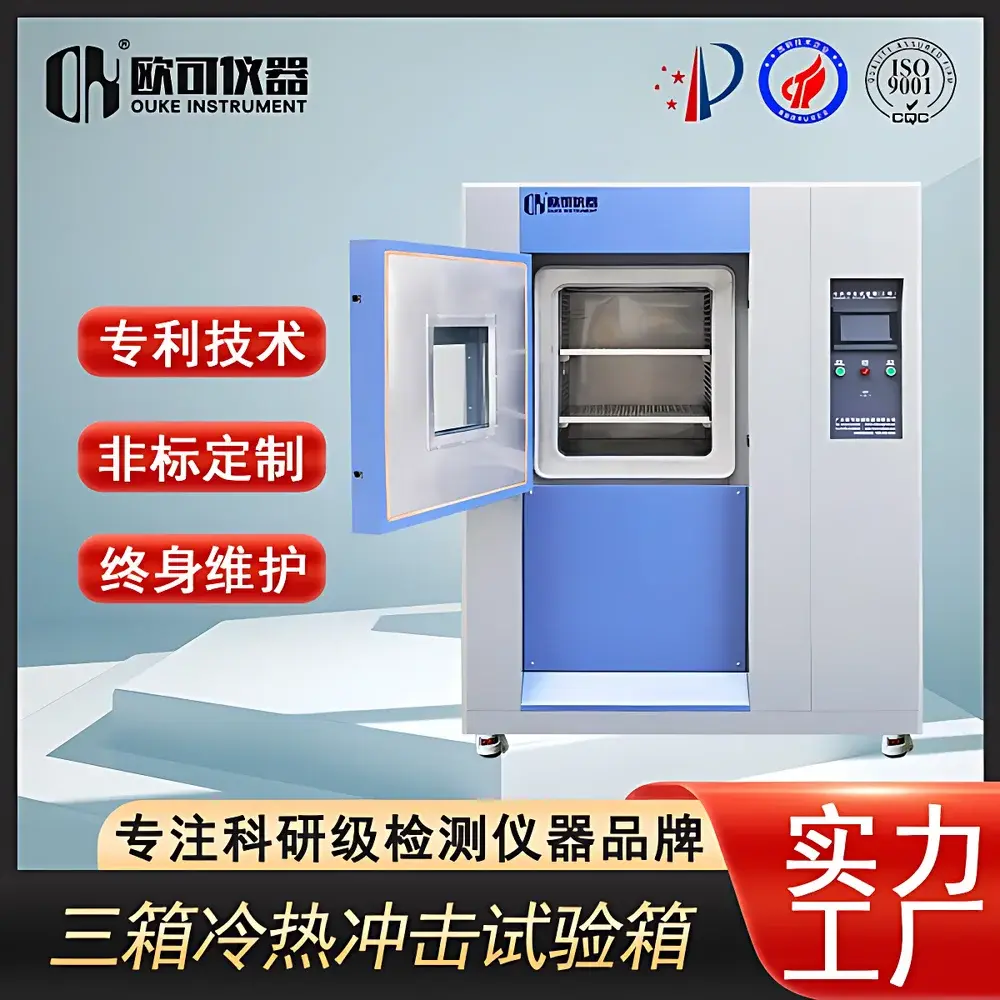
OK Instruments OK-TS-49.00 Three-Zone Thermal Shock Test Chamber
| Brand | OK Instruments |
|---|---|
| Origin | Guangdong, China |
| Manufacturer Type | Direct Manufacturer |
| Model | OK-TS-49.00 |
| High-Temperature Range | +150 °C |
| Low-Temperature Range | −50 °C |
| Thermal Shock Range | −50 °C to +150 °C |
| Temperature Stability | ±2 °C |
| Heating Rate | 10 °C/min |
| Cooling Rate | 10 °C/min |
Overview
The OK Instruments OK-TS-49.00 Three-Zone Thermal Shock Test Chamber is an engineered environmental test system designed for rapid, repeatable, and highly controlled thermal cycling of electronic components, automotive modules, aerospace materials, and high-reliability packaging. Unlike two-chamber (hot/cold) configurations, this three-zone architecture physically isolates the test chamber from dedicated high-temperature (up to +200 °C) and low-temperature (down to −70 °C) reservoirs—enabling true static-sample testing with pneumatic air-lock door switching. This design eliminates mechanical stress on test specimens caused by movement between zones and ensures superior thermal inertia management. The system operates on a dual-stage cascade refrigeration principle, integrating a high-temperature R404A circuit and a low-temperature R23 circuit linked via an evaporative condenser. This configuration delivers stable, energy-efficient cooling performance while meeting the stringent thermal transition requirements defined in IEC 60068-2-14, MIL-STD-810H Method 503.7, and JESD22-A104.
Key Features
- Three-zone static-sample architecture with independent hot (RT to +200 °C), cold (RT to −70 °C), and test (−50 °C to +150 °C) chambers
- PID-based temperature control with ±0.5 °C setpoint accuracy and ±2.0 °C uniformity across the 40 × 35 × 30 cm internal workspace
- Programmable thermal shock profiles: user-defined cycle count, dwell time per zone, auto-defrost scheduling, and optional 2-zone or 3-zone cycling modes
- Pre-conditioning capability: automatic pre-heating or pre-cooling initiated prior to scheduled test start time
- Real-time operational status monitoring with integrated fault diagnostics—including text-guided error identification and step-by-step remediation instructions
- Robust safety architecture featuring over-temperature cut-off, compressor high-pressure protection, phase failure detection, and door interlock sensors
- Full 3D parametric modeling and virtual assembly validation performed during engineering design phase to eliminate mechanical interference and ensure functional integrity
Sample Compatibility & Compliance
The OK-TS-49.00 accommodates rigid and semi-rigid samples up to 25 kg with dimensions ≤38 × 33 × 28 cm. Its stainless-steel (SUS#304) interior and exterior construction, combined with high-density fire-retardant PU insulation, support long-term exposure to aggressive thermal gradients without outgassing or structural degradation. Standard features include one 50-mm diameter cable port and two adjustable SUS#304 shelves. The chamber meets structural and operational requirements for ISO/IEC 17025-accredited laboratories and supports audit-ready documentation for GLP and GMP environments. While not certified to UL or CE as a complete system, all electrical components comply with IEC 61000-6-2 (immunity) and IEC 61000-6-4 (emissions); refrigerant selection (R404A/R23) conforms to current EPA SNAP and EU F-Gas Regulation Annex I allowances for laboratory-grade thermal shock equipment.
Software & Data Management
The embedded controller provides intuitive touch-interface operation with multilingual UI (English, Chinese, Spanish). All test parameters—including ramp rates, dwell durations, cycle counts, and real-time thermocouple readings from up to six user-placed PT100 sensors—are logged at configurable intervals (1–60 seconds) and stored internally for ≥30 days. Data export is supported via USB 2.0 to CSV format for post-processing in MATLAB, Excel, or LIMS platforms. Optional Ethernet connectivity enables remote monitoring and integration with enterprise MES or SCADA systems. Audit trail functionality records operator ID, parameter changes, alarm events, and system resets—supporting compliance with FDA 21 CFR Part 11 when paired with validated user access controls and electronic signature protocols.
Applications
This chamber is routinely deployed in reliability qualification testing for solder joint integrity (IPC-J-STD-020), PCB delamination resistance (JEDEC JESD22-A104), battery cell thermal runaway propagation studies, MEMS device hermeticity validation, and optical coating adhesion assessment under extreme thermal transients. It is also used in incoming QC screening for automotive ECUs (AEC-Q200), avionics connectors (RTCA DO-160 Section 4.9), and medical device sterilization packaging (ISO 11607-2 Annex B). Its precise 10 °C/min heating and cooling rates enable accelerated life modeling per Arrhenius-based failure prediction algorithms.
FAQ
What is the required external cooling infrastructure?
A dedicated water-cooled condenser system is mandatory: users must supply a circulating cooling tower rated at ≥10 m³/h flow rate, with inlet water temperature ≤32 °C.
Can the chamber operate continuously in single-zone mode?
Yes—the hot and cold reservoirs can be independently maintained at setpoints while the test chamber remains isolated, enabling extended high- or low-temperature soak testing.
Is calibration traceability provided with delivery?
Each unit ships with a factory calibration certificate referencing NIST-traceable standards for temperature uniformity and stability verification at three load points.
What maintenance intervals are recommended?
Compressor oil analysis every 2,000 operating hours; refrigerant leak check annually; air filter replacement quarterly; full system performance verification biannually.
Does the system support custom protocol scripting?
Yes—via RS-485 Modbus RTU interface, third-party software (e.g., LabVIEW, Python pySerial) can execute sequence-triggered commands including zone activation, ramp rate override, and data polling.



