
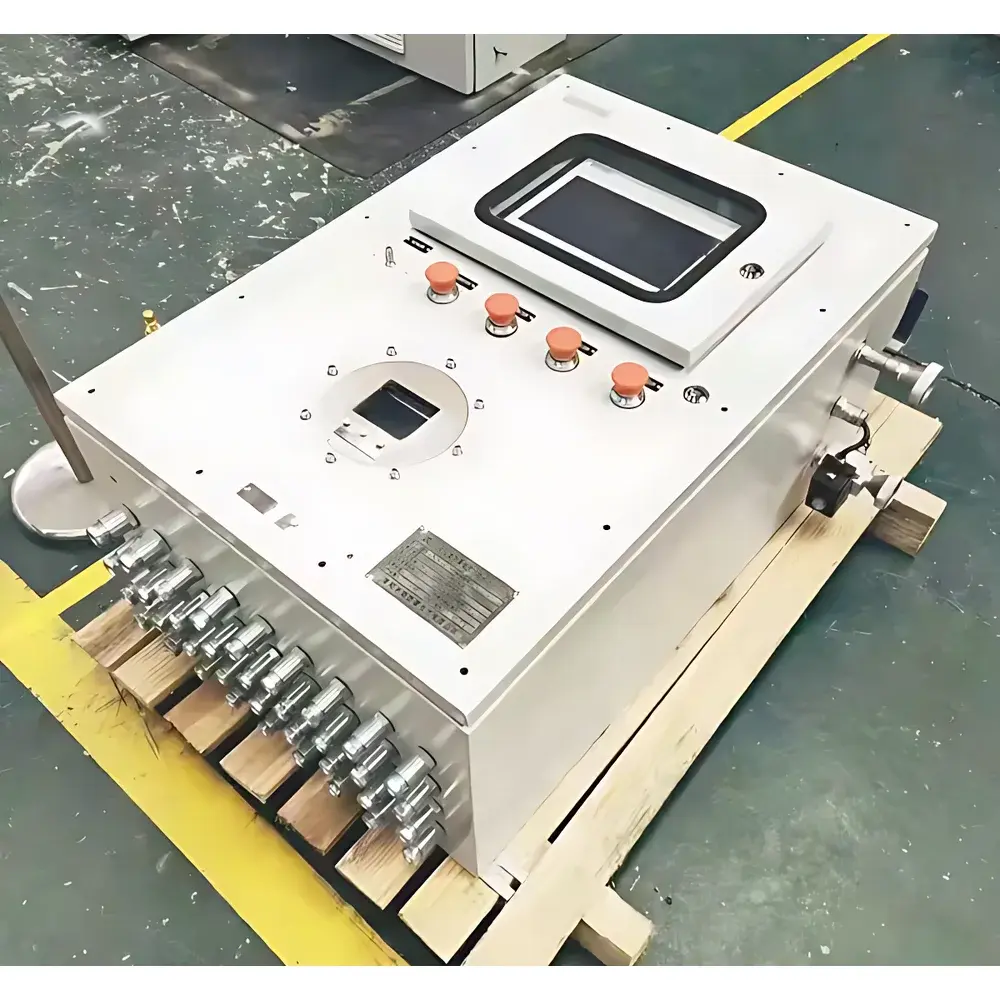
GAOMAI GM Explosion-Proof Enclosure for Gas Chromatographs
| Brand | GAOMAI |
|---|---|
| Origin | Beijing, China |
| Manufacturer Type | Authorized Distributor |
| Product Category | Domestic |
| Model | GM Explosion-Proof Enclosure |
| Price Range | USD 70,000 – 140,000 |
| Instrument Type | External Protective Enclosure for Portable Gas Chromatographs |
| Application Scope | General-Purpose Hazardous Area Deployment |
| Explosion Protection Rating | Exdp II BT1 to Exdp II CT6 (GB 3836 Compliant) |
| IP Rating | IP65 |
| Internal Pressure Range | 30–100 Pa |
| Power Supply | 220 VAC ±10%, 50 Hz |
| Construction Materials | EP-grade stainless steel tubing (welded or VCR-fitted) |
| Viewing Window | Shatter-resistant explosion-proof borosilicate glass |
| Certification Basis | GB 3836.1–2010, GB 3836.5–2017 |
Overview
The GAOMAI GM Explosion-Proof Enclosure is an engineered passive safety solution designed specifically for the external housing of portable gas chromatographs (GCs) and other sensitive analytical instruments deployed in classified hazardous locations—Class I, Division 1 or Zone 1 environments where flammable gases, vapors, or mists may be present under normal operating conditions. Unlike intrinsically safe or purged instrument designs, this enclosure operates on the pressurized purging principle (Exdp), maintaining a continuous positive internal overpressure with clean, dry instrument air or nitrogen to prevent ingress of explosive atmospheres. Its structural integrity is validated against mechanical shock, thermal propagation, and flame containment per GB 3836.5–2017 (equivalent to IEC 60079-5), ensuring that any internal ignition event remains fully contained without compromising operational continuity of the enclosed GC system.
Key Features
- Robust structural design fabricated from corrosion-resistant carbon steel or optional 316L stainless steel, rated for long-term service in chemical processing, petrochemical, and refinery environments.
- Integrated pressure regulation and monitoring system maintains stable internal overpressure (30–100 Pa) with redundant pressure switches and real-time analog output for SCADA integration.
- Explosion-proof viewing window constructed from laminated borosilicate glass meeting EN 14420-4 and ISO 13702 requirements for optical clarity and blast resistance.
- EP-grade stainless steel internal piping (electropolished, orbital-welded or VCR-sealed) ensures ultra-low particle and extractable contamination—critical for trace-level GC analysis in environmental or pharmaceutical applications.
- Comprehensive pre-shipment validation protocol including five mandatory tests: pressure hold (24 h), helium leak detection (<1×10⁻⁶ mbar·L/s), moisture content (<1 ppmv), oxygen content (<1 ppmv), and particulate count (ISO Class 5 compliant).
- Full electromagnetic compatibility (EMC) shielding, anti-static grounding provisions (≤10 Ω), and vibration-dampened mounting interface to isolate sensitive GC detectors from facility-induced mechanical noise.
- Modular architecture supports custom internal layout configurations—including dual-GC deployment, integrated carrier gas manifolds, and auxiliary power/data routing—without compromising explosion protection integrity.
Sample Compatibility & Compliance
The GM Enclosure does not directly interact with samples but serves as a certified physical barrier enabling safe operation of analyzers handling volatile organic compounds (VOCs), hydrogen sulfide, hydrocarbons, ammonia, chlorine, and other Class I Group B–D substances. It complies with national and international standards governing equipment for explosive atmospheres, including GB 3836.1–2010 (General Requirements), GB 3836.5–2017 (Pressurized “p” Protection), and aligns with functional equivalency to IEC 60079-1 and IEC 60079-5. All units are supplied with bilingual (English/Chinese) certification documentation, third-party test reports, and hazard zone classification diagrams suitable for inclusion in Process Safety Management (PSM) files and HAZOP studies. The enclosure meets IP65 per IEC 60529 for dust-tightness and water jet resistance, supporting outdoor or semi-outdoor installation in unconditioned process areas.
Software & Data Management
While the enclosure itself contains no embedded firmware or software, its pressure monitoring, alarm relay outputs, and status signals are designed for seamless integration into plant-wide control systems. Analog 4–20 mA pressure feedback and discrete dry-contact alarms (e.g., low-pressure, purge failure, door-open interlock) comply with ISA-84.00.01 (IEC 61511) for use in Safety Instrumented Functions (SIFs) up to SIL 2. Optional Modbus RTU or HART communication modules enable remote diagnostics and audit logging. All alarm events are timestamped and recorded in accordance with 21 CFR Part 11-compliant data historians when interfaced via validated DCS/PLC gateways—supporting GLP/GMP traceability requirements for regulated laboratories conducting method validation or routine QC testing.
Applications
This enclosure is routinely deployed in upstream and midstream oil & gas facilities for real-time hydrocarbon composition monitoring; in chemical manufacturing plants for reactor off-gas analysis; in wastewater treatment plants for odorant (e.g., mercaptan) tracking; and in biogas upgrading stations for CH₄/CO₂ ratio verification. Its modular footprint accommodates leading portable GC platforms—including those from Agilent, Thermo Fisher, and Shimadzu—enabling field-deployable compliance with EPA Method 25A, ASTM D1945, and ISO 6974-2 for natural gas analysis. The unit also supports mobile laboratory configurations used in emergency response, fugitive emission surveys, and industrial hygiene monitoring where rapid re-deployment across multiple hazardous zones is required.
FAQ
What standards does the GM Enclosure meet for hazardous area certification?
It conforms to GB 3836.1–2010 and GB 3836.5–2017, covering general requirements and pressurized “p” protection for electrical equipment in explosive gas atmospheres. Certificates include detailed zone classification, gas group (IIA–IIC), temperature class (T1–T6), and IP65 rating.
Can the enclosure house non-GC instrumentation?
Yes—provided the internal devices are non-sparking, operate within the specified ambient temperature range (–20 °C to +55 °C), and do not exceed the enclosure’s internal volume and heat dissipation limits (max. 500 W). Prior engineering review is required for non-standard integrations.
Is third-party type examination available?
All production units undergo factory acceptance testing (FAT) at GAOMAI’s Beijing facility. Optional CNEX or SIRA-certified type examination reports can be arranged upon request for international project submissions.
How is maintenance access managed without compromising explosion safety?
The door features a certified flame-path sealing mechanism with torque-controlled fasteners and visual interlock indicators. Opening requires depressurization confirmation via integrated pressure gauge and manual purge cycle reset—preventing unauthorized access during active pressurization.
Does the enclosure support integration with existing plant safety systems?
Yes—via configurable relay outputs, 4–20 mA analog signals, and optional digital protocols (Modbus RTU/HART). Integration schematics and loop drawings are provided for DCS/ESD system engineers during commissioning.
Related Products




