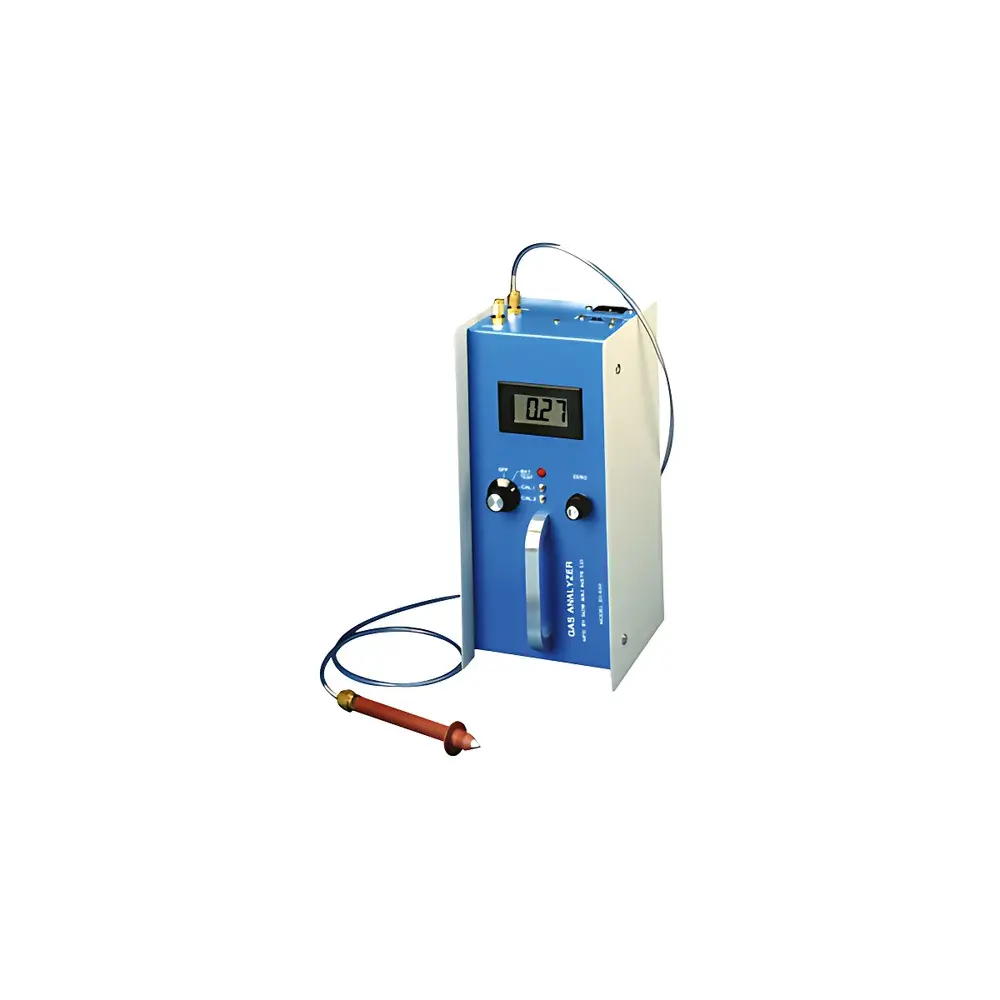
GOW-MAC 20600 Portable Thermal Conductivity Gas Analyzer
| Brand | GOW-MAC |
|---|---|
| Origin | USA |
| Model | 20600 |
| Detection Principle | Thermal Conductivity Detection (TCD) |
| Detector Type | Sealed-reference-cell TCD with four filament elements (rhenium-tungsten, tungsten, nickel) |
| Response Time | <10 s |
| Power Supply | Rechargeable battery or AC adapter |
| Calibration | Dual-range, user-configurable for specific binary gas pairs |
| Sensitivity | Calibratable to 0.5% O₂ in air |
| Display | Integrated LCD showing direct % concentration reading |
| Sample Handling | Integrated diaphragm pump |
| Compliance | Designed for field-deployable industrial process monitoring and leak verification per ASTM D1946 and ISO 8573-5 guidelines |
| Operating Environment | Portable, ruggedized housing for ambient industrial site use |
Overview
The GOW-MAC 20600 Portable Thermal Conductivity Gas Analyzer is a field-deployable, dual-range analytical instrument engineered for precise quantitative analysis of binary gas mixtures in industrial process control, environmental monitoring, and leak verification applications. Based on the fundamental principle of thermal conductivity detection (TCD), the analyzer measures the differential heat transfer between a sample gas stream and a sealed reference gas (typically air or an inert background), exploiting differences in thermal conductivity coefficients among gaseous species. This concentration-sensitive, non-destructive detection method delivers stable, drift-resistant output without consumables or reactive reagents. The instrument integrates a high-stability, four-filament TCD sensor—comprising rhenium-tungsten, tungsten, and nickel filaments—mounted within a thermally isolated, hermetically sealed reference cell. Its robust mechanical architecture, compact footprint, and IP-rated enclosure ensure reliable operation in ambient industrial environments, including plant floors, utility tunnels, and outdoor pipeline inspection sites.
Key Features
- Thermal conductivity detection platform optimized for binary gas quantification with inherent linearity and low cross-sensitivity to non-analyte gases
- Sealed-reference-cell design eliminates drift from ambient pressure or temperature fluctuations during extended field deployment
- Dual-range calibration capability supports both trace-level (e.g., 0–5% H₂ in CH₄) and major-component (e.g., 0–100% N₂ in Ar) measurement configurations
- Integrated diaphragm sampling pump enables consistent flow control across variable backpressure conditions without external vacuum sources
- Rechargeable lithium-ion battery pack provides ≥8 hours of continuous operation; optional AC adapter enables benchtop or vehicle-mounted use
- Real-time % concentration readout on integrated backlit LCD—no software or PC required for basic operation
- User-programmable calibration parameters via front-panel interface to accommodate application-specific gas pairs and concentration ranges
Sample Compatibility & Compliance
The GOW-MAC 20600 is validated for routine analysis of over two dozen industrially relevant binary combinations, including but not limited to: NH₃ in air, CO₂ in flue gas (N₂ matrix), He in air, CH₄ in air, H₂ in CH₄, refrigerant R-12 in air, natural gas (CH₄) in air, N₂ in Ar, Ar in He, and Halon 1301 in air. It meets functional requirements specified in ASTM D1946 (Standard Practice for Analysis of Gases by Gas Chromatography — applicable to TCD-based verification workflows) and ISO 8573-5 (Compressed air — Part 5: Test methods for oil vapor and organic solvent content — where TCD serves as complementary verification). While not a GLP/GMP-certified system, its stable analog output and audit-ready calibration logs support integration into controlled environments requiring documented traceability under internal QA protocols.
Software & Data Management
The 20600 operates as a standalone instrument with no mandatory software dependency. However, optional RS-232 or analog 4–20 mA output enables connection to distributed control systems (DCS), SCADA platforms, or data loggers for time-series trending. Calibration history—including date, operator ID, span gas lot number, and zero-check results—is stored in non-volatile memory and retrievable via serial command. Firmware supports configurable alarm thresholds with relay outputs for pass/fail go/no-go screening. All calibration and operational parameters are protected by password-secured access levels to ensure data integrity in shared-lab or multi-shift environments.
Applications
- Leak detection and purge verification in semiconductor fab tooling and vacuum chamber commissioning
- In-line monitoring of inert gas blanket purity (e.g., Ar/N₂ ratios in heat-treating furnaces)
- Refrigerant recovery verification and HVAC charge validation
- Flue gas composition spot-checking for combustion efficiency assessment
- Quality assurance of specialty gas cylinders prior to distribution
- Field verification of helium leak test residuals in aerospace component testing
- Environmental health & safety (EHS) screening for oxygen deficiency or enrichment in confined spaces
FAQ
Does the GOW-MAC 20600 require carrier gas or calibration gases for routine operation?
No—its sealed reference cell eliminates the need for continuous carrier gas supply. However, certified calibration standards are required for initial setup and periodic verification per ISO/IEC 17025-recommended intervals.
Can the instrument measure more than two gases simultaneously?
No—it is designed exclusively for binary gas mixture analysis. For multi-component analysis, gas chromatography or infrared spectroscopy platforms are recommended.
What maintenance is required beyond periodic calibration?
Annual inspection of the sampling pump diaphragm and filament resistance check using built-in diagnostics. No consumable parts other than optional particulate inlet filters.
Is the device suitable for hazardous area classification (e.g., Class I Div 1)?
The standard 20600 is rated for general-purpose industrial use. A custom ATEX/IECEx-certified variant is available upon request with modified enclosure and intrinsically safe power management.
How is measurement uncertainty characterized for a given gas pair?
Uncertainty is derived from combined contributions of filament stability (±0.2% FS/year), reference cell thermal drift (<±0.1% FS/°C), and calibration gas certificate tolerance (typically ±1% relative). Total expanded uncertainty (k=2) is typically ≤±2.5% of reading for well-characterized binary systems.