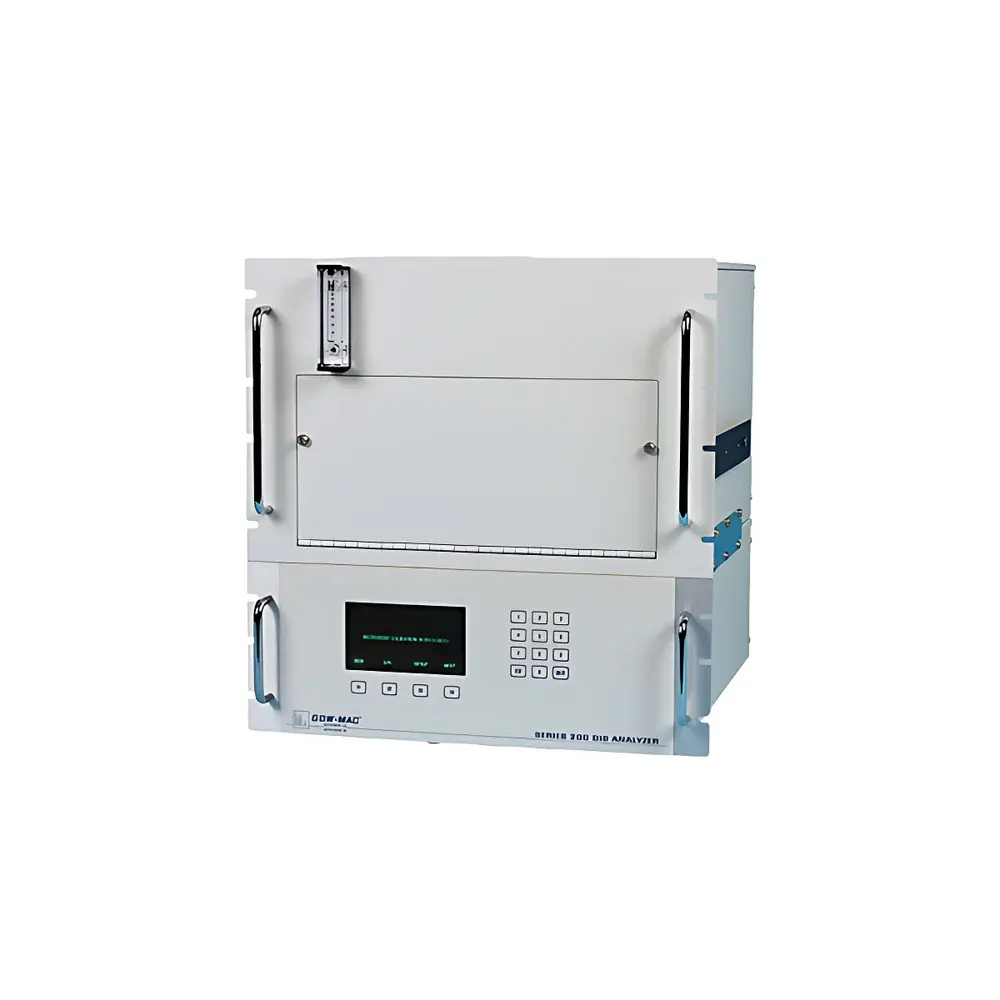
GOW-MAC 200DID Dedicated Online Gas Chromatograph with Helium Discharge Ionization Detector
| Brand | GOW-MAC |
|---|---|
| Origin | USA |
| Model | GOW-MAC 200DID |
| Detector Type | Helium Discharge Ionization Detector (DID) |
| Detection Limit | <5 ppb |
| Linear Dynamic Range | >10⁶ |
| Column Oven Temperature Range | +10 °C to 150 °C |
| Column Format | Micro-packed and 1/8″ packed columns |
| Flow Control | Precision Mass Flow Controllers |
| Sample Introduction | Pneumatically Actuated Gas Sampling Valve |
| Valve Configurations | Backflush, Column Selection, Heart-Cut, Series/Bypass |
| Construction Materials | Electropolished Stainless Steel with VCR Fittings |
| Operating Modes | Manual (for method development) and Fully Automated (for continuous process analysis) |
| Compliance | Designed for GLP/GMP environments |
Overview
The GOW-MAC 200DID Dedicated Online Gas Chromatograph is a purpose-built, rack-mountable analytical instrument engineered for continuous, high-sensitivity gas-phase composition monitoring in industrial process control environments. Based on the fundamental principles of gas chromatography—differential partitioning of volatile analytes between a mobile gas phase (carrier gas) and a stationary phase within a capillary or packed column—the system leverages helium discharge ionization detection (DID) to achieve universal, non-destructive quantification of permanent gases, hydrocarbons, and reactive species. Unlike general-purpose GC platforms, the 200DID integrates hardware-level optimization for gas analysis: its micro-packed and 1/8″ packed column architecture minimizes band broadening and retention time drift, while the dedicated DID provides stable, reproducible response across trace-level (sub-ppb) to percent-level concentrations without chemical derivatization or catalytic conversion. The instrument operates autonomously—no external PC or proprietary chromatography software is required—making it suitable for deployment in hazardous locations, cleanrooms, or distributed control system (DCS)-integrated facilities where reliability, minimal maintenance, and deterministic timing are critical.
Key Features
- Rack-mount 19″ form factor (standard EIA-310-D compliance) for seamless integration into industrial control cabinets and analyzer shelters.
- Helium Discharge Ionization Detector (DID) with sub-5 ppb detection limit, >10⁶ linear dynamic range, and <1% RSD at ppb-level concentration—validated using certified NIST-traceable gas standards.
- Thermally stabilized column oven featuring dual-zone temperature control, maintaining ±0.1 °C stability across +10 °C to 150 °C operating range; optimized for rapid thermal equilibration and long-term baseline integrity.
- Gas handling system constructed entirely from electropolished 316 stainless steel with VCR face-seal fittings and strategically minimized dead volumes; includes pneumatically actuated sampling valves with programmable timing sequences.
- Configurable multi-valve manifold supporting backflush, heart-cutting, column selection, and series/parallel column routing—enabling compound-specific isolation and matrix interference mitigation.
- Two operational modes: manual mode for method scouting and retention time calibration; automated mode with fixed cycle times (configurable from 30 seconds to 30 minutes) for unattended, repetitive process stream analysis.
Sample Compatibility & Compliance
The GOW-MAC 200DID is validated for analysis of both corrosive (e.g., HCl, HF, Cl₂, NH₃, SO₂) and non-corrosive (e.g., H₂, O₂, N₂, CH₄, CO, CO₂, C₂H₄, SF₆) gas matrices in raw feed, reactor effluent, purge streams, and ultra-high-purity (UHP) semiconductor process gases. Its inert flow path and DID’s non-reactive ionization mechanism eliminate catalytic memory effects and surface adsorption artifacts common in TCD or FID-based systems. The platform meets mechanical and electrical requirements for Class I, Division 2 (CID2) hazardous area installation when housed in appropriate enclosures. While the base instrument does not include embedded electronic records, its analog/digital I/O interfaces (4–20 mA, RS-232/485, discrete relays) enable integration with LIMS, DCS, or SCADA systems compliant with FDA 21 CFR Part 11, ISO/IEC 17025, and ASTM D1945/D1946 methodologies for gas analysis.
Software & Data Management
The 200DID operates as a standalone analyzer with embedded firmware controlling all acquisition, valve sequencing, temperature ramping, and detector bias parameters. All configuration and diagnostics are accessible via front-panel membrane keypad and LCD display. For enterprise-level data governance, optional analog output signals (peak height/area, retention time, status flags) can be routed to historian systems with full timestamping and metadata tagging. When interfaced with third-party compliant software platforms—such as DeltaV, PI System, or LabArchives—the instrument supports electronic signature, audit trail generation, and change control protocols aligned with GLP and GMP regulatory expectations. No proprietary software license is required for basic operation; firmware updates are delivered via USB flash drive with cryptographic signature verification.
Applications
- Real-time monitoring of hydrogen purity in PEM electrolyzer off-gas streams (ASTM D7165).
- Trace impurity profiling (O₂, H₂O, CO, CO₂, hydrocarbons) in semiconductor-grade nitrogen and argon supply lines (SEMI F57/F63).
- Reaction endpoint detection in chlor-alkali and fluorination processes via continuous H₂, Cl₂, and HF tracking.
- Quality assurance of medical oxygen (USP ) and inhalation anesthetic blends (ISO 8535-1).
- Leak detection and compositional trending in LNG liquefaction and regasification units (ISO 6974-2).
- Environmental emissions monitoring of VOCs and greenhouse gases in flare stack and vent header streams (EPA Method 25A, EN 15267).
FAQ
Does the GOW-MAC 200DID require a computer or chromatography data system (CDS) to operate?
No. The instrument is fully self-contained and executes all chromatographic functions—including valve actuation, oven temperature regulation, detector signal processing, and result calculation—via onboard firmware.
Can the 200DID analyze moisture or hydrogen sulfide in natural gas streams?
Yes, provided appropriate column chemistry (e.g., molecular sieve 5A or alumina PLOT) and calibration with certified wet gas standards; moisture detection requires careful attention to sample conditioning and zero-gas purity.
What is the typical maintenance interval for the DID detector?
Under normal operation with purified helium carrier gas and clean sample matrices, the DID electrode assembly typically requires inspection every 12–18 months; no consumables such as filaments or radioactive sources are used.
Is remote diagnostics or firmware update capability available?
Firmware updates are performed locally via USB interface; remote access is supported only through customer-configured network-connected gateways—not natively embedded in the instrument.
How is calibration traceability maintained for regulatory reporting?
Calibration is performed using NIST-traceable certified reference materials (CRMs); the instrument logs calibration date, operator ID, standard lot number, and deviation metrics—data exportable via serial interface for inclusion in quality records.
Related Products