
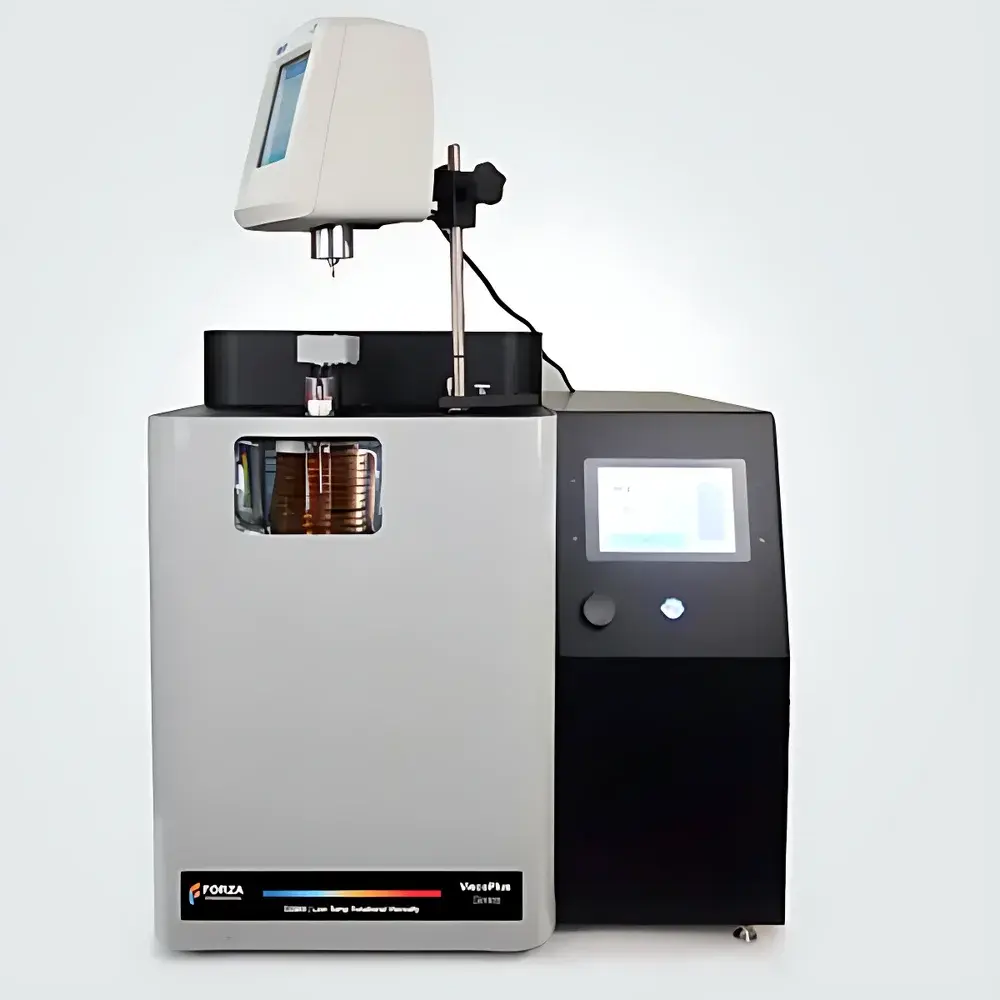
LTRV-D2983-L-10 Low-Temperature Brookfield Viscometer
| Brand | FORZA |
|---|---|
| Origin | USA |
| Model | LTRV-D2983-L-10 |
| Standards Compliance | ASTM D2983, ISO 9262, IP 267, GB/T 11145 |
| Temperature Range | +20 °C to –55 °C |
| Bath Type | Liquid-immersion thermal bath with nitrogen purge |
| Sample Capacity | 10 samples per bath |
| Control Interface | Integrated touchscreen controller with real-time bath temperature display |
| Cooling Profile | Programmable air-bath emulation mode |
| Viewing | Full panoramic optical access to samples in bath |
| Mounting | Direct floor-standing installation—no wooden pallet or external support required |
Overview
The LTRV-D2983-L-10 Low-Temperature Brookfield Viscometer is an engineered solution for precise rotational viscosity measurement of petroleum products, lubricants, and low-temperature fluids under rigorously controlled thermal conditions. Designed in accordance with the fundamental principles of torque-based rotational viscometry—where viscosity is derived from the resistance torque exerted on a rotating spindle immersed in the test fluid—the instrument delivers high reproducibility across extreme sub-zero temperature ranges. Its core architecture integrates a calibrated Brookfield-style spindle drive system with a proprietary liquid-immersion thermal bath capable of stable operation from +20 °C down to –55 °C. Unlike conventional air-cooled systems, this configuration ensures rapid thermal equilibration, minimal temperature gradients, and superior control fidelity—critical parameters for compliance with ASTM D2983 (Standard Test Method for Low-Temperature Viscosity of Lubricating Oils), ISO 9262 (Petroleum products — Determination of apparent viscosity at low temperatures), and IP 267 (Determination of apparent viscosity of oils at low temperatures). The system is validated for use in quality control laboratories operating under GLP and GMP frameworks, supporting audit-ready data integrity through traceable calibration and environmental monitoring.
Key Features
- Full-range low-temperature operation from +20 °C to –55 °C with ±0.1 °C thermal stability over 30-minute dwell periods
- Liquid-immersion bath with optically transparent walls enabling real-time visual assessment of sample homogeneity, wax formation, and flow initiation
- Integrated nitrogen purge manifold delivering continuous dry gas flow across sample surfaces to suppress condensation and ice nucleation during prolonged cold exposure
- Programmable cooling profile generator that emulates standardized air-bath cooling curves defined in ASTM D2983 Annex A1, ensuring method equivalence across laboratory platforms
- Embedded touchscreen controller providing direct setpoint input, live bath temperature feedback, alarm logging, and firmware-updatable operational logic
- Modular 10-position sample rack permitting unattended sequential testing without manual repositioning or bath refilling
- Structural design compliant with IEC 61000-6-3 (EMC) and UL 61010-1 (safety), certified for continuous-duty operation in ISO Class 7 cleanroom-adjacent environments
Sample Compatibility & Compliance
The LTRV-D2983-L-10 accommodates standard ASTM D2983 sample cups (60 mL volume), as well as alternative geometries including cylindrical glass vials (25–100 mL) and metal cans conforming to IP 267 dimensional specifications. It supports Newtonian and mildly non-Newtonian fluids typical of engine oils, gear oils, hydraulic fluids, and synthetic ester-based lubricants. All thermal and mechanical protocols align with regulatory expectations for method validation under FDA 21 CFR Part 11 (electronic records and signatures), including operator authentication, electronic audit trails, and immutable data export (CSV/Excel-compatible). Calibration documentation follows ISO/IEC 17025 requirements and includes NIST-traceable reference oil certificates for kinematic viscosity verification at –30 °C, –40 °C, and –50 °C.
Software & Data Management
The instrument operates via embedded firmware with no external PC dependency. Data acquisition, temperature ramping, spindle speed selection (0.1–200 rpm), and torque integration are managed through the onboard controller. Exported datasets include timestamped bath temperature, spindle RPM, measured torque (µN·m), calculated viscosity (mPa·s), and shear rate (s⁻¹)—all structured in tab-delimited format for import into LIMS or statistical process control (SPC) platforms. Optional Ethernet interface enables remote monitoring via HTTP API (RESTful endpoints for status polling and log retrieval), compatible with enterprise SCADA systems. Audit trail records capture user ID, parameter changes, calibration events, and error flags with SHA-256 hashed integrity verification.
Applications
- Determination of borderline pumping temperature (BPT) and apparent viscosity of engine oils per ASTM D2983
- Low-temperature rheological screening of biodegradable lubricants and bio-based hydraulic fluids
- Quality release testing of aviation turbine oils under MIL-PRF-23699 and DEF STAN 91-91 specifications
- Research into wax crystallization kinetics and gel point transitions in paraffinic base stocks
- Validation of pour point depressant (PPD) efficacy through comparative viscosity profiling below –30 °C
- Supporting ASTM D5293 (Cold Cranking Simulator) correlation studies via viscosity–temperature modeling
FAQ
Does the LTRV-D2983-L-10 require external chiller units or cryogenic gases?
No. The integrated refrigeration system is self-contained and achieves –55 °C using a cascade compressor architecture with environmentally compliant R-513A/R-1234yf blend.
Can the instrument be used for ASTM D5293 or ASTM D4684 testing?
It is not configured for CCS or MRV measurements; it is specifically validated for ASTM D2983-compliant Brookfield viscosity determinations.
Is nitrogen supply pressure regulated internally?
Yes. An integrated precision regulator maintains 0.5–1.0 bar(g) purge pressure with automatic shutoff upon bath door opening.
How is calibration traceability maintained?
Each unit ships with a factory calibration report referencing NIST SRM 2789 (low-viscosity reference oils) and ISO 8217 RM-100 certified standards, with optional annual recalibration services available through FORZA-accredited labs.
What maintenance intervals are recommended for routine operation?
Bath fluid exchange every 12 months; spindle inspection and torque sensor zero-check every 250 operational hours; full system performance verification annually or after 5,000 test cycles.




