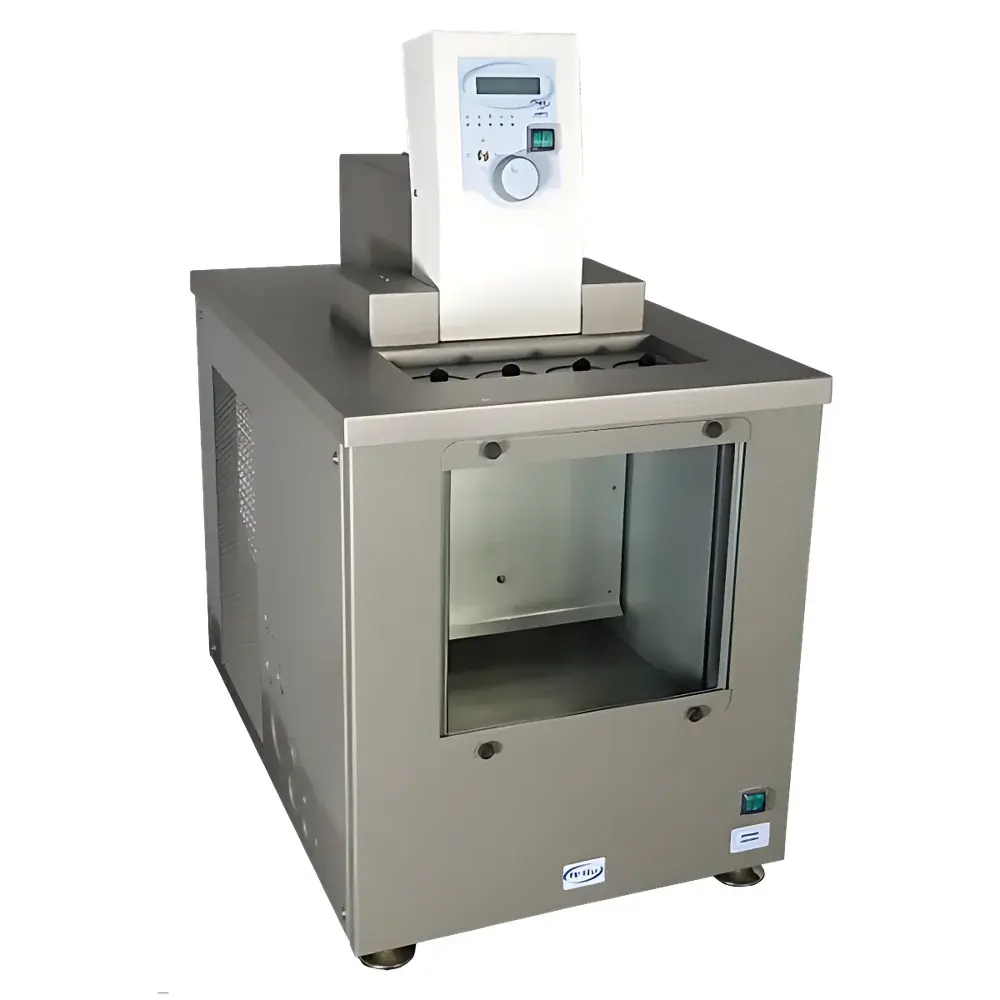
TAMSON TV12LT Low-Temperature Bath for Petroleum Fluid Viscosity and Cold Flow Property Testing
| Brand | TAMSON |
|---|---|
| Origin | Netherlands |
| Model | TV12LT |
| Temperature Range | −42 °C to +80 °C |
| Display Resolution | 0.01 °C (0.001 °C optional) |
| Test Positions | 4 |
| Bath Volume | 15 L |
| Construction Material | Stainless Steel |
| Illumination | Integrated LED Lighting |
| Cooling System | Built-in Compressor-Based Cooling |
| Observation Window | Heated, Removable Outer Pane for Easy Cleaning |
| Interface | RS232 for PC-based Temperature Programming and Data Logging |
| Standards Compliance | ASTM D445, ASTM D446, ASTM D1655, ASTM D2270, IP 71, EN ISO 3104, ISO 3105, DIN 51562 |
Overview
The TAMSON TV12LT Low-Temperature Bath is an engineered thermal immersion system specifically designed for standardized cold-temperature testing of aviation turbine fuels (Jet A-1, JP-8) and other petroleum distillates requiring precise viscosity and cold flow property evaluation. It operates on a closed-loop, compressor-driven refrigeration architecture with high-stability PID temperature control, enabling reproducible thermal environments across the full operational range of −42 °C to +80 °C. Its primary function is to serve as a calibrated, thermally uniform medium for capillary viscometers, pour point testers, cloud point apparatuses, and other ASTM/ISO-compliant sample holders—ensuring traceable thermal conditioning in accordance with method-defined bath depth, stability, and homogeneity requirements.
Key Features
- Four independent test positions with optimized spacing to minimize thermal cross-talk and support simultaneous multi-sample evaluation under identical thermal conditions.
- Compact 15-liter stainless steel bath vessel—engineered for rapid thermal equilibration, low coolant consumption, and minimal footprint in regulated laboratory spaces.
- High-resolution digital display (0.01 °C standard; 0.001 °C optional) with real-time temperature readout and setpoint confirmation, traceable to NIST-traceable reference standards.
- Integrated LED illumination system providing uniform, shadow-free visibility of immersed capillaries and sample tubes without introducing radiant heat or UV degradation.
- Heated observation window with removable outer pane—prevents condensation and frost formation during sub-zero operation while enabling safe, tool-free access for cleaning internal surfaces without draining the bath.
- RS232 serial interface compliant with industry-standard SCPI command syntax, supporting remote temperature ramping, dwell programming, and time-stamped data logging via third-party or custom LabVIEW/Python applications.
Sample Compatibility & Compliance
The TV12LT is validated for use with glass capillary viscometers (e.g., Ubbelohde, Cannon-Fenske), pour point test jars (ASTM D97), and cloud point cells (ASTM D2500). Its bath geometry and thermal uniformity meet the immersion depth, temperature gradient, and stability criteria specified in ASTM D445 (kinematic viscosity), ASTM D2270 (viscosity index), EN ISO 3104 (petroleum products—determination of kinematic viscosity), and IP 71 (standard test method for kinematic viscosity of petroleum products). All materials in contact with the cooling fluid are electropolished 316 stainless steel, ensuring long-term corrosion resistance against hydrocarbon solvents and glycol–water mixtures. The unit is CE-marked and conforms to IEC 61010-1:2010 for electrical safety in laboratory equipment.
Software & Data Management
While the TV12LT operates autonomously via its front-panel interface, its RS232 port enables integration into centralized laboratory data management systems. When connected to a host PC, users can configure multi-step temperature profiles (e.g., ramp–hold–ramp sequences), initiate automated calibration verification routines, and export timestamped temperature logs (.CSV format) with metadata including setpoint, actual bath temperature, elapsed time, and system status flags. The communication protocol supports audit trail generation compatible with GLP and GMP environments, and logged data may be archived in accordance with FDA 21 CFR Part 11 requirements when paired with appropriate electronic signature and record retention infrastructure.
Applications
- Kinematic viscosity determination of aviation turbine fuel per ASTM D445 and ISO 3104 at −20 °C, −30 °C, and −40 °C.
- Viscosity index calculation per ASTM D2270 using measurements at 40 °C and 100 °C.
- Cloud point and pour point pre-conditioning baths for ASTM D2500 and ASTM D97 test assemblies.
- Thermal calibration of liquid-in-glass thermometers and platinum resistance thermometers (PRTs) per ASTM D446 and ISO 17025-accredited procedures.
- Reference bath for validation of secondary temperature sensors used in refinery QC laboratories.
FAQ
What is the minimum stable temperature achievable with the TV12LT, and how long does it take to reach −42 °C from ambient?
The unit achieves and maintains −42 °C with ±0.05 °C stability over 30 minutes (per ASTM D445 Annex A1). Typical cooldown from 20 °C to −42 °C requires approximately 90 minutes with empty bath and standard coolant mixture.
Can the bath be operated continuously at −42 °C?
Yes—the compressor and thermal management system are rated for continuous operation at all temperatures within the specified range, including extended dwell periods at minimum temperature.
Is the RS232 interface compatible with modern Windows/Linux operating systems?
Yes—using standard USB-to-RS232 adapters and terminal emulation software (e.g., Tera Term, PuTTY) or Python’s pySerial library, full bidirectional communication is supported without proprietary drivers.
Does the heated observation window consume significant power or affect bath temperature uniformity?
No—the low-wattage resistive heater operates only on the outer pane and is thermally decoupled from the bath chamber; temperature mapping confirms no measurable impact on axial or radial thermal gradients within the test zone.
What maintenance is required for long-term reliability?
Annual inspection of refrigerant charge, condenser coil cleaning, and verification of bath fluid level and glycol concentration (recommended 40% propylene glycol/water) are advised per TAMSON’s service schedule.