
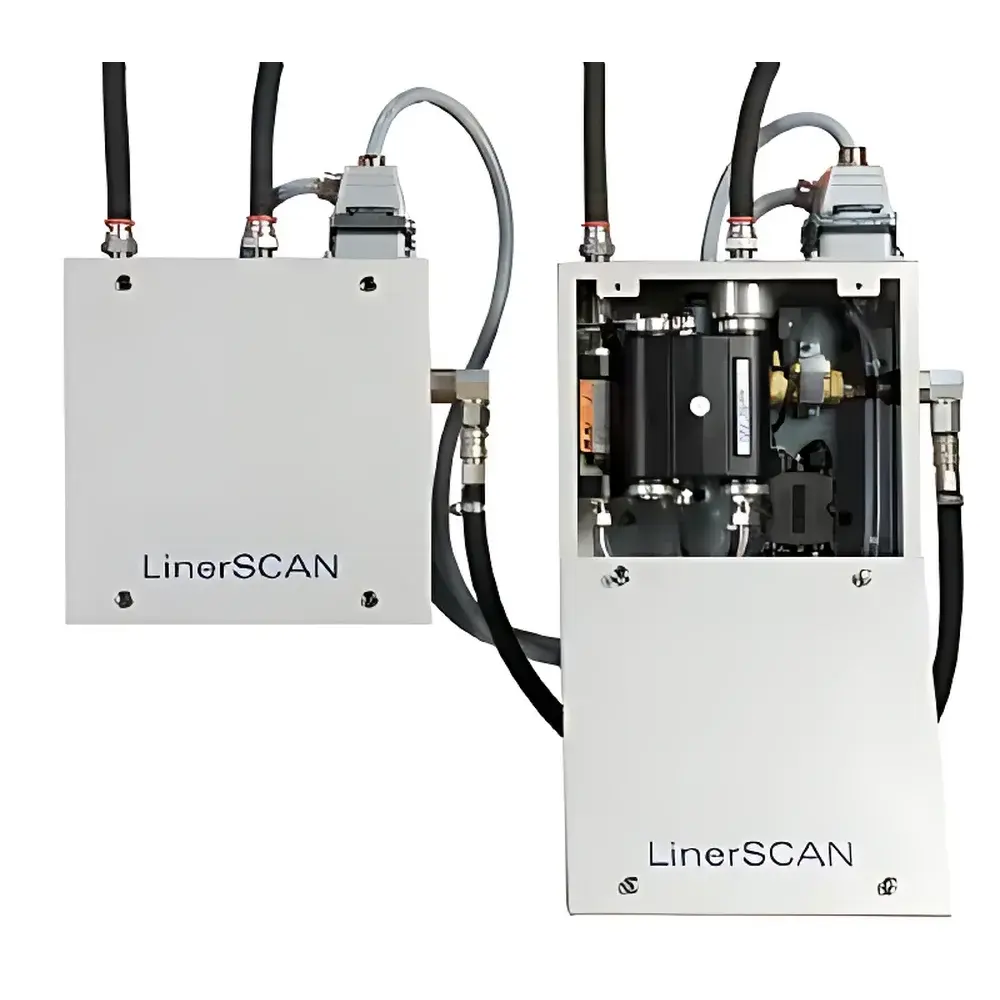
Kittiwake LinerSCAN Real-Time Cylinder Wear Monitoring System
| Brand | Kittiwake |
|---|---|
| Origin | United Kingdom |
| Model | FG-K17400-KW |
| Instrument Type | Resistive Particle Counter |
| Measurement Range | 0–2000 ppm |
| Accuracy | ±30 ppm |
| Operating Ambient Temperature | 0–65 °C |
| Power Supply | 24 V DC / 0.7 A |
| Weight | 17 kg |
| Dimensions | 380 × 44 × 32 cm |
Overview
The Kittiwake LinerSCAN Real-Time Cylinder Wear Monitoring System is an engineered solution for continuous, in-service assessment of liner and piston ring wear in marine two-stroke and four-stroke diesel engines. Based on resistive pulse sensing (RPS) — a well-established principle in particle quantification where conductive particles suspended in a dielectric fluid perturb an electrical field across a precision orifice — LinerSCAN detects and counts metallic wear debris generated during normal and abnormal cylinder running conditions. Unlike offline oil analysis methods requiring periodic sampling and laboratory turnaround, LinerSCAN delivers real-time, on-stream data directly from the engine’s lubrication circuit, enabling condition-based maintenance decisions with high temporal resolution. Its deployment supports ISO 28122 (Condition Monitoring of Marine Machinery), aligns with class society guidelines for machinery health monitoring (e.g., DNV SE-0377, ABS MEPC.1/Circ.863), and contributes to compliance with IMO MARPOL Annex VI requirements by facilitating optimized cylinder oil feed rates and reducing unburned lube oil emissions.
Key Features
- Real-time detection of ferrous and non-ferrous metallic wear particles in engine lubricating oil, with sensitivity down to sub-10 µm equivalent spherical diameter
- Automated baseline calibration and adaptive thresholding to distinguish between nominal wear progression and incipient scuffing or seizure events
- Integrated break-in (run-in) protocol that dynamically adjusts alarm logic during initial engine commissioning or post-overhaul operation
- Compact modular design (380 × 44 × 32 cm; 17 kg) enabling retrofit installation on existing engine platforms without structural modification or hydraulic system interruption
- 24 V DC power interface compliant with IEC 60945 marine electrical standards; EMC tested to EN 60945 and IEC 60533
- Seamless integration via Modbus TCP or NMEA 2000 into vessel-wide monitoring systems (e.g., Kongsberg K-Master, Wärtsilä NOVUS, Rolls-Royce Promas)
- Self-diagnostics with continuous flow rate verification, sensor integrity checks, and orifice blockage detection
Sample Compatibility & Compliance
LinerSCAN operates exclusively on pressurized main engine lubricating oil streams (typically drawn from the scavenge drain or camshaft supply line), supporting mineral, semi-synthetic, and low-SAPS cylinder oils with viscosities ranging from 10 to 150 cSt at 40 °C. It is validated for use with ISO VG 32–100 lubricants meeting OEM specifications (MAN ES, Wärtsilä, Mitsubishi, Hyundai Mipo). The system conforms to GLP-aligned data integrity practices: all measurements are time-stamped, logged with audit trail metadata, and support 21 CFR Part 11-compliant electronic signatures when paired with Kittiwake’s certified FleetLink software suite. Calibration traceability follows UKAS-accredited procedures per ISO/IEC 17025.
Software & Data Management
The LinerSCAN Control Interface (LCI) provides a web-accessible HMI hosted locally on the unit’s embedded ARM processor. Data visualization includes real-time particle concentration trends (ppm), cumulative wear index, event-triggered waveform capture, and configurable alarm histories. All raw and processed data export in CSV, XML, or OPC UA format. FleetLink cloud platform enables fleet-wide benchmarking against historical baselines, cross-vessel wear pattern correlation, and automated reporting aligned with ISO 55001 asset management frameworks. Audit logs record user access, parameter changes, and firmware updates — essential for Class-approved maintenance records and PMS audits.
Applications
- Early identification of liner scuffing, micro-welding, and abrasive wear induced by contaminated fuel (e.g., catalytic fines, vanadium/sodium compounds)
- Optimization of cylinder oil feed rate (COFR) based on actual wear kinetics rather than fixed schedules — demonstrated reductions in lube oil consumption up to 25% without compromising wear protection
- Support for slow-steaming and variable-speed operation where traditional wear thresholds become unreliable
- Verification of post-repair performance following liner replacement or piston ring overhaul
- Integration into digital twin models for predictive simulation of remaining useful life (RUL) of cylinder kits
FAQ
Does LinerSCAN require oil sampling or offline lab analysis?
No. It performs continuous in-line measurement using the engine’s active lubrication circuit.
Can it differentiate between normal wear and catastrophic failure modes?
Yes — through multi-parameter pattern recognition including particle count rate, size distribution skew, and temporal clustering, correlated with engine load and speed signals.
Is calibration required between installations?
The system performs automatic zero and span verification at startup and during idle periods; annual traceable recalibration is recommended per ISO 17025 protocols.
What cybersecurity safeguards are implemented?
Firmware signed with ECDSA keys; TLS 1.2+ encrypted data transmission; role-based access control with password policy enforcement and session timeout.
How does LinerSCAN interface with existing vessel automation systems?
Via native Modbus TCP (Ethernet), optional RS-485/Modbus RTU, or NMEA 2000 gateways — no proprietary middleware required.



