
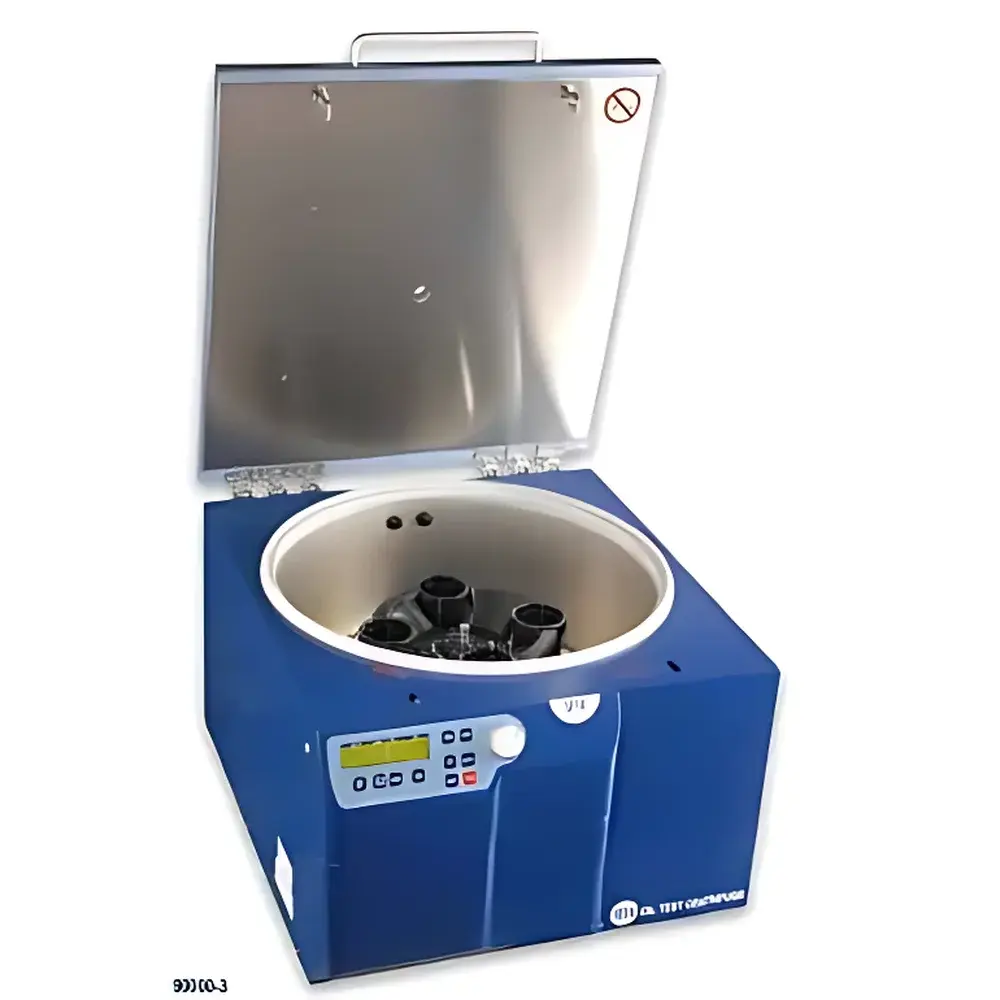
SETA 90000-3 ASTM-Compliant Oil Analysis Centrifuge
| Key | Brand: SETA |
|---|---|
| Origin | United Kingdom |
| Model | 90000-3 |
| Max RCF | 2214 × g |
| Max Speed | 3000 rpm |
| Temperature Range | 30–80 °C (±1 °C) |
| Timer Range | 10 s – 100 h (continuous mode available) |
| Sample Capacity | 4 positions |
| Tube Compatibility | 6" and 8" centrifuge tubes with adapters |
| Control System | Microprocessor-based, 99 programmable methods |
| Power Supply | 220/240 V, 50/60 Hz (110/120 V optional) |
| Power Consumption | 950 W |
| Dimensions (H×W×D) | 40.1 × 56.4 × 63.9 cm |
| Weight | 72.5 kg |
Overview
The SETA 90000-3 is a purpose-built, microprocessor-controlled centrifuge engineered for quantitative determination of water and mechanical impurities in crude oil and refined petroleum products. It operates on the principle of controlled sedimentation under precisely regulated thermal and rotational conditions—enabling phase separation of immiscible components (e.g., water droplets, particulate contaminants, and hydrocarbon matrix) in accordance with standardized gravimetric and volumetric protocols. Unlike general-purpose laboratory centrifuges, the 90000-3 integrates programmable heating, high-precision temperature compensation, and ASTM-aligned operational sequences to ensure method fidelity across critical industry test standards. Its design prioritizes reproducibility, traceability, and compliance—notably supporting full execution of ASTM D96 (observed), D4007, D5546, ISO 9030, and API MPMS Chapter 10.3, among others. The instrument’s heated chamber, calibrated RCF control, and real-time thermal offset correction collectively minimize systematic error arising from sample–cavity thermal lag—a known source of deviation in conventional heated centrifugation.
Key Features
- Two operational modes: selectable by rotational speed (rpm) or relative centrifugal force (RCF), ensuring method-specific parameter alignment per ASTM or ISO requirements.
- Rapid acceleration: rotor reaches target speed within 25 seconds; deceleration is controlled and vibration-damped to preserve sample integrity and tube positioning.
- Thermally stabilized chamber: temperature range 30–80 °C, maintained within ±1 °C tolerance. Advanced software applies dynamic cavity-to-sample temperature offset correction, displaying actual sample-equivalent temperature—not just ambient chamber reading.
- Predetermined preheat protocol: upon lid closure, chamber initiates preheating to 4 °C below setpoint, achieving final temperature within ≤2 minutes after start—reducing total assay cycle time without compromising thermal equilibrium.
- Four-position rotor accommodating both 6-inch and 8-inch centrifuge tubes via interchangeable adapters; post-centrifugation tube reorientation minimizes meniscus distortion and improves volumetric readability.
- Full microprocessor control with front-panel digital interface: all parameters—including speed, temperature, time, and method ID—are editable in real time. Up to 99 user-defined methods can be stored and recalled.
- Integrated safety architecture: automatic imbalance shutdown (>8 g mass asymmetry), lid-interlocked motor inhibition, dual overtemperature protection (chamber and motor), and acoustic noise emission <55 dB(A) during operation.
Sample Compatibility & Compliance
The SETA 90000-3 is validated for use with standard ASTM/ISO-compliant glass or polypropylene centrifuge tubes (6″ and 8″) containing crude oil, fuel oils, lubricants, and distillates. Its thermal and mechanical specifications meet the physical constraints defined in ASTM D96 (observed), D4007 (water content by centrifuge), D5546 (sediment by extraction and centrifugation), ISO 3734 (petroleum products — determination of water), and API MPMS Chapter 10.3 (standard test method for water and sediment in crude oil by centrifuge). The system complies with IEC 61010-1 and IEC 61010-2-020 for electrical safety, BS 4402 and DIN 58970 for mechanical stability, and carries CE marking for conformity with EU health, safety, and environmental protection legislation. Optional hazardous vapor abatement (part no. 900010-0) enables safe handling of volatile solvents and heated hydrocarbon samples by maintaining sub-atmospheric chamber pressure and routing diluted exhaust to external ventilation.
Software & Data Management
While the 90000-3 operates as a standalone benchtop instrument with embedded firmware, its parameter logging and method recall functionality support GLP-aligned workflow documentation. Each run stores timestamped metadata—including method ID, setpoints, actual RCF, chamber temperature profile, and elapsed time—in non-volatile memory. No proprietary software is required for basic operation; however, audit trails and electronic records may be exported manually via front-panel review. For laboratories operating under FDA 21 CFR Part 11 or ISO/IEC 17025, the device supports integration into broader LIMS environments through manual data transcription or third-party serial logging (RS-232 interface optional). All firmware updates are delivered via secure USB key and require authorized technician validation to maintain calibration integrity.
Applications
- Determination of water content in crude oil per ASTM D96 (observed) and ISO 9030.
- Quantification of bottom sediment and water (BS&W) in pipeline custody transfer samples per API MPMS Chapter 10.3.
- Analysis of insoluble contaminants and particulate matter in diesel fuels (ASTM D2273, D2709) and lubricating oils (ASTM D893, D1796).
- Preparative separation of emulsified water phases prior to Karl Fischer titration or infrared spectroscopy.
- Method development and validation studies requiring precise thermal–rotational coupling in petroleum QC/QA laboratories.
FAQ
Does the SETA 90000-3 meet ASTM D4007 requirements for water content testing?
Yes—the instrument implements all thermal ramping, rotation duration, and temperature hold specifications outlined in ASTM D4007, including the 60-minute centrifugation at 3000 rpm and 60 °C chamber temperature.
Can the centrifuge operate continuously for extended periods?
Yes—timer function supports continuous operation mode, and thermal management system is rated for uninterrupted use up to 100 hours under nominal load.
Is the hazardous vapor abatement unit certified for use with flammable solvents?
The 900010-0 abatement module is designed for Class I, Division 2 hazardous locations when installed with appropriate ducting and explosion-proof exhaust fans; certification documentation is provided upon request.
How is temperature calibration verified?
SETA provides NIST-traceable calibration certificates for chamber temperature sensors; users may perform in-house verification using a calibrated PT100 probe inserted into designated port during routine maintenance.
What maintenance intervals are recommended?
Rotor inspection and balance verification every 6 months; chamber gasket replacement every 24 months; full firmware and safety interlock validation annually per ISO/IEC 17025 internal audit requirements.



