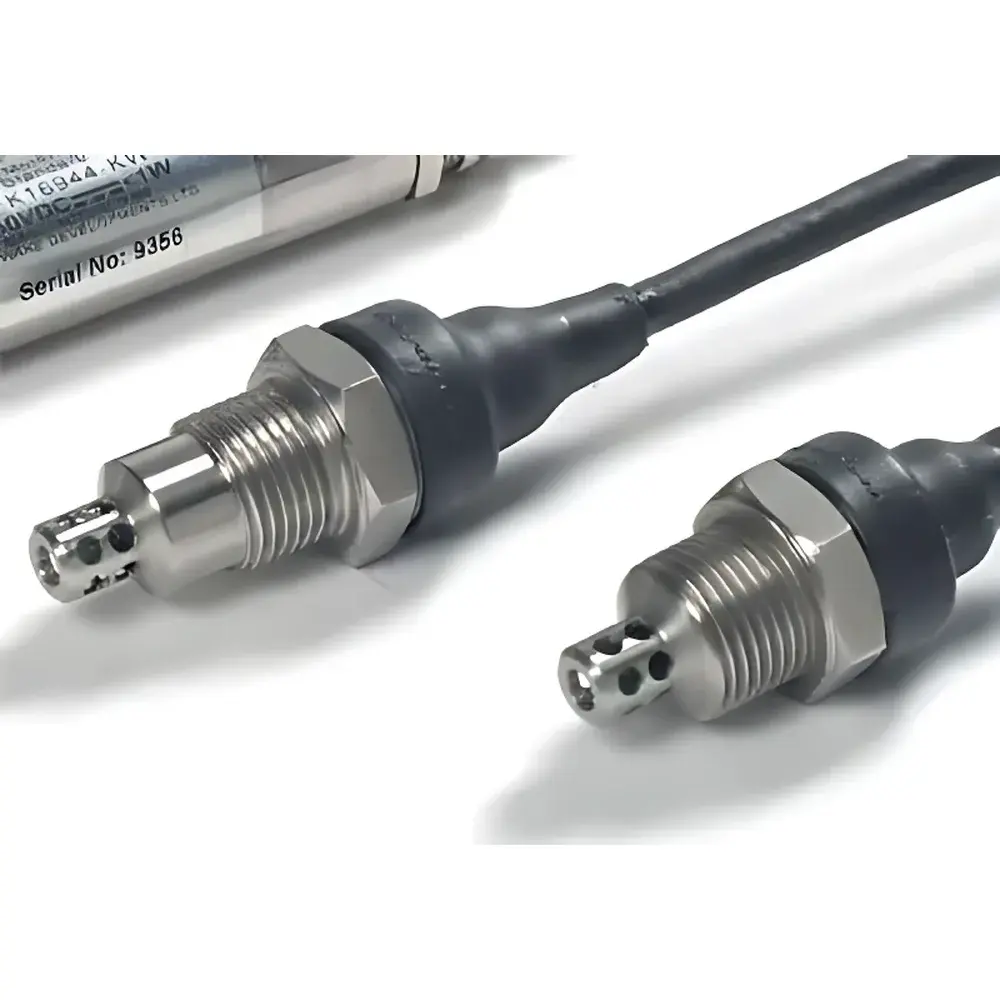
Kittiwake FG Online Moisture Sensor
| Brand | Kittiwake |
|---|---|
| Origin | United Kingdom |
| Manufacturer Type | Authorized Distributor |
| Origin Category | Imported |
| Model | FG |
| Pricing | Available Upon Request |
| Water Saturation Accuracy | ±2% |
| Temperature Accuracy | ±1 °C |
| Analog Outputs | 4–20 mA (for % saturation), 4–20 mA (for oil temperature) |
| Calibration | ISO/IEC 17025, NIST & NPL Traceable |
| Connection Method | Multi-core shielded cable |
| Data Interface | RS232 |
| Compatible Fluids | Mineral oils, synthetic lubricants, hydraulic fluids, turbine oils |
| Housing Material | 304 Stainless Steel |
| Maximum Operating Pressure | 10 bar |
| Oil Temperature Range | −40 to +100 °C |
| Power Supply | 12–30 VDC (<1 W) |
| Response Time | 30 s |
| Ingress Protection Rating | IP67 |
| Weight | 0.3 kg |
| Threaded Port | 1/2″ BSP Male |
Overview
The Kittiwake FG Online Moisture Sensor is an industrial-grade, in-line monitoring device engineered for continuous, real-time measurement of water saturation levels in lubricating and hydraulic oils. It operates on the principle of capacitive dielectric sensing—detecting changes in the relative permittivity of the oil-water mixture to quantify water concentration as percent saturation (%Sat). Unlike offline lab-based Karl Fischer titration, the FG sensor enables proactive condition-based maintenance by delivering stable, field-deployable readings directly within pressurized circulation systems. Its design targets critical infrastructure where moisture ingress compromises oxidation stability, promotes sludge formation, accelerates bearing wear, and degrades additive performance—particularly in gas turbines, marine propulsion systems, power generation hydraulics, and wind turbine gearboxes.
Key Features
- Capacitive sensing architecture with factory-calibrated response curves traceable to ISO/IEC 17025-accredited laboratories and certified against NIST and NPL reference standards.
- Robust 304 stainless steel housing rated IP67 for dust-tight and immersion-resistant operation in harsh industrial environments—including offshore platforms, engine rooms, and outdoor substations.
- Dual 4–20 mA analog outputs: one dedicated to water saturation (%Sat), the other to concurrent oil temperature—enabling correlated thermal compensation without external signal conditioning.
- Low-power electronics consuming less than 1 W at 12–30 VDC, compatible with standard PLC and DCS input modules and suitable for battery-backed or solar-powered remote installations.
- 1/2″ BSP male threaded port ensures mechanical compatibility with existing filtration housings, reservoir manifolds, and bypass lines; no welding or custom flange adapters required.
- Fast 30-second response time (t90) under dynamic flow conditions, validated per ASTM D6304 Annex A3 for online sensor responsiveness verification.
Sample Compatibility & Compliance
The FG sensor is validated for use in mineral-based, PAO, and ester-based lubricants, including ISO VG 32–680 hydraulic oils, turbine oils (ISO-L-TGA/TGB), and engine oils meeting API CK-4/CJ-4 specifications. It is not intended for use in water-glycol or phosphate ester fire-resistant fluids due to dielectric interference. The device complies with electromagnetic compatibility requirements per EN 61000-6-2 (immunity) and EN 61000-6-4 (emissions), and its construction adheres to pressure equipment guidelines for non-certified auxiliary instrumentation under PED 2014/68/EU. All calibration documentation includes uncertainty budgets and metrological traceability statements aligned with ILAC-MRA signatory laboratory practices.
Software & Data Management
While the FG operates autonomously via analog outputs, its integrated RS232 serial interface supports optional configuration, diagnostics, and firmware updates using Kittiwake’s proprietary PC utility (Windows-compatible). Logged data—including timestamped %Sat, temperature, and sensor health flags—can be ingested into SCADA, CMMS, or cloud-based predictive maintenance platforms via Modbus RTU gateway conversion. Audit trails generated during calibration events meet GLP-aligned record retention expectations, and output signals are stable under transient voltage fluctuations typical in generator-fed or VFD-proximate installations.
Applications
- Continuous moisture trending in turbine lube oil systems to preempt varnish formation and servo-valve stiction.
- Early detection of heat exchanger leaks in marine diesel engine lubrication circuits.
- Monitoring of stored bulk oil inventories in depots where ambient humidity drives seasonal saturation drift.
- Validation of desiccant breather performance across wind farm gearboxes.
- Integration into OEM lubrication management systems requiring ASME PTC 19.11-compliant fluid health inputs.
FAQ
Does the FG sensor require periodic recalibration in the field?
No—its calibration is stable over time and temperature when installed per manufacturer torque specifications and protected from mechanical shock. Annual verification against a certified reference standard is recommended for ISO 55001-aligned asset management programs.
Can the sensor be installed vertically or horizontally?
Yes—the capacitive sensing element is orientation-independent; however, mounting must ensure full oil wetting of the probe tip and avoid air entrapment in the sensing zone.
Is the RS232 interface mandatory for operation?
No—it is optional for diagnostics and configuration only; the 4–20 mA outputs provide fully functional standalone operation.
What happens if oil temperature exceeds 100 °C at the sensor location?
Exposure beyond the specified −40 to +100 °C range may cause irreversible drift in the dielectric measurement circuitry and void warranty coverage.
How does the sensor handle particulate contamination?
The 304 stainless steel probe surface resists fouling from common wear metals and carbonaceous debris; routine inspection and cleaning with lint-free cloth and isopropyl alcohol are advised during scheduled maintenance intervals.