
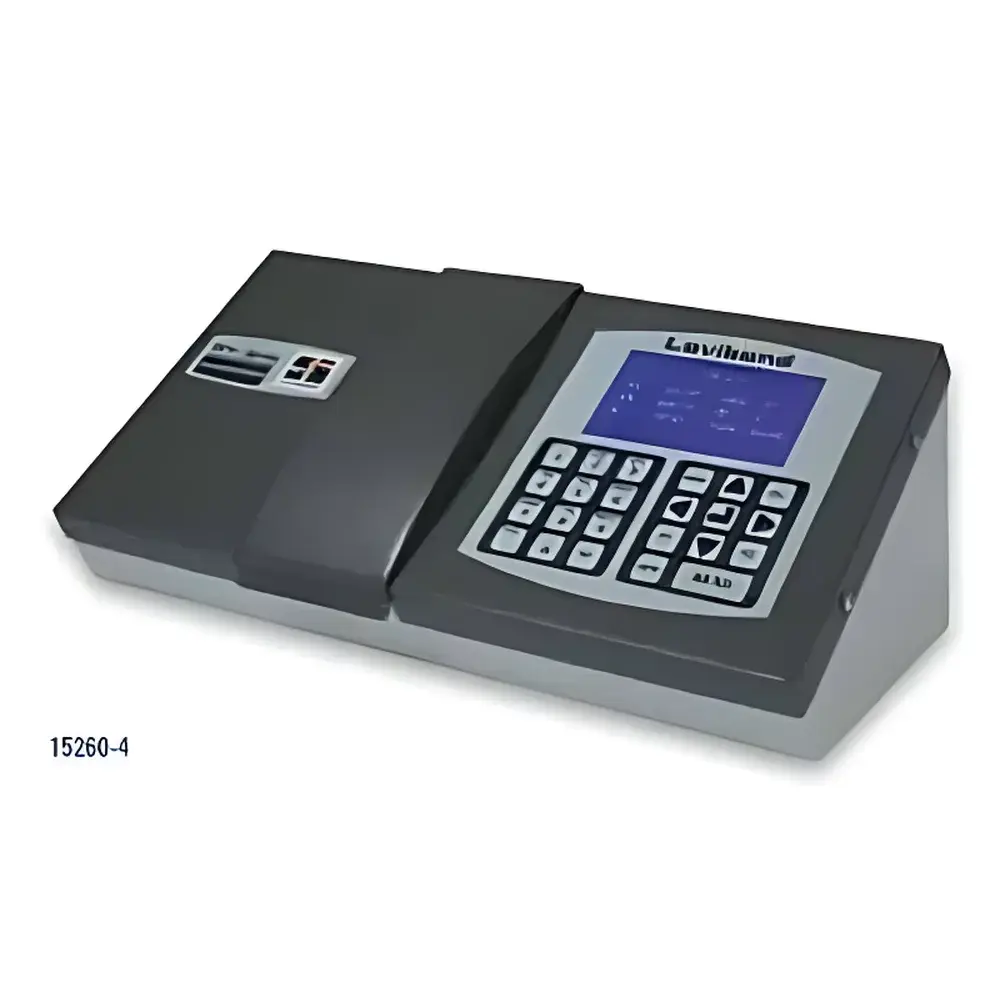
Tintometer PFXi-195 Automated Colorimeter (Model PFXi-195, Part No. 15260-4)
| Brand | SETA |
|---|---|
| Origin | United Kingdom |
| Manufacturer Type | Authorized Distributor |
| Origin Category | Imported |
| Model | PFXi-195 (15260-4) |
| Price | Upon Request |
| Measurement Method | 9-Channel Interference Filter Photometry |
| Spectral Range | 420–710 nm |
| Bandwidth | 20 nm |
| Colorimetric Repeatability | ±0.0004 CIE ΔE*ab |
| Transmittance Accuracy | ±0.5% |
| Saybolt Color Reproducibility | ±1 unit |
| Measurement Time | ≤25 s |
| Light Source | Tungsten-Halogen Lamp |
| Optical Path Length | Adjustable from 0.1 to 50 mm |
| Data Storage Capacity | 32 test records |
| Dimensions | 17 × 20 × 44 cm |
| Weight | 7 kg |
| Interface | RS232 |
Overview
The Tintometer PFXi-195 Automated Colorimeter (Model PFXi-195, Part No. 15260-4), distributed by SETA and engineered in the United Kingdom, is a precision photometric instrument designed for objective, high-reproducibility color assessment of transparent and semi-transparent liquid and molten solid samples. It operates on the principle of multi-channel interference filter photometry—employing nine discrete, factory-calibrated optical filters spanning the visible spectrum (420–710 nm) with nominal 20 nm bandwidth—to quantify color according to internationally standardized scales. Unlike subjective visual comparison methods, the PFXi-195 delivers quantitative CIE tristimulus values (X, Y, Z), chromaticity coordinates (x, y), and derived metrics including L*a*b*, ΔE*ab, and spectral transmittance profiles. Its core application domain encompasses petroleum products (e.g., lubricants, fuels, solvents), edible oils, waxes, fats, resins, and pharmaceutical excipients—where compliance with ASTM D156, D1209, D1500, D5386, D6045, E308; ISO 2049, 2211; IP 196; BS 2000-196, 5339, 5859; DIN 51411; NF T60-104, M07-003; JIS K2580; and GB/T 6540 and 3555 is mandatory for quality release and regulatory documentation.
Key Features
- Fixed 6-inch (152 mm) long-path cuvette option ensures optimal signal-to-noise ratio for low-absorbance, pale-colored samples—minimizing cumulative error associated with short-path cells and enabling accurate measurement of light-hued hydrocarbons and refined oils.
- Adjustable optical path length (0.1–50 mm) accommodates both highly concentrated and dilute samples without manual dilution, preserving sample integrity and reducing analyst intervention.
- Integrated tungsten-halogen light source provides stable, continuous-spectrum illumination with minimal drift over extended operational cycles—critical for GLP-compliant routine testing.
- Rugged steel chassis with industrial-grade surface treatment supports continuous operation in laboratory or 24/7 production environments, meeting IP20 environmental protection requirements.
- Full automatic calibration and zeroing sequence eliminates operator-dependent variability; built-in reference checks verify photometric stability prior to each measurement cycle.
- Onboard display presents real-time CIE XYZ, x,y chromaticity, and spectral transmittance data—enabling immediate technical review without external software dependency.
Sample Compatibility & Compliance
The PFXi-195 is validated for use with clear to slightly hazy liquids and thermally stable melts—including paraffin wax, stearin, cocoa butter, and hydrogenated vegetable oils—when equipped with the optional integrated heater module (PFXi-195-H). The heater maintains precise temperature control (up to 80 °C) within the sample cell using corrosion-resistant, low-thermal-mass materials that prevent premature solidification during analysis. All measurement protocols align with Good Manufacturing Practice (GMP) and Good Laboratory Practice (GLP) frameworks. Data integrity is reinforced through non-volatile memory storage (32 test records with timestamp, operator ID, and method identifier), RS232 audit trail export, and compatibility with FDA 21 CFR Part 11–compliant third-party software packages for electronic signature and change control.
Software & Data Management
The instrument interfaces seamlessly with Tintometer’s proprietary Windows-based ColorSoft™ software (supplied standard) for comprehensive data management, trend analysis, and report generation. ColorSoft supports customizable test templates aligned with specific ASTM, ISO, or internal SOPs; automated pass/fail evaluation against user-defined limits; and export to CSV, PDF, or XML formats for integration into LIMS or ERP systems. Raw spectral transmittance data and full CIE calculation logs are retained for retrospective reprocessing and regulatory inspection readiness. Firmware updates are delivered via USB or serial connection, ensuring continued alignment with evolving metrological standards.
Applications
- Refinery QC: Routine Saybolt color grading of jet fuel (ASTM D156), gasoline (ASTM D1500), and diesel (ASTM D5386) to verify refining efficiency and detect oxidation or contamination.
- Fat & Oil Processing: Quantitative assessment of bleaching efficacy in edible oil refining (ISO 2049, GB/T 6540) and thermal stability monitoring of frying oils.
- Pharmaceutical Excipients: Color consistency verification of purified water, glycerin, and propylene glycol per USP and EP 2.2.22.
- Polymer & Resin Manufacturing: Monitoring yellowness index (YI) and b* value drift during polymerization or aging studies (ASTM E313, ISO 11507).
- Paint & Coating R&D: Objective evaluation of pigment dispersion uniformity and batch-to-batch hue matching in solventborne systems.
FAQ
Does the PFXi-195 require annual recalibration by an accredited service provider?
No—its self-diagnostic routines and factory-traceable filter set enable user-performed verification using supplied calibration standards. However, traceable recalibration every 12 months is recommended for ISO/IEC 17025-accredited laboratories.
Can the instrument measure opaque or turbid samples?
No—it is designed exclusively for transmission-mode analysis of optically clear or near-clear media. Hazy or suspended particulate samples require prior filtration or centrifugation per ASTM D4176 or ISO 4406.
Is the heater module compatible with all sample cell configurations?
Yes—the PFXi-195-H variant integrates the heating element directly into the standard 6-inch path-length cell assembly, maintaining optical alignment and thermal uniformity across the entire measurement zone.
How is data security maintained during RS232 transfer?
RS232 communication is unidirectional (instrument → host) and does not support remote command execution. All exported files retain embedded metadata (date, time, method ID) for full traceability under 21 CFR Part 11 Annex 11 requirements.
What maintenance intervals are specified for the tungsten-halogen lamp?
Lamp life is rated at ≥2,000 hours under typical usage. Replacement is performed as a field-serviceable module with no optical realignment required.





