
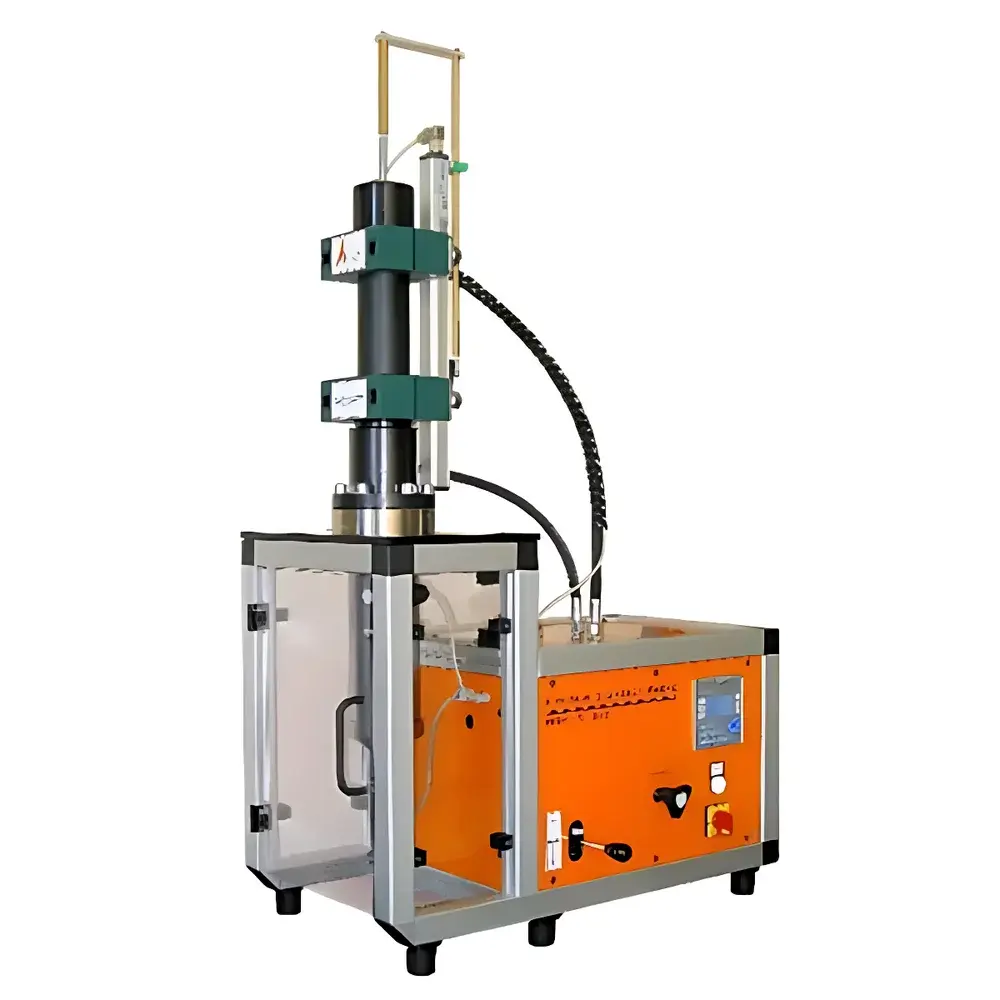
Lubricating Grease Solid Content Analyzer TTZH Model (DIN 51813 Compliant)
| Brand | TTZH |
|---|---|
| Origin | Germany |
| Manufacturer Type | Authorized Distributor |
| Origin Category | Imported |
| Model | Available Upon Inquiry |
| Price | Request Quote |
| Max Pressure | 150 bar |
| Piston Test Load | 60–70 kN |
| Sample Capacity | Up to 0.5 kg |
| Power Supply | 3-Phase, 380 V, 50 Hz |
Overview
The TTZH Lubricating Grease Solid Content Analyzer is a precision-engineered laboratory instrument designed specifically for quantitative determination of insoluble solid particles in lubricating greases according to DIN 51813. This standardized method addresses a critical quality parameter: the presence of hard, non-dispersible contaminants—such as metal wear debris, dust ingress, or manufacturing residues—that compromise grease performance by accelerating bearing wear, inducing abnormal noise, and promoting premature failure in high-load rotating equipment. The analyzer operates on a controlled mechanical filtration principle: a precisely metered grease sample is subjected to uniform hydraulic pressure via a calibrated piston system, forcing the base oil and soap matrix through a certified 25 µm stainless steel mesh filter. Solids retained on the filter surface are quantified gravimetrically after solvent extraction and drying, delivering traceable, repeatable results essential for QC laboratories in lubricant formulation, OEM supply chain validation, and maintenance reliability programs.
Key Features
- Hydraulically actuated piston system delivering stable, programmable pressure up to 150 bar—ensuring full dispersion and consistent flow dynamics across diverse grease consistency classes (NLGI #00 to #6).
- High-force load frame engineered to apply and maintain 60–70 kN axial force on the sample column, minimizing compressibility artifacts and enabling reproducible compaction of semi-solid matrices.
- Dedicated sample chamber accommodating up to 0.5 kg of grease per test cycle—optimized for statistical representativeness while maintaining compatibility with standard DIN 51813 procedural mass requirements (typically 10–50 g per replicate).
- Robust 3-phase 380 V / 50 Hz power architecture compliant with industrial-grade electrical safety standards (IEC 61000-6-2/4), suitable for integration into ISO/IEC 17025-accredited testing environments.
- Modular filter holder assembly accepting certified 25 µm woven stainless steel mesh (ASTM E161-compliant dimensional tolerance ±1.5 µm), with leak-tight sealing and post-test accessibility for residue recovery and SEM/EDS analysis.
Sample Compatibility & Compliance
This analyzer supports all common lubricating grease types—including lithium, calcium sulfonate, polyurea, clay-thickened, and biodegradable formulations—without requiring chemical pretreatment or dilution. Its mechanical separation approach avoids solvent-induced particle agglomeration or dissolution artifacts common in centrifugal or ultrasonic methods. The system is fully aligned with DIN 51813:2021-09 (“Testing of lubricants — Determination of solid content in greases”) and provides documented traceability to national metrology institutes via NIST-traceable pressure transducers and Class I analytical balances (not included). It further supports audit readiness for ISO 9001, ISO 14001, and API RP 541 lubricant management systems, with optional calibration certificates issued per ISO/IEC 17025 requirements.
Software & Data Management
While the core filtration process is manually supervised per DIN 51813 protocol, the TTZH analyzer integrates seamlessly with laboratory information management systems (LIMS) via RS-232 and Ethernet interfaces. Optional firmware enables timestamped logging of applied pressure, duration, and piston displacement—critical for GLP/GMP documentation and FDA 21 CFR Part 11-compliant electronic records when paired with validated LIMS platforms. All operational parameters are stored with user ID, date/time stamp, and audit trail metadata, satisfying internal QA review cycles and third-party accreditation audits.
Applications
- Quality control of incoming grease batches at wind turbine gearbox manufacturers and railway traction suppliers.
- Root cause analysis of bearing failures in petrochemical process pumps and steel mill rolling stands.
- Stability assessment during grease shelf-life studies under accelerated aging conditions.
- Verification of filtration efficiency in grease reclamation units used in marine and mining operations.
- Supporting ASTM D1401 and ISO 6743-9 lubricant specification compliance reporting.
FAQ
Is this instrument capable of automated gravimetric analysis?
No—the TTZH analyzer performs the standardized mechanical filtration step only. Gravimetric weighing of retained solids requires external Class I analytical balance and controlled environment (e.g., desiccator, humidity-controlled lab), as specified in DIN 51813.
Can it be used for greases containing volatile thickeners or synthetic esters?
Yes—its pressure-driven, solvent-free separation mechanism avoids thermal degradation or volatilization losses associated with oven-drying or Soxhlet extraction methods.
What maintenance intervals are recommended for the hydraulic system?
Annual recalibration of the pressure transducer and biannual inspection of O-rings and piston seals are advised; full service kits and OEM-certified technicians are available through TTZH’s European support network.






