
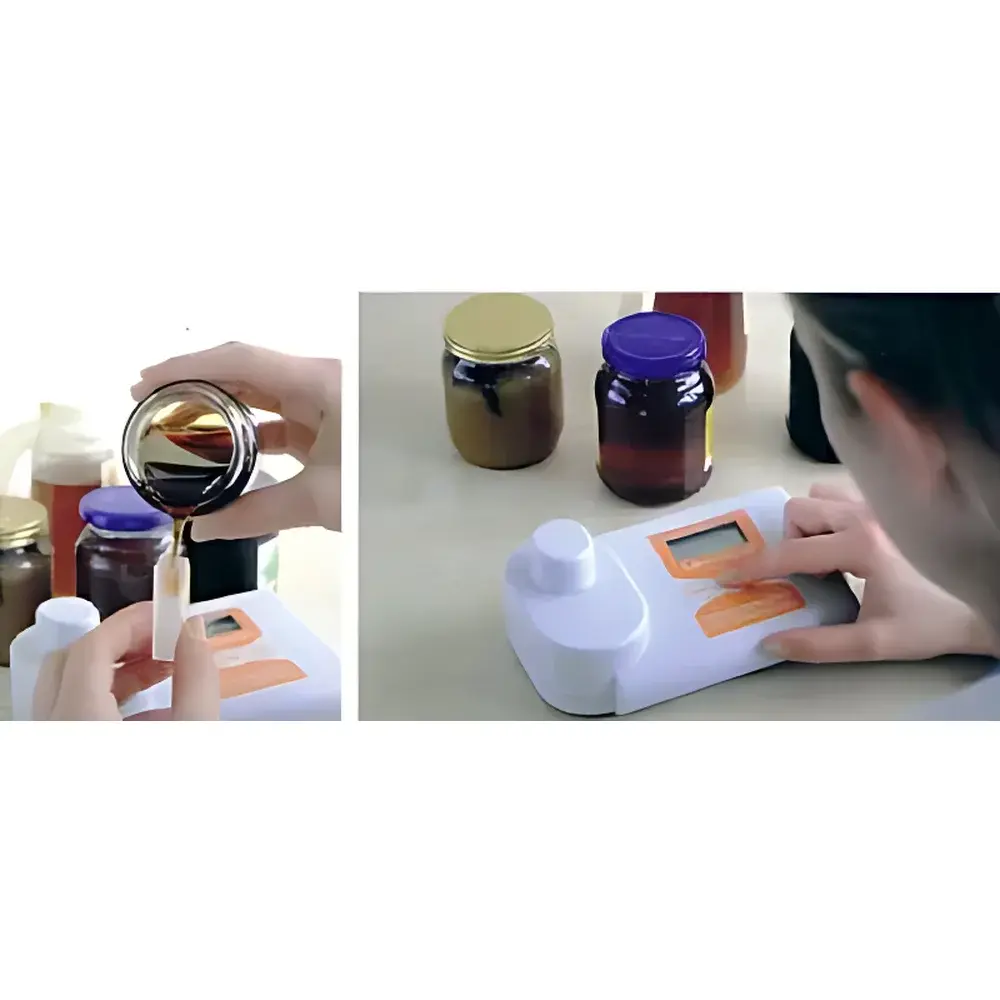
Lovibond ET4110 Honey Colorimeter (Pfund Scale)
| Brand | Lovibond/Tintometer |
|---|---|
| Origin | United Kingdom |
| Model | ET4110 |
| Measurement Unit | Pfund scale (0–160 Pfund) |
| Compliance | USDA Honey Grading Standards (7 Grade Classes), ASTM D1544 (for color reference correlation) |
| Display | Digital LCD with keypad interface |
| Application Mode | Benchtop & Field-Portable Operation |
| Power Supply | AC adapter or battery-powered (4 × AA, optional) |
Overview
The Lovibond ET4110 Honey Colorimeter is a dedicated optical measurement instrument engineered for the precise quantification of honey color according to the internationally recognized Pfund scale. Based on the principle of visual color comparison standardized through calibrated amber glass reference standards, the ET4110 employs a fixed-pathlength optical geometry (10 mm cuvette chamber) and a stabilized tungsten-halogen light source operating in the visible spectrum (approx. 380–780 nm). Unlike broad-spectrum spectrophotometers, this instrument is purpose-built for honey grading — eliminating spectral interpolation and minimizing operator-dependent variability. Its optical design conforms to the geometric and photometric constraints defined in ASTM D1544 (Standard Test Method for Color of Transparent Liquids – Platinum-Cobalt Scale), enabling traceable correlation between Pfund values and established liquid color scales. The device delivers direct Pfund readings from 0 (water-white) to 160 (dark amber), aligned with USDA Agricultural Marketing Service (AMS) specifications for honey classification into seven official grade categories: Water-White, Extra White, White, Extra Light Amber, Light Amber, Amber, and Dark Amber.
Key Features
- Dedicated Pfund-scale calibration — factory-aligned against NIST-traceable Lovibond® reference standards, ensuring long-term repeatability within ±1 Pfund unit under controlled ambient conditions.
- Integrated dual-mode operation — supports both laboratory benchtop use (with AC power) and field deployment (via 4 × AA alkaline batteries, up to 10,000 measurements per set).
- Optimized optical path — fixed 10 mm pathlength cell holder with precision-machined alignment grooves, minimizing refractive index errors common in viscous honey samples.
- High-contrast digital LCD display with backlight — readable under variable lighting conditions; numeric output eliminates subjective interpretation of analog comparator disks.
- Robust IP54-rated enclosure — dust- and splash-resistant housing suitable for agricultural co-ops, packing facilities, and QC labs without climate-controlled environments.
- No warm-up time required — tungsten-halogen lamp achieves stable luminance within 2 seconds of activation, supporting high-throughput batch analysis.
Sample Compatibility & Compliance
The ET4110 is validated exclusively for filtered, clarified honey samples meeting AOAC 969.37 preparation guidelines (i.e., heated to 40 °C ± 2 °C, centrifuged at 3,000 rpm for 5 min, and cooled to 20 °C ± 0.5 °C prior to measurement). It is incompatible with unfiltered, crystallized, or pollen-rich honey unless preprocessed per USDA AMS Directive 2022-01. Instrument compliance extends to regulatory frameworks governing honey labeling in the EU (Commission Implementing Regulation (EU) 2023/1452), U.S. (USDA AMS Honey Grading Manual, Rev. 2021), and Codex Alimentarius STAN 12-1981. While not FDA 21 CFR Part 11 compliant out-of-the-box, audit-ready usage logs can be maintained manually per GLP requirements for internal quality control documentation.
Software & Data Management
The ET4110 operates as a standalone instrument with no embedded data logging or USB connectivity. All measurements are displayed in real time and must be recorded externally. For laboratories requiring electronic record retention, Lovibond recommends pairing the ET4110 with the optional Lovibond® LabLink Pro software (v4.2+) via third-party RS-232-to-USB adapters — enabling manual timestamped entry, batch ID assignment, and export to CSV or PDF formats. Data integrity is preserved through user-defined calibration verification checks (performed daily using supplied Pfund 20 and Pfund 100 reference standards), with records satisfying ISO/IEC 17025 clause 7.7 (Measurement Traceability) when documented in a controlled logbook.
Applications
- USDA-compliant honey grading for commercial export certification and domestic market labeling.
- Raw material incoming inspection at packing houses to verify supplier consistency against contractual Pfund thresholds.
- Process monitoring during thermal treatment — detecting caramelization onset via progressive Pfund increase beyond baseline (e.g., >15 Pfund shift after prolonged heating at 65 °C).
- Research applications in apicultural science, including floral source identification studies where color correlates with botanical origin (e.g., acacia vs. buckwheat honey differentiation).
- Training and proficiency testing for sensory panels, providing objective benchmarks to calibrate visual assessment protocols.
FAQ
Does the ET4110 require annual recalibration by an accredited lab?
No — but users must perform daily verification using the included Pfund 20 and Pfund 100 reference standards. Full recalibration is recommended every 12 months or after physical impact, per Lovibond Technical Bulletin TB-ET4110-Rev.C.
Can the ET4110 measure other viscous liquids like maple syrup or molasses?
Not validly — its optical algorithm and reference set are mathematically constrained to honey’s specific refractive index range (1.472–1.498 at 20 °C) and spectral absorption profile. Use of non-honey samples voids Pfund traceability.
Is the 10 mm cuvette reusable?
Yes — supplied quartz cuvettes are autoclavable and chemically resistant to honey’s organic acids; cleaning protocol requires rinsing with warm distilled water followed by ethanol wipe and air-drying in laminar flow.
What is the minimum sample volume required?
2.5 mL — sufficient to fill the 10 mm pathlength chamber without meniscus interference; viscosity-independent due to gravity-fed loading design.
How does temperature affect Pfund readings?
A deviation of ±1 °C from 20 °C introduces ±0.8 Pfund error; therefore, strict temperature equilibration per AOAC 969.37 is mandatory for compliance-grade reporting.



