
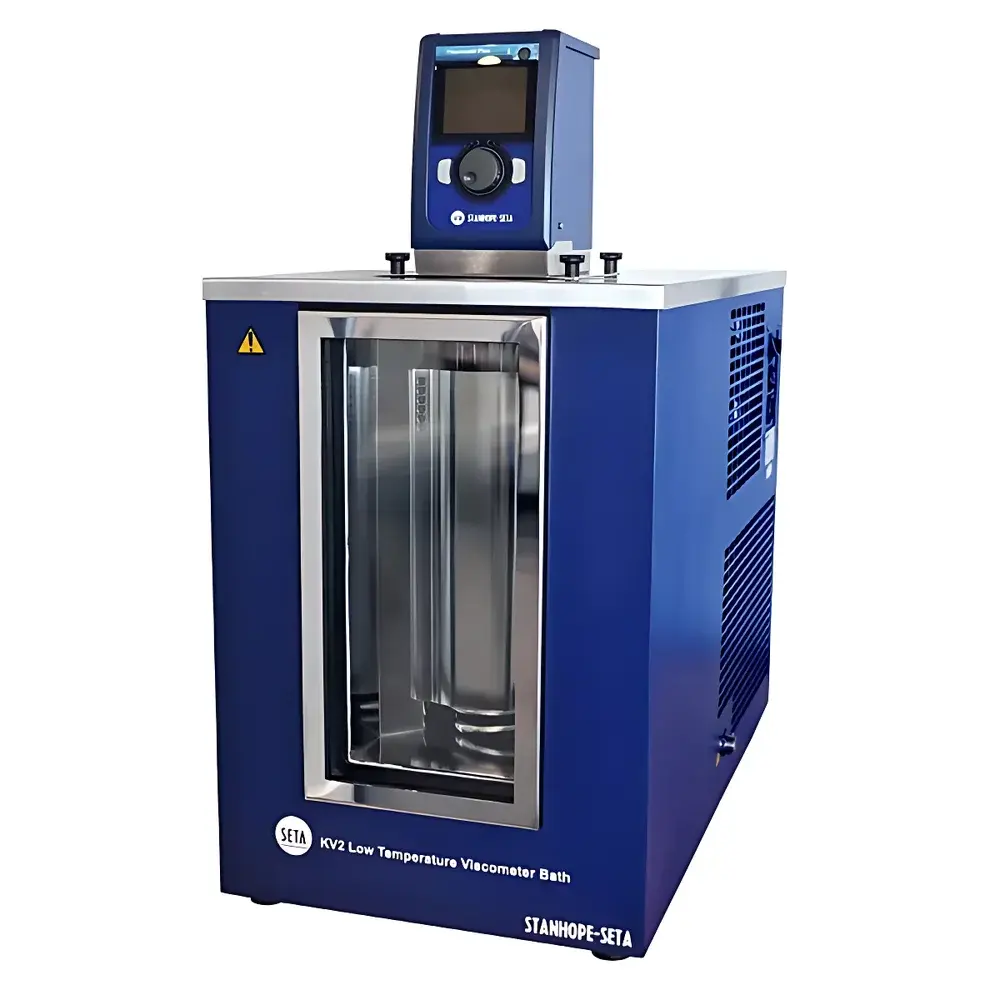
SETA 94710-4 Kinematic Viscosity Tester
| Brand | SETA |
|---|---|
| Origin | United Kingdom |
| Model | 94710-4 |
| Temperature Range | -40 °C to +20 °C |
| Temperature Stability | ±0.01 °C |
| Test Positions | 2 |
| Bath Volume | 7 L (oil) |
| Cooling System | Integrated refrigeration (reaches -40 °C in <4 h) |
| Safety Features | Independent overtemperature and low-fluid-level cut-off |
| Viewing Window & Insulated Top Plate | Prevents condensation |
| Compliance | ASTM D445, ASTM D446, IP 71, BS 188, BS 2000-71-2, ISO 3105, BS EN ISO 3104, BS 2000-71.1, GB/T 265 |
Overview
The SETA 94710-4 Kinematic Viscosity Tester is a precision-engineered instrument designed for the accurate and repeatable determination of kinematic viscosity in petroleum products, lubricants, fuels, and related hydrocarbon-based fluids. It operates on the capillary viscometry principle defined in internationally recognized standards—including ASTM D445 and ISO 3104—wherein the time required for a fixed volume of liquid to flow under gravity through a calibrated glass capillary tube is measured at a precisely controlled temperature. Kinematic viscosity (ν), expressed in mm²/s (cSt), is derived from the product of the capillary constant and the efflux time. This method remains the reference technique for quality control, specification compliance, and formulation validation across upstream, midstream, and downstream petroleum operations.
Key Features
- Two independent test positions enable concurrent analysis of duplicate samples or different materials—enhancing laboratory throughput without compromising measurement integrity.
- High-stability temperature bath with ±0.01 °C uniformity over the full operating range (–40 °C to +20 °C), achieved via a dual-mode thermal control system combining Peltier-based cooling and resistive heating.
- Integrated refrigeration module achieves –40 °C setpoint in under four hours, eliminating reliance on external cryogenic baths or dry ice—a critical advantage for low-temperature testing of jet fuels, diesel, and synthetic lubricants.
- Optically clear heated viewing window and insulated top plate minimize surface condensation and thermal stratification, ensuring unobstructed visual monitoring of capillary flow and reducing operator intervention.
- 7-liter oil-filled bath provides thermal mass sufficient for long-duration tests while maintaining laminar flow conditions around capillaries—essential for minimizing convection-induced timing errors.
- Dual independent safety interlocks: automatic power cutoff upon detection of overtemperature or low oil level, protecting both equipment and operator in accordance with IEC 61010-1 requirements.
Sample Compatibility & Compliance
The 94710-4 supports standard U-tube (e.g., Cannon-Fenske, Ostwald, or Ubbelohde) and suspended-level (e.g., BS/IP-type) capillaries, accommodating viscosities from approximately 1 mm²/s to >10⁶ mm²/s depending on capillary selection. Its design conforms rigorously to the mechanical, thermal, and procedural specifications outlined in ASTM D445 (Standard Test Method for Kinematic Viscosity of Transparent and Opaque Liquids), ISO 3104 (Petroleum products — Determination of kinematic viscosity and calculation of dynamic viscosity), and BS EN ISO 3104. It is also validated for use with IP 71 (Institute of Petroleum Standard) and GB/T 265 (Chinese National Standard). The instrument’s traceable temperature calibration and documented thermal uniformity profile support audit readiness for GLP and ISO/IEC 17025-accredited laboratories.
Software & Data Management
While the 94710-4 operates as a benchtop analog/digital hybrid system—prioritizing mechanical reliability and regulatory simplicity—it includes digital timing interfaces compatible with third-party data acquisition modules. Optional RS-232 or USB output enables integration with LIMS platforms or custom scripts for automated timestamping, efflux time logging, and viscosity calculation per ISO 3104 Annex A. All temperature setpoints, dwell times, and alarm thresholds are user-configurable and retained in non-volatile memory. Audit trails—including operator ID, test date/time, bath temperature history, and safety event logs—are exportable in CSV format to meet FDA 21 CFR Part 11 requirements when paired with compliant software environments.
Applications
- Quality assurance of aviation turbine fuels (Jet A-1, JP-8) per ASTM D1655 and DEF STAN 91-91.
- Viscosity grading of engine oils (SAE J300) and industrial lubricants (ISO VG classes).
- Batch release testing of base oils, bitumen emulsions, and biodiesel blends (ASTM D6751, EN 14214).
- Research and development of low-temperature fluid formulations, including synthetic esters and polyalphaolefins (PAOs).
- Regulatory submission support for EPA, ECHA, and national petroleum regulatory bodies requiring standardized kinematic viscosity data.
FAQ
What capillary types are supported by the 94710-4?
The instrument accommodates all standard gravity-flow capillaries referenced in ASTM D445 and ISO 3104, including Cannon-Fenske Routine, Ubbelohde, and suspended-level designs—subject to appropriate bath depth and mounting fixtures.
Is calibration certification included with shipment?
Each unit ships with a factory-issued temperature calibration certificate traceable to UKAS-accredited standards; capillary calibration certificates are provided separately per customer-specified capillary set.
Can the bath accommodate water-based calibration fluids?
No—the 7 L bath is specified for silicone oil or mineral oil only; aqueous media are incompatible with the refrigeration system and pose corrosion risks to internal components.
How is thermal uniformity verified across the bath?
SETA performs multi-point thermal mapping during final acceptance testing using NIST-traceable platinum resistance thermometers (PRTs); results are documented in the Instrument Qualification Report supplied with each unit.
Does the system support automated viscosity calculation?
The base unit does not include embedded calculation logic; however, its digital timer output is fully compatible with external software that applies the standard formula ν = C × t, where C is the capillary constant and t is efflux time.






