
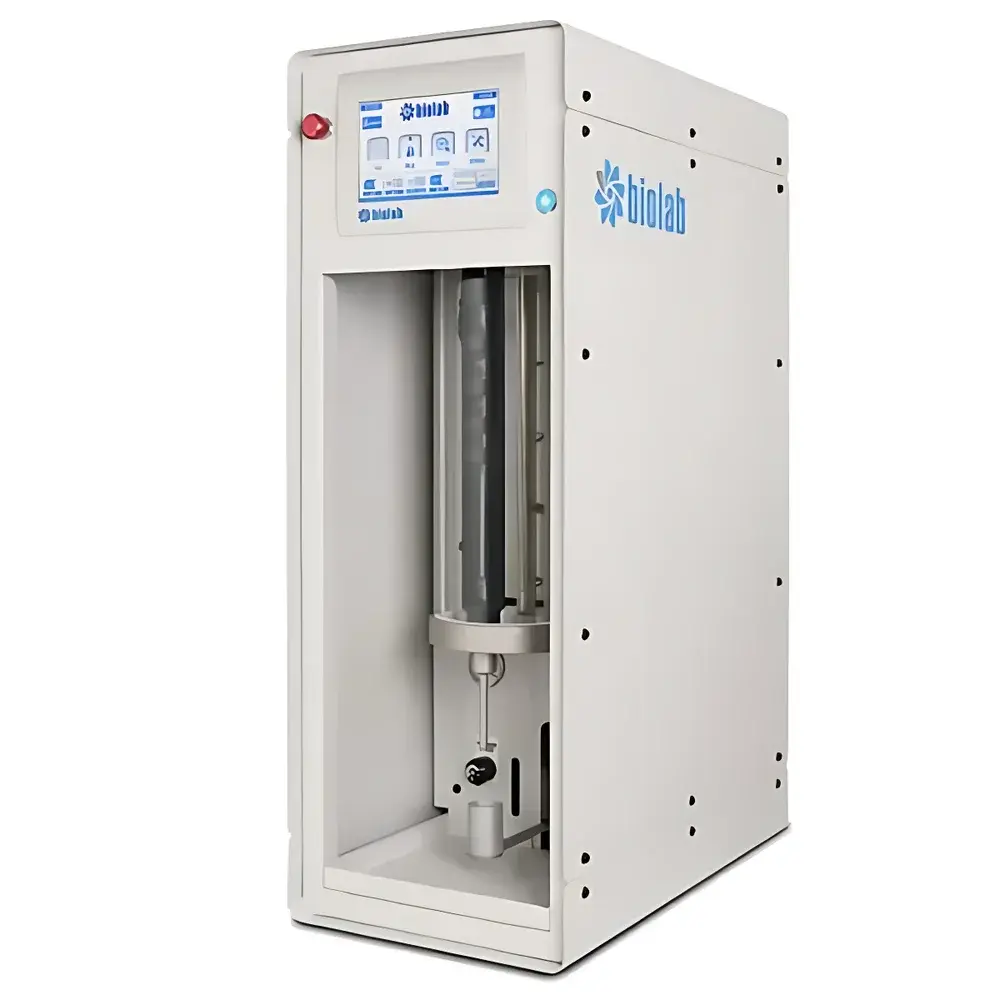
Biolab Viscol-10A Automatic Kinematic Viscosity Tester
| Brand | Biolab |
|---|---|
| Model | Viscol-10A |
| Application | Fuel & Lubricant Testing |
| Temperature Control Points | 40 °C and 100 °C |
| Measurement Principle | Capillary Flow Timing (ASTM D445 / ISO 3104) |
| Viscosity Index Calculation | Integrated |
| Automation Level | Fully Automated (Measurement, Rinse, Calibration, Drain) |
| Compliance | ASTM D445, ISO 3104, IP 71, GB/T 265 |
| Temperature Stability | ±0.01 °C |
| Timing Resolution | 0.01 s |
| Sample Capacity | Up to 6 positions (configurable) |
| Cleaning Protocol | Solvent-based automated rinse cycle |
| Data Output | CSV, PDF report with VI, kinematic viscosity (mm²/s), and instrument metadata |
Overview
The Biolab Viscol-10A Automatic Kinematic Viscosity Tester is a precision-engineered capillary viscometer system designed for routine and regulatory-compliant kinematic viscosity determination of transparent and opaque Newtonian liquids—primarily petroleum-based fuels, base oils, finished lubricants, and hydraulic fluids. It operates on the fundamental principle of capillary flow timing: under gravity-driven laminar flow, the kinematic viscosity (ν) of a fluid is directly proportional to its efflux time (t) through a calibrated glass capillary tube of known dimensions, as defined by the Hagen–Poiseuille equation. The instrument maintains strict thermal equilibrium at standardized test temperatures—specifically 40 °C and 100 °C—per ASTM D445, ISO 3104, IP 71, and GB/T 265. Its fully enclosed, thermostatically regulated bath ensures temperature stability within ±0.01 °C, minimizing thermal drift and maximizing inter-laboratory reproducibility. Unlike manual or semi-automated alternatives, the Viscol-10A eliminates operator-dependent variables—including meniscus detection timing, bath immersion depth, and post-run cleaning consistency—by integrating optical flow detection, microprocessor-controlled timing, and programmable solvent rinse sequences.
Key Features
- Fully automated measurement cycle: sample aspiration, temperature equilibration, efflux timing, data calculation, solvent rinse, and waste drainage—all executed without manual intervention.
- Dual-standard temperature control: independent Peltier-assisted baths optimized for both 40 °C (for low-viscosity distillates) and 100 °C (for high-viscosity residual fuels and multigrade oils).
- Optical meniscus detection system: high-resolution photodiode array with adaptive thresholding ensures precise start/stop timing across variable fluid clarity (including dyed or hazy samples).
- Integrated viscosity index (VI) computation: automatically calculates VI per ASTM D2270 using kinematic viscosity results at both 40 °C and 100 °C, with traceable calibration constants stored in non-volatile memory.
- Modular capillary rack support: accommodates Ubbelohde, Cannon-Fenske, and reverse-flow viscometers; configurable for up to six simultaneous test positions with independent thermal zoning.
- GLP-ready audit trail: timestamps all critical events—including calibration date, operator ID (via optional RFID login), bath temperature logs, timing deviations, and rinse solvent lot tracking.
Sample Compatibility & Compliance
The Viscol-10A is validated for use with petroleum distillates (gasoline, kerosene, diesel), mineral and synthetic lubricants, transformer oils, and hydraulic fluids meeting API, ASTM, and ISO specifications. It supports both transparent and mildly turbid samples, provided they do not contain suspended particulates that could occlude capillary bores. The system complies with the mandatory procedural requirements of ASTM D445 (Standard Test Method for Kinematic Viscosity of Transparent and Opaque Liquids), ISO 3104 (Petroleum products — Determination of kinematic viscosity and calculation of dynamic viscosity), IP 71 (Determination of kinematic viscosity of petroleum products), and GB/T 265 (Petroleum products — Determination of kinematic viscosity). All firmware and calibration routines are documented per ISO/IEC 17025:2017 clause 7.7 (Ensuring validity of results), and electronic records conform to FDA 21 CFR Part 11 requirements when paired with Biolab’s optional LIMS integration module.
Software & Data Management
The Viscol-10A runs on embedded Linux-based firmware with a web-accessible interface (HTTPS-enabled), supporting remote configuration, real-time monitoring, and secure data export. Measurement data—including efflux time, calculated kinematic viscosity (mm²/s), VI, temperature deviation logs, and capillary identification—is stored locally with SHA-256 hashed integrity verification. Export formats include timestamped CSV (compatible with Excel and statistical process control software) and PDF reports containing full metrological traceability: capillary calibration certificate number, reference standard viscosity values, uncertainty budget (k=2), and analyst signature field. Optional Biolab Viscosoft Suite provides advanced features: multi-instrument fleet management, trend analysis across batches, automated outlier flagging per ASTM E178, and electronic signature workflows compliant with 21 CFR Part 11 Annex 11.
Applications
- Quality control of finished lubricants and base stocks per OEM specifications (e.g., SAE J300, ACEA, API licensing programs).
- Refinery process monitoring: feedstock characterization, blending verification, and distillation cut validation.
- Regulatory submission testing for fuel certification (EN 590, ASTM D975, ASTM D3948).
- Research and development of viscosity index improvers (VIIs) and shear-stable additive packages.
- Third-party testing laboratories accredited to ISO/IEC 17025 seeking auditable, repeatable kinematic viscosity data for certification reports.
- Condition monitoring of in-service oils via trending of kinematic viscosity shifts indicative of oxidation, fuel dilution, or thermal degradation.
FAQ
What capillary types are supported by the Viscol-10A?
Ubbelohde, Cannon-Fenske Routine, and reverse-flow viscometers—each requiring individual calibration certificates traceable to NIST or equivalent national metrology institutes.
Does the instrument support ASTM D7042 (HTHS viscosity) measurements?
No—the Viscol-10A is dedicated to kinematic viscosity per ASTM D445; high-temperature high-shear (HTHS) viscosity requires a separate rotational rheometer platform.
Can the system be integrated into an existing LIMS?
Yes—via ASTM E1394-compliant HL7 or direct SQL database push using Biolab’s certified middleware drivers.
Is manual timing override available for method validation studies?
Yes—engineering mode permits manual trigger initiation and raw efflux time logging, with full audit trail retention.
What maintenance intervals are recommended for long-term accuracy?
Capillary cleaning after every 20 runs; bath fluid replacement every 6 months; annual recalibration of temperature sensors and timing circuitry by authorized Biolab service engineers.






