
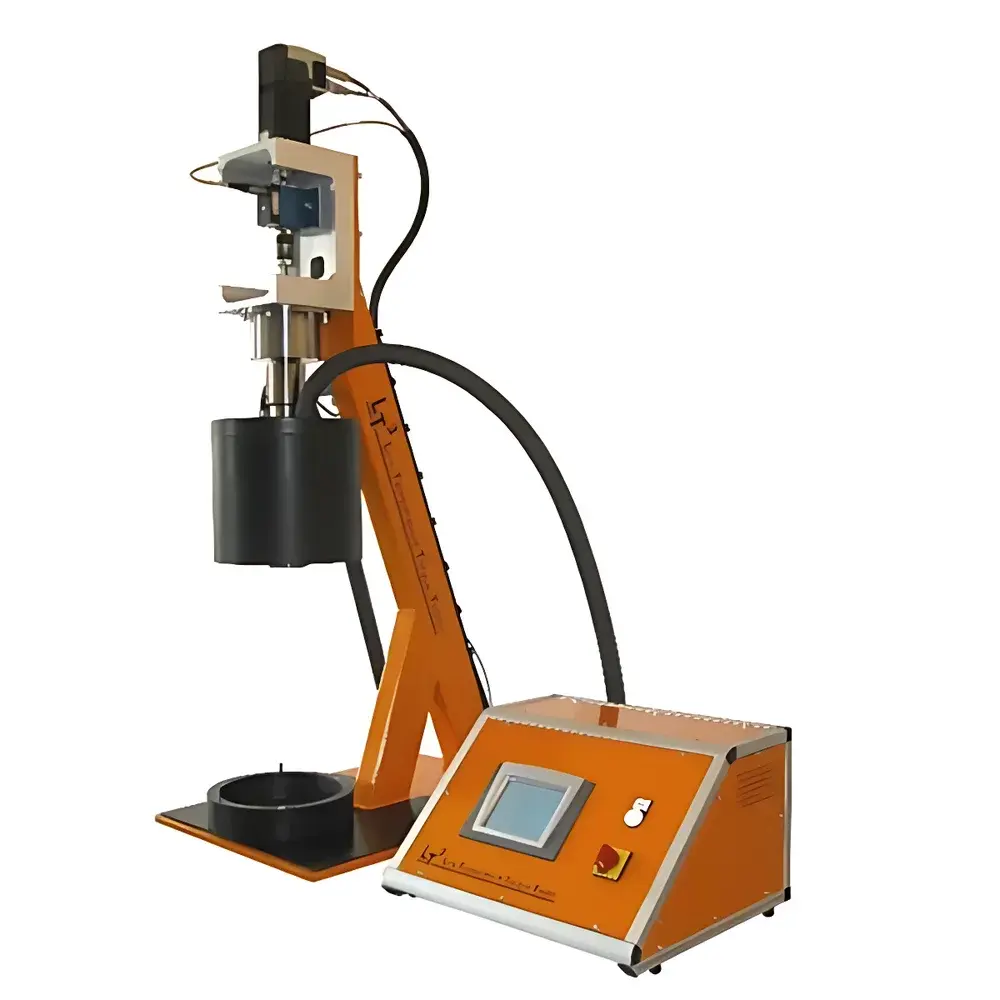
TTZH LT3 Low-Temperature Torque Tester
| Brand | TTZH |
|---|---|
| Origin | Germany |
| Manufacturer Type | Authorized Distributor |
| Origin Category | Imported |
| Model | LT3 |
| Test Temperature Range | Down to −73 °C (with external cryogenic cooling system) |
| Axial Load | 50 N (standard, fixed) |
| Torque Measurement Range | 0–2000 N·mm (custom ranges available on request) |
| Drive System | Electronically controlled high-precision direct-drive motor |
| Torque Sensor | High-resolution digital torque transducer |
| Cooling Interface | Closed-loop cryogenic jacket compatible with liquid nitrogen or mechanical chillers |
| Control Unit | Integrated PLC-based controller with industrial touchscreen HMI |
| Data Acquisition | Real-time synchronized sampling of torque, temperature, and time |
| Software | Windows-based application supporting ASTM D1478 / IP 186/93 compliance reporting, GLP audit trails, and CSV/PDF export |
Overview
The TTZH LT3 Low-Temperature Torque Tester is an engineered solution for quantifying the starting torque resistance of greases under extreme low-temperature conditions, specifically in accordance with standardized test method IP 186/93. This instrument operates on the principle of axial loading of a standardized ball bearing while rotating at a defined speed (typically 1 rpm), with torque measured as a function of decreasing temperature. The core measurement reflects the combined effects of grease rheology, base oil viscosity, thickener network rigidity, and interfacial friction at sub-zero temperatures—critical parameters for evaluating performance in aerospace, automotive cold-climate drivetrain, and arctic instrumentation applications. Unlike legacy mechanical testers relying on analog load cells and open-loop refrigeration, the LT3 integrates a digitally regulated direct-drive actuator, a calibrated NIST-traceable torque transducer, and a thermally isolated closed-loop cooling jacket, enabling stable thermal equilibration and repeatable dynamic torque acquisition down to −73 °C.
Key Features
- Electronically controlled direct-drive motor delivering precise rotational speed (1 rpm ±0.02 rpm) with zero backlash and minimal inertia interference
- High-stability torque sensor with resolution better than 0.1 N·mm and linearity ≤±0.25% FS over full 0–2000 N·mm range
- Closed-loop cryogenic jacket interface compatible with standard liquid nitrogen dewars or programmable mechanical chillers (−80 °C capable), ensuring uniform thermal transfer across bearing housing
- Integrated PLC-based control unit with 7-inch industrial touchscreen HMI, supporting real-time parameter monitoring, test sequencing, and emergency thermal/torque interlocks
- Modular bearing fixture design accommodating ISO-standard deep-groove ball bearings from 12 mm to 62 mm bore diameter (e.g., 608, 6204, 6306 series)
- Preconfigured test profiles aligned with IP 186/93: includes ramped cooling protocol (−20 °C → −73 °C at 1 °C/min), dwell stabilization (≥15 min per step), and torque capture at 1 rpm after thermal equilibrium
Sample Compatibility & Compliance
The LT3 accommodates standardized single-row deep-groove ball bearings per ISO 15 and DIN 625, with optional custom adapters for tapered roller or angular contact configurations upon request. Grease samples are applied per ASTM D4950 specification (standardized quantity and distribution). The system supports full traceability per GLP and GMP requirements: all test runs log timestamp, operator ID, ambient lab conditions (optional external hygrothermograph integration), raw torque vs. temperature curves, and final reported values (e.g., “torque at −40 °C”, “minimum torque temperature”). Output reports comply with IP 186/93 formatting, including mandatory fields for bearing type, grease mass, axial load, rotational speed, and cooling medium. Optional 21 CFR Part 11-compliant software module enables electronic signatures, audit trail logging, and role-based access control.
Software & Data Management
The LT3 Control Suite is a Windows 10/11 native application built on .NET Framework with SQLite backend. It acquires synchronized data streams at 10 Hz (torque, thermocouple voltage, drive current, elapsed time), applies real-time cold-junction compensation, and stores raw binary files (.lt3bin) alongside human-readable CSV exports. Analysis tools include automatic peak detection (for maximum torque onset), derivative-based inflection point identification (to locate minimum torque temperature), and statistical comparison across multiple grease batches. All data files contain embedded metadata (test ID, calibration certificate IDs, firmware version), and support automated upload to LIMS via secure SFTP or OPC UA. Backup and restore functions preserve configuration templates, user-defined test methods, and historical calibration logs.
Applications
- Formulation screening of low-temperature greases for aviation wheel bearings (SAE AS5780 compliant)
- Quality control of lithium-complex, polyurea, and PFPE-based greases used in satellite mechanisms and cryogenic valves
- Development validation of biodegradable greases under EN 16807 environmental specifications
- Comparative assessment of thickener–oil interactions during phase transition below −40 °C
- Supporting ASTM D1478 revision efforts through high-fidelity torque-temperature profiling
FAQ
What external cooling systems are compatible with the LT3?
The LT3 accepts standard G1/4″ threaded ports for connection to liquid nitrogen dewars (via vaporizer) or commercial mechanical chillers rated for −80 °C outlet temperature. A flow regulator and pressure relief valve are required upstream.
Can the axial load be adjusted beyond 50 N?
The standard configuration uses a fixed 50 N spring-loaded axial actuator per IP 186/93. Custom high-load variants (up to 200 N) are available with recalibrated torque compensation algorithms and reinforced bearing housings.
Is calibration certification included with delivery?
Yes — each unit ships with NIST-traceable calibration certificates for torque (0–2000 N·mm), temperature (−73 °C to +50 °C), and rotational speed, valid for 12 months from commissioning date.
How is bearing alignment verified prior to testing?
The fixture incorporates precision-ground V-blocks and adjustable lateral stops; alignment is confirmed using a dial indicator (±2 µm runout tolerance) before each test sequence.
Does the software support multi-language interfaces?
English and German UI languages are pre-installed; additional languages (French, Spanish, Japanese) can be enabled via licensed localization packs.





