
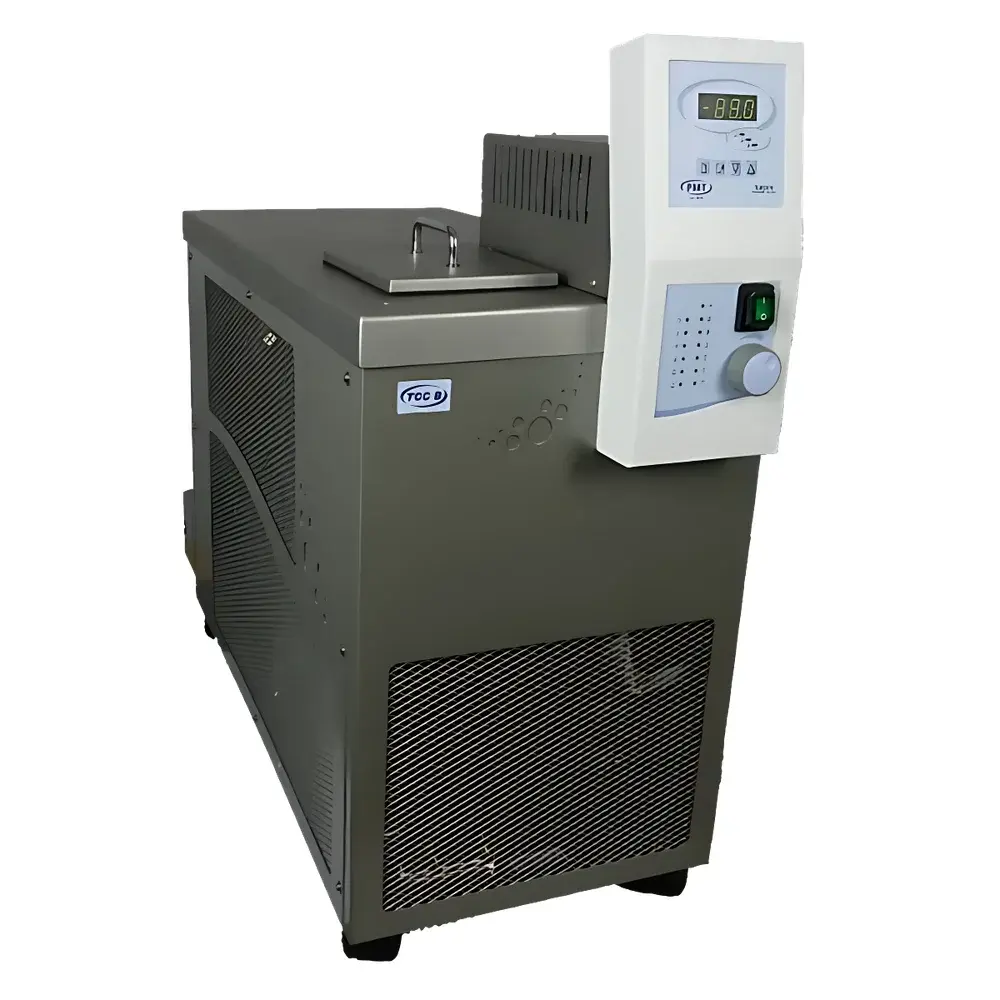
TAMSON TCC-B Low-Temperature Circulating Bath
| Brand | TAMSON |
|---|---|
| Origin | Netherlands |
| Model | TCC-B |
| Temperature Range | Down to –90 °C |
| Bath Tank Material | Stainless Steel |
| Temperature Stability | ±0.05 °C |
| Communication Interface | RS232 Serial Port |
| Software | Included Free PC Control Software |
| Distribution Type | Authorized Distributor (Non-Manufacturer) |
| Import Status | Imported Instrument |
Overview
The TAMSON TCC-B Low-Temperature Circulating Bath is an engineered thermal management system designed for precise, stable, and reproducible temperature control in laboratory and analytical applications requiring sub-ambient cooling. Operating on a closed-loop refrigeration principle with cascade compressor technology, the TCC-B delivers continuous, high-flow circulation of heat-transfer fluid—typically ethanol or silicone oil—to external devices such as spectrophotometer cells, reaction jackets, calorimeters, or material testing fixtures. Its core function is to maintain setpoint temperatures from ambient down to –90 °C with exceptional short-term stability (±0.05 °C), enabling experiments where thermal drift must be minimized—for instance, kinetic studies, polymer crystallization monitoring, or low-temperature spectroscopy. Unlike open-bath chillers, the TCC-B integrates a sealed stainless steel reservoir, integrated pump, expansion tank, and digital PID controller—all housed in a compact, benchtop-ready chassis compliant with IEC 61010-1 safety standards.
Key Features
- Stainless steel bath tank with corrosion-resistant finish and integrated fluid level sensor for safe dry-run prevention
- Cascade dual-compressor refrigeration system optimized for deep-cooling performance at –90 °C without liquid nitrogen dependency
- Digital PID temperature controller with intuitive keypad interface, real-time display of setpoint/actual temperature, and programmable ramp-soak profiles
- High-capacity centrifugal circulation pump delivering up to 22 L/min flow rate at low backpressure—compatible with most external jacketed vessels and coil-based heat exchangers
- RS232 serial communication port supporting ASCII command protocol for integration into automated lab systems or custom LabVIEW/Python control environments
- Free Windows-compatible control software included, enabling remote setpoint adjustment, data logging (timestamped temperature and status variables), and alarm history export in CSV format
Sample Compatibility & Compliance
The TCC-B is compatible with a wide range of external thermal loads—including glass or metal jacketed reactors (up to 5 L volume), UV-Vis cuvette holders, DSC sample stages, and rheometer temperature control units—provided fluid compatibility (e.g., 30% ethylene glycol/water or specialized low-viscosity silicone oils) and pressure drop constraints are observed. All electrical components meet CE marking requirements under the EU Machinery Directive 2006/42/EC and Electromagnetic Compatibility Directive 2014/30/EU. The unit supports GLP-compliant operation through software audit trail functionality (user login, parameter changes, and error logs) and may be validated per IQ/OQ protocols in regulated environments (e.g., pharmaceutical QC labs adhering to USP and FDA 21 CFR Part 11 when paired with validated software configurations).
Software & Data Management
The bundled PC software provides bidirectional communication via RS232, allowing full instrument control—including temperature setpoint, ramp rate, hold time, pump speed, and alarm thresholds—without manual panel interaction. Logged data includes timestamp, bath temperature, setpoint deviation, pump status, and compressor runtime; all records are stored locally in UTF-8 encoded CSV files suitable for import into Excel, MATLAB, or LIMS platforms. The software architecture supports multi-instrument polling (when used with optional RS232 hub), and its API documentation (available upon request) facilitates integration into larger automation frameworks governed by ISA-88 or ASTM E2500 principles.
Applications
- Low-temperature reaction monitoring in synthetic organic chemistry and catalysis research
- Thermal conditioning of optical components during FTIR, Raman, or fluorescence measurements
- Calibration and verification of thermocouples, RTDs, and infrared sensors across extended cryogenic ranges
- Stabilization of detector housings in mass spectrometry and X-ray diffraction systems
- Material property evaluation—including thermal expansion coefficients, glass transition behavior (Tg), and low-temperature tensile testing fixtures
- Supporting ISO 291 (plastics conditioning), ASTM D5229 (low-temp composite testing), and IEC 60068-2-1 (cold testing) environmental test procedures
FAQ
What fluids are recommended for operation at –90 °C?
Ethanol, methanol, or low-viscosity silicone oils (e.g., DC-200 series) are commonly used; fluid selection must consider pour point, vapor pressure, thermal conductivity, and chemical compatibility with stainless steel and pump seals.
Is the TCC-B suitable for use with pressurized external systems?
No—it is designed for open-loop or low-backpressure (< 2 bar) circulation only; integration with pressurized jackets requires an external pressure-regulating manifold and safety relief valve.
Does the unit support Ethernet or USB connectivity?
No native Ethernet or USB interface is provided; RS232 remains the sole standard communication option, though USB-to-RS232 adapters (FCC/CE certified) are widely deployed in practice.
Can the TCC-B be validated for GMP environments?
Yes—when operated with documented IQ/OQ protocols, calibrated traceable references (e.g., NIST-traceable PRTs), and configured software with electronic signature and audit trail enabled, it meets foundational requirements for equipment qualification under EU Annex 15 and FDA guidance.





