
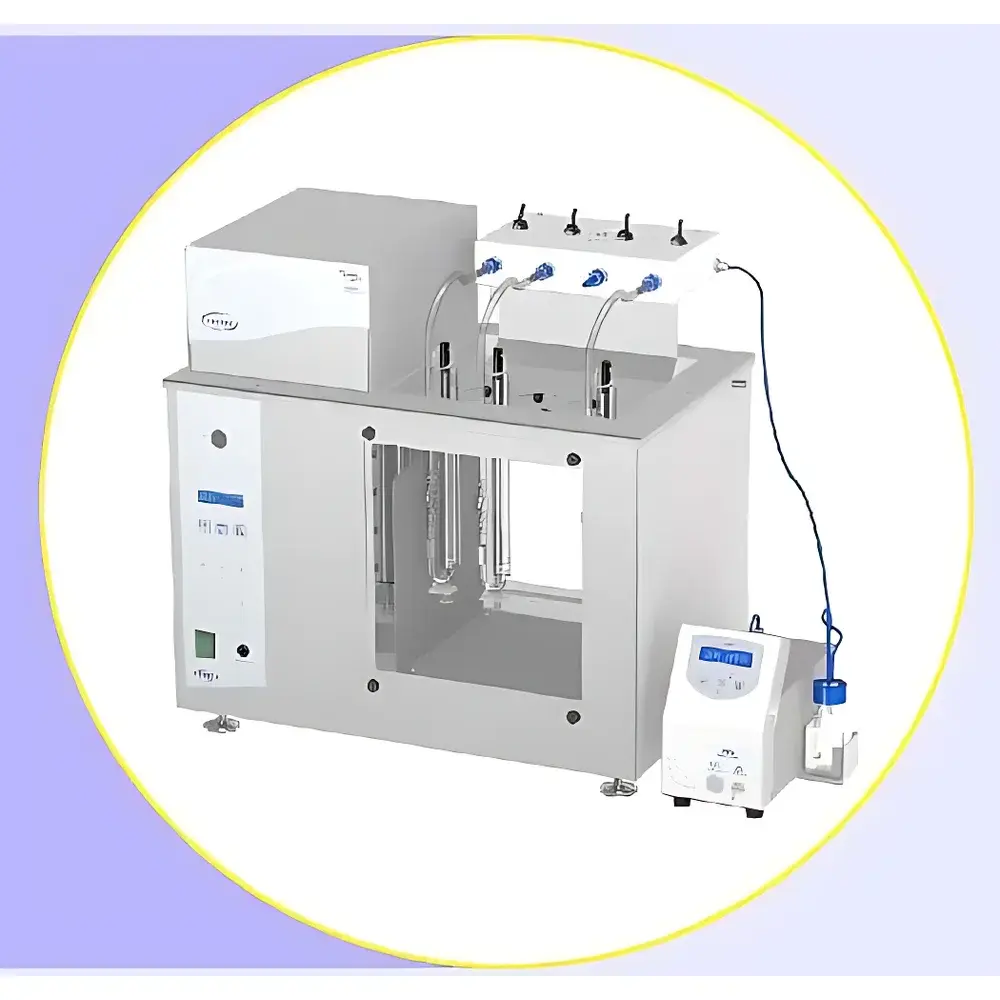
Tamson TV4000 Vacuum Capillary Viscometer for Bitumen Viscosity Testing
| Brand | TAMSON |
|---|---|
| Origin | Netherlands |
| Model | TV4000 |
| Instrument Type | Vacuum Capillary Viscometer |
| Viscosity Range | 0.0036–20,000 Pa·s |
| Temperature Range | Ambient to 230 °C |
| Temperature Stability | ±0.01 °C |
| Bath Volume | 40 L |
| Bath Opening Dimensions | 260 × 240 mm |
| Vacuum Pressure Range | 30–430 mbar (negative pressure) |
| Vacuum Accuracy | ±0.5 mbar |
| Compliant Standards | ASTM D2171, SH/T 0557, IP 222, EN 12596, AASHTO T 202 |
Overview
The Tamson TV4000 Vacuum Capillary Viscometer is a precision-engineered instrument designed specifically for the kinematic and dynamic viscosity determination of highly viscous bituminous materials under controlled vacuum and temperature conditions. It operates on the principle of capillary flow viscometry in accordance with Poiseuille’s law, where viscosity is derived from the measured efflux time of a fixed volume of sample through a calibrated capillary tube under defined hydrostatic head—here maintained by regulated vacuum (300 mmHg / 40 kPa). The system integrates a high-stability thermostatic bath (±0.01 °C), a digitally controlled vacuum manifold, and standardized Ubbelohde- or Cannon-Fenske-type capillaries conforming to ASTM D2171 Annex A1 and EN 12596 specifications. Its primary application domain includes quality control laboratories in asphalt production, road construction material certification, refinery QC/QA departments, and independent testing facilities performing compliance-driven bitumen characterization per global regulatory frameworks.
Key Features
- High-precision thermostatic bath with 40 L capacity and uniform temperature distribution across the full 260 × 240 mm opening—optimized for simultaneous multi-capillary operation and long-duration stability at 60 °C or elevated test temperatures up to 230 °C.
- Digital vacuum regulation system with real-time pressure monitoring and ±0.5 mbar accuracy over a 30–430 mbar (negative pressure) range, ensuring repeatable hydrostatic head conditions critical for low-shear-rate viscosity assessment.
- Modular capillary mounting platform compatible with standard ASTM/ISO-compliant viscometers—including calibrated glass capillaries traceable to NIST or UKAS-accredited reference standards.
- Robust stainless-steel and borosilicate glass construction, corrosion-resistant fluid pathways, and integrated safety interlocks for overtemperature and vacuum loss protection.
- Compliance-ready design supporting audit trails, calibration logging, and user-access control—facilitating alignment with GLP, ISO/IEC 17025, and internal SOP documentation requirements.
Sample Compatibility & Compliance
The TV4000 is validated for use with penetration-grade and polymer-modified bitumens, cutback asphalts, and heavy fuel oils exhibiting viscosities between 0.0036 Pa·s and >20,000 Pa·s. It meets the physical measurement criteria specified in ASTM D2171 (Standard Test Method for Viscosity of Asphalts by Vacuum Capillary Viscometer), SH/T 0557 (Chinese petroleum industry standard), IP 222 (Institute of Petroleum), EN 12596 (European Standard for Bitumen Testing), and AASHTO T 202 (American Association of State Highway and Transportation Officials). All thermal and vacuum subsystems are factory-calibrated against traceable reference standards, and calibration certificates include uncertainty budgets per ISO/IEC 17025:2017 Annex A. The instrument supports method-specific validation protocols required for accreditation under CNAS, UKAS, or DAkkS scopes.
Software & Data Management
While the TV4000 operates as a stand-alone analog/digital hybrid system, it is fully compatible with Tamson’s optional ViscoLink™ PC software suite (sold separately). ViscoLink™ enables automated timing capture via optical sensor integration, real-time vacuum and temperature logging, calculation of absolute viscosity using capillary constant and density inputs, and export of structured CSV or PDF reports compliant with 21 CFR Part 11 requirements—including electronic signatures, audit trail generation, and role-based user permissions. Data files retain full metadata (operator ID, calibration status, environmental parameters), supporting traceability in regulated environments such as those governed by FDA, EMA, or national transport authority QA systems.
Applications
- Routine viscosity grading of penetration and viscosity-grade (VG) bitumens per ASTM D3381 and EN 1426.
- Evaluation of temperature susceptibility and rheological consistency in polymer-modified binders (PMBs) during formulation development.
- Verification of storage stability and shear-thinning behavior in warm-mix asphalt (WMA) additives.
- Supporting pavement performance modeling (e.g., MEPDG) by generating input viscosity data at standardized test conditions (60 °C, 40 kPa).
- Third-party conformity assessment for CE marking, CE-DoP, or DOT specification compliance in infrastructure procurement contracts.
FAQ
What capillary types are supported with the TV4000?
The system accommodates standard Ubbelohde, Cannon-Fenske, and BS 2000-243 capillaries with certified calibration constants; users must select capillary geometry based on expected viscosity range per ASTM D2171 Table 1.
Is the vacuum system oil-free?
Yes—the TV4000 employs a diaphragm-type vacuum pump with PTFE-coated components, eliminating oil contamination risk and enabling clean operation with volatile or reactive samples.
Can the bath be used for non-bitumen applications?
Yes—while optimized for bitumen, the TV4000’s wide temperature range (ambient to 230 °C) and vacuum capability support viscosity testing of resins, adhesives, lubricants, and bio-oils per ASTM D445 or ISO 3104 when paired with appropriate capillaries.
How often does the system require recalibration?
Annual recalibration of temperature sensors and vacuum transducers is recommended; capillary calibration must be verified before each test series using certified reference oils per ISO 17025 procedures.
Does the instrument meet GLP requirements out-of-the-box?
The hardware architecture supports GLP workflows; full compliance requires implementation of documented SOPs, user training records, and integration with validated software (e.g., ViscoLink™) for electronic record integrity.



