
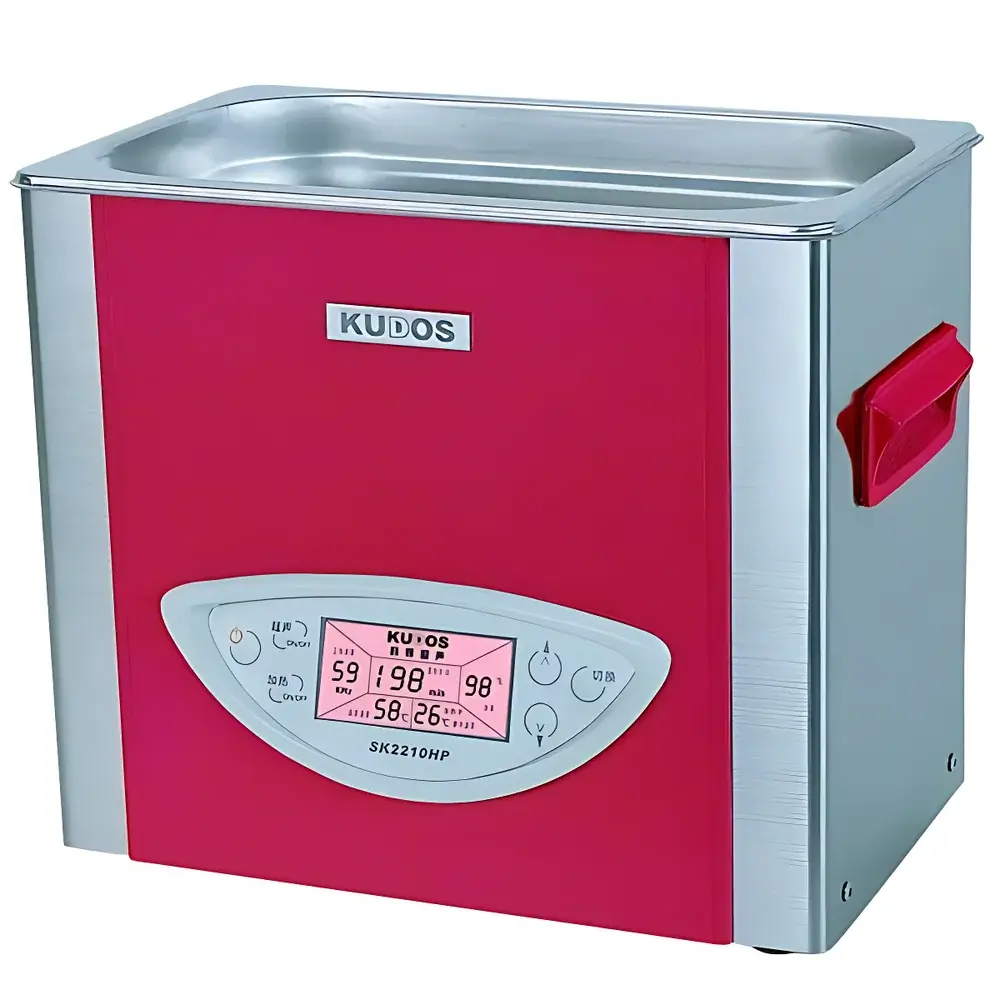
Shanghai Kedao SK2210HP Heated Ultrasonic Cleaner
| Brand | Shanghai Kedao |
|---|---|
| Origin | Shanghai, China |
| Model | SK2210HP |
| Capacity | 3 L |
| Ultrasonic Frequency | 53 kHz |
| Ultrasonic Power | 100 W |
| Power Adjustment Range | 40–100% (1% incremental steps) |
| Heating Temperature Range | 20–60 °C |
| Heating Power | 75 W |
| Timer Range | 1–199 min |
| Noise-Reduction Lid | Yes |
| Manual Drain Valve | Yes |
| Tank Material | 304 Stainless Steel |
| Dimensions (Tank) | 24 × 14 × 10 cm |
| Overall Dimensions | 27 × 16 × 24 cm |
| Power Supply | 220 V / 50 Hz |
| Display | Backlit LCD with real-time parameter monitoring |
| Dry-Run Protection | Yes |
| Power Loss Memory Function | Yes |
Overview
The Shanghai Kedao SK2210HP Heated Ultrasonic Cleaner is a compact, benchtop ultrasonic cleaning system engineered for precision and reliability in routine laboratory environments. It operates on the principle of cavitation—generating high-frequency acoustic energy (53 kHz) that induces microscopic bubble formation and collapse within the cleaning medium, delivering mechanical agitation to dislodge particulate contaminants from surfaces. Integrated resistive heating (75 W) enables temperature-controlled cleaning processes critical for enhancing solvent efficacy, accelerating dissolution of organic residues, and reducing surface tension. Designed for consistent performance across diverse sample geometries and material types, the SK2210HP supports reproducible cleaning protocols essential for quality control, sample preparation prior to analytical instrumentation (e.g., HPLC vials, SEM stubs, optical components), and pre-sterilization workflows.
Key Features
- Backlit LCD interface with intuitive menu navigation and real-time display of set temperature, actual bath temperature, ultrasonic power level, and remaining timer duration.
- Intelligent dry-run protection circuitry automatically halts heating upon detection of insufficient liquid volume, preventing thermal damage to the transducer and tank.
- Ultrasonic-assisted thermal uniformity: continuous acoustic agitation promotes rapid and homogeneous heat distribution throughout the 3 L stainless steel tank (304 grade), minimizing thermal gradients that may compromise cleaning consistency.
- Fine-resolution power control (40–100% in 1% increments) allows optimization of cavitation intensity for delicate substrates (e.g., microfluidic chips, coated optics) or robust removal of tenacious deposits (e.g., dried protein films, metal oxides).
- Programmable digital timer (1–199 minutes) with automatic shutdown ensures protocol adherence and eliminates operator dependency for endpoint determination.
- Integrated noise-reduction lid reduces ambient sound pressure levels during operation, supporting compliance with occupational health guidelines in shared laboratory spaces.
- Power-loss memory retains all user-defined parameters—including temperature setpoint, power level, and timer value—enabling seamless resumption after unexpected power interruption.
Sample Compatibility & Compliance
The SK2210HP accommodates a broad range of laboratory items including glassware (volumetric flasks, pipettes, cuvettes), metallic tools (tweezers, forceps, surgical instruments), ceramic substrates, and polymer-based components—provided they are chemically compatible with aqueous or mild solvent-based cleaning media. Its 304 stainless steel tank meets ASTM A240 standards for corrosion resistance in mildly aggressive environments. While not certified for medical device reprocessing under ISO 15883 or EN 285, the unit supports GLP-aligned documentation practices through its deterministic operational parameters and repeatable process windows. The absence of automated fill/drain functionality necessitates manual fluid handling, making it suitable for non-GMP research labs, academic teaching facilities, and QC environments where cleaning validation is performed per internal SOPs rather than regulatory submission requirements.
Software & Data Management
The SK2210HP operates as a standalone hardware platform without external software connectivity or data export capability. All operational parameters are configured and monitored via the embedded LCD interface. No USB, RS-232, or Ethernet ports are provided; therefore, electronic audit trails, remote monitoring, or integration with LIMS are not supported. For laboratories requiring 21 CFR Part 11 compliance, supplementary procedural controls—including logbook entries for each cleaning cycle (date, operator ID, load description, temperature, power %, duration)—must be implemented manually. Firmware updates are not field-upgradable; calibration verification relies on periodic physical checks using NIST-traceable thermometers and calibrated power meters.
Applications
- Pretreatment of analytical glassware to eliminate trace organic carryover prior to spectroscopic or chromatographic analysis.
- Cleaning of reusable labware in microbiology and cell culture facilities, particularly when combined with enzymatic or low-concentration alkaline detergents.
- Removal of polishing compounds and embedded debris from precision mechanical parts used in metrology and instrumentation maintenance.
- Surface decontamination of electron microscopy grids and TEM specimen holders prior to coating or imaging.
- Routine maintenance of reusable pipette tips, filtration housings, and microcentrifuge tubes in molecular biology workflows.
- Supporting ASTM D2621 and ISO 11475 standard test methods for evaluating cleaning agent performance under controlled thermal and acoustic conditions.
FAQ
Is the SK2210HP suitable for cleaning delicate optical lenses?
Yes—when operated at reduced power (40–60%) and moderate temperature (30–40 °C) with a non-abrasive, low-surface-tension cleaning solution, it effectively removes fingerprint oils and dust without damaging anti-reflective coatings.
Does the unit include a built-in drain pump?
No—the SK2210HP features only a manual drain valve; users must rely on gravity drainage or siphoning for fluid removal.
Can the heater operate independently of ultrasonic activation?
Yes—temperature control and ultrasonic generation are fully decoupled functions; either can be enabled or disabled independently via the front-panel interface.
What is the expected service life of the transducer assembly under normal usage?
With proper maintenance—including regular descaling, avoidance of dry operation, and use of deionized or softened water—the piezoelectric transducers typically maintain stable output for ≥5,000 operating hours.
Is the tank geometry optimized for uniform cavitation distribution?
The rectangular 24 × 14 × 10 cm tank incorporates bottom-mounted transducers arranged to minimize standing-wave node formation; however, optimal cleaning uniformity requires part rotation or repositioning during extended cycles (>30 min).



