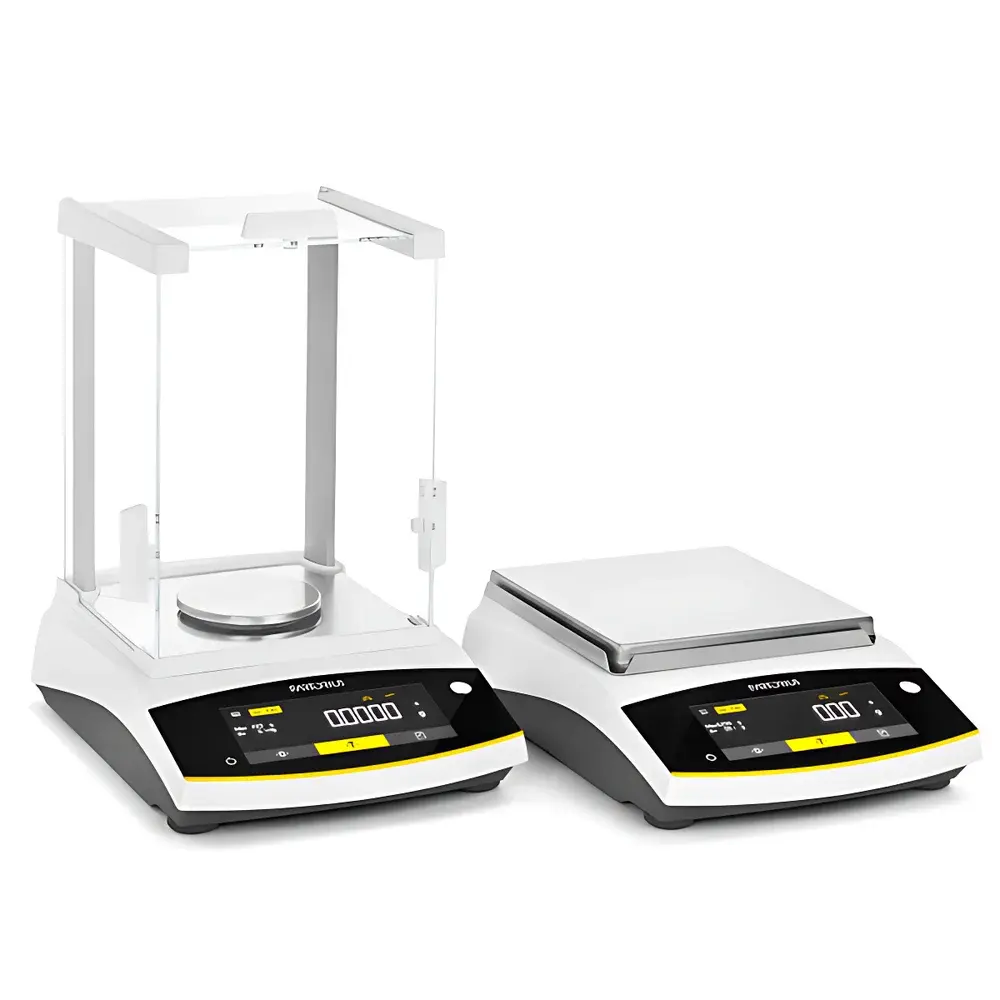
Sartorius BCE323i-1CCN Precision Balance
| Brand | Sartorius |
|---|---|
| Origin | Shanghai, China |
| Model | BCE323i-1CCN |
| Maximum Capacity | 320 g |
| Readability | 1 mg |
| Repeatability | ≤ ±1 mg |
| Calibration | Internal (isoCAL®) |
| Pan Dimensions | Rectangular |
| Connectivity | USB-C, RS-232 (9-pin) |
| Compliance | GLP/GMP-compliant data output |
| Applications | Weighing, Counting, Percentage, Density, Statistics, Animal Weighing, Checkweighing, Peak Hold, Unit Conversion, Below-balance weighing |
| Languages | 8 built-in (English, German, French, Italian, Spanish, Portuguese, Russian, Polish) |
| Enclosure | Fully removable draft shield with anti-static coated glass |
| Construction | PBT polymer housing, stainless steel pan, tempered glass components |
| Environmental Protection | Chemical-resistant, easy-clean design |
Overview
The Sartorius BCE323i-1CCN is a high-performance precision balance engineered for routine laboratory and quality control environments requiring reliable 1 mg readability across a 320 g maximum capacity. Built upon Sartorius’ legacy of German metrological excellence—refined over nearly 150 years—the BCE323i-1CCN integrates the isoCAL® fully automatic internal calibration and adjustment system, which triggers calibration based on time intervals and temperature drift to maintain traceable accuracy without manual intervention. Its core sensing architecture employs a monolithic electromagnetic force compensation transducer—a proprietary “SuperMonoBloc” sensor technology—designed to deliver exceptional long-term stability, minimal thermal drift, and rapid settling times (<2 seconds typical). The balance operates within ISO/IEC 17025-aligned environmental conditions (20 ±5 °C, <60% RH non-condensing), and its robust mechanical design ensures consistent performance under repeated daily use in regulated settings such as pharmaceutical QC labs, academic research facilities, and industrial R&D departments.
Key Features
- isoCAL® automatic internal calibration: Temperature- and time-triggered recalibration ensures continuous compliance with SOPs and regulatory expectations.
- Monolithic electromagnetic force compensation sensor: Delivers high reproducibility (≤ ±1 mg repeatability) and superior resistance to mechanical shock and environmental fluctuations.
- Large rectangular weighing pan (180 × 180 mm) with integrated overload protection: Accommodates voluminous containers and irregular samples while safeguarding sensor integrity.
- Fully removable draft shield with anti-static coated glass panels: Minimizes electrostatic interference during low-mass or powder weighing; side and top sliding doors facilitate easy access and cleaning.
- Intuitive dual-interface display: High-contrast LED backlight combined with responsive capacitive touchscreen enables glove-compatible operation and clear readability under varied lighting conditions.
- Dual connectivity architecture: Native USB-C port for plug-and-play data transfer to PCs or printers; backward-compatible 9-pin RS-232 interface supports legacy LIMS and ERP integrations.
- Chemical-resistant construction: Housing composed of durable polybutylene terephthalate (PBT), stainless steel pan, and tempered glass components—designed for frequent decontamination and resistance to common solvents and reagents.
Sample Compatibility & Compliance
The BCE323i-1CCN supports diverse sample types—including powders, granules, liquids in open vessels, and small solid objects—thanks to its spacious weighing chamber (W × D × H: 220 × 210 × 240 mm) and optional below-pan hook for density determination or suspended weighing. It complies with international standards relevant to analytical balance validation, including ASTM E898–22 (Standard Guide for Selection and Use of Laboratory Balances), ISO 9001:2015 (clause 7.1.5), and USP “Weights and Balances.” Data output adheres to GLP and GMP requirements: all printed or exported records include timestamp, operator ID (with password-protected access), balance ID, calibration status, ambient temperature/humidity (when connected to optional external sensors), and audit trail metadata—fully compatible with 21 CFR Part 11–compliant software platforms when used with Sartorius LabX™ or third-party validated systems.
Software & Data Management
The BCE323i-1CCN features embedded firmware supporting 12 preconfigured weighing applications—counting, percentage weighing, density determination (with auxiliary kit), statistics (mean, SD, CV), animal weighing (dynamic averaging), checkweighing with configurable tolerance zones, peak hold, and unit conversion—each generating structured, export-ready datasets. All results can be transmitted via USB-C to CSV files or directly to Windows-based applications using Sartorius’ free Data Transfer Software (DTS). For enterprise-scale deployment, the balance integrates seamlessly with LabX™ standalone or networked versions, enabling centralized method management, electronic signatures, automated report generation, and full audit trail logging—including user actions, calibration events, and error logs—required for FDA inspections and internal quality audits.
Applications
This balance serves critical roles across multiple workflows: formulation and batch release testing in pharmaceutical manufacturing (e.g., active ingredient dispensing per USP ); raw material verification in food and chemical production; educational lab instruction in quantitative analysis courses; and environmental sample preparation where precise mass allocation is essential. Its density application supports solid and liquid density measurement per ISO 1183-1; counting mode enables rapid inventory reconciliation of tablets or microcomponents; and the checkweighing function enforces packaging line compliance with target weight specifications (e.g., EU Directive 2004/22/EC for prepackaged goods). The below-pan hook further extends utility to buoyancy-corrected measurements and custom fixture mounting.
FAQ
What does “1 mg readability” mean in practice?
It indicates the smallest mass increment the balance can resolve and display—equivalent to 0.001 g—and is verified under standard test conditions per OIML R 76-1 and ISO/IEC 17025 calibration protocols.
Is isoCAL® compliant with regulatory requirements for automated calibration?
Yes: isoCAL® meets the functional expectations of Annex 11 (EU GMP), FDA Guidance for Industry on Process Validation, and ISO/IEC 17025 clause 6.4.10 for instrument monitoring and adjustment.
Can the BCE323i-1CCN be integrated into a validated LIMS environment?
Yes—via RS-232 or USB-C with appropriate driver configuration and documented IQ/OQ protocols; Sartorius provides validation support packages and URS templates for LabX™ integration.
Does the balance support multi-language operation without firmware updates?
Yes: eight languages are embedded at factory level; language selection is accessible via touchscreen menu without external tools or service intervention.
How is data security enforced on the device?
Through hierarchical password protection (administrator/operator levels), encrypted internal memory, and configurable auto-lock timeout—ensuring only authorized users modify settings or delete calibration records.