
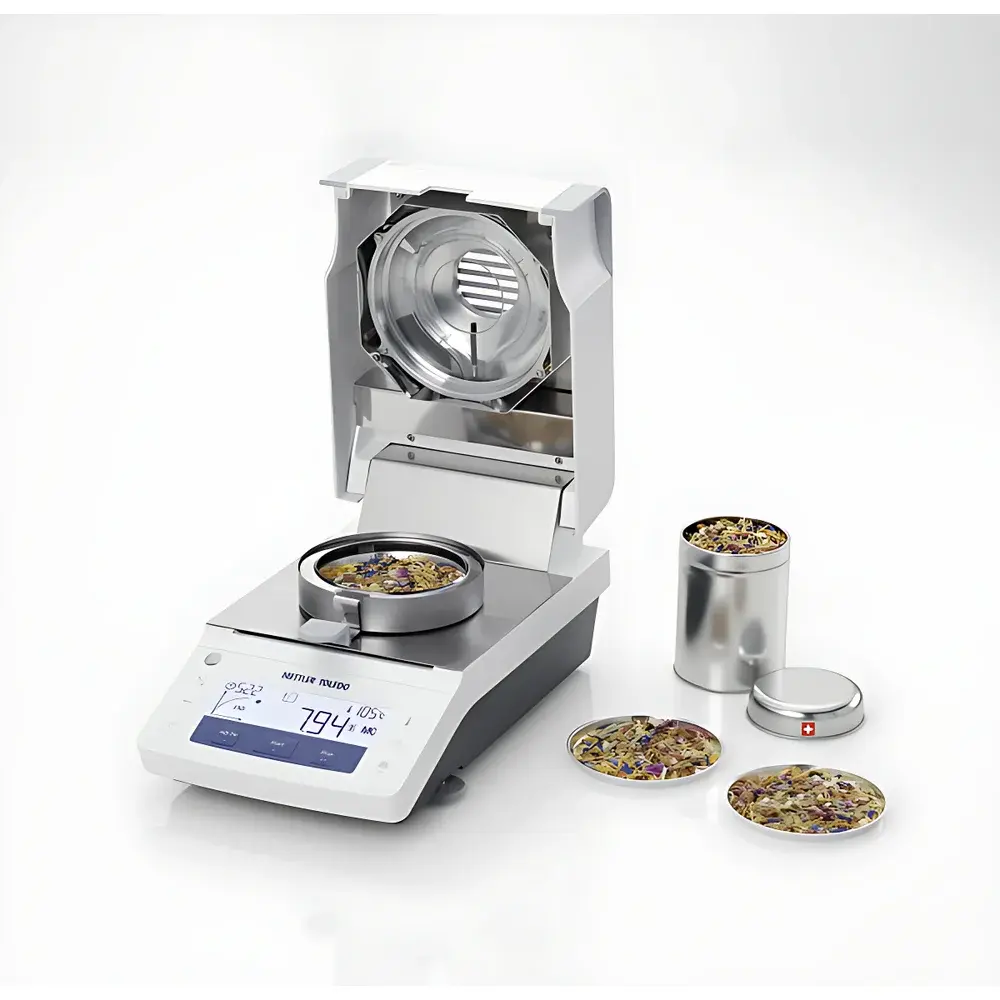
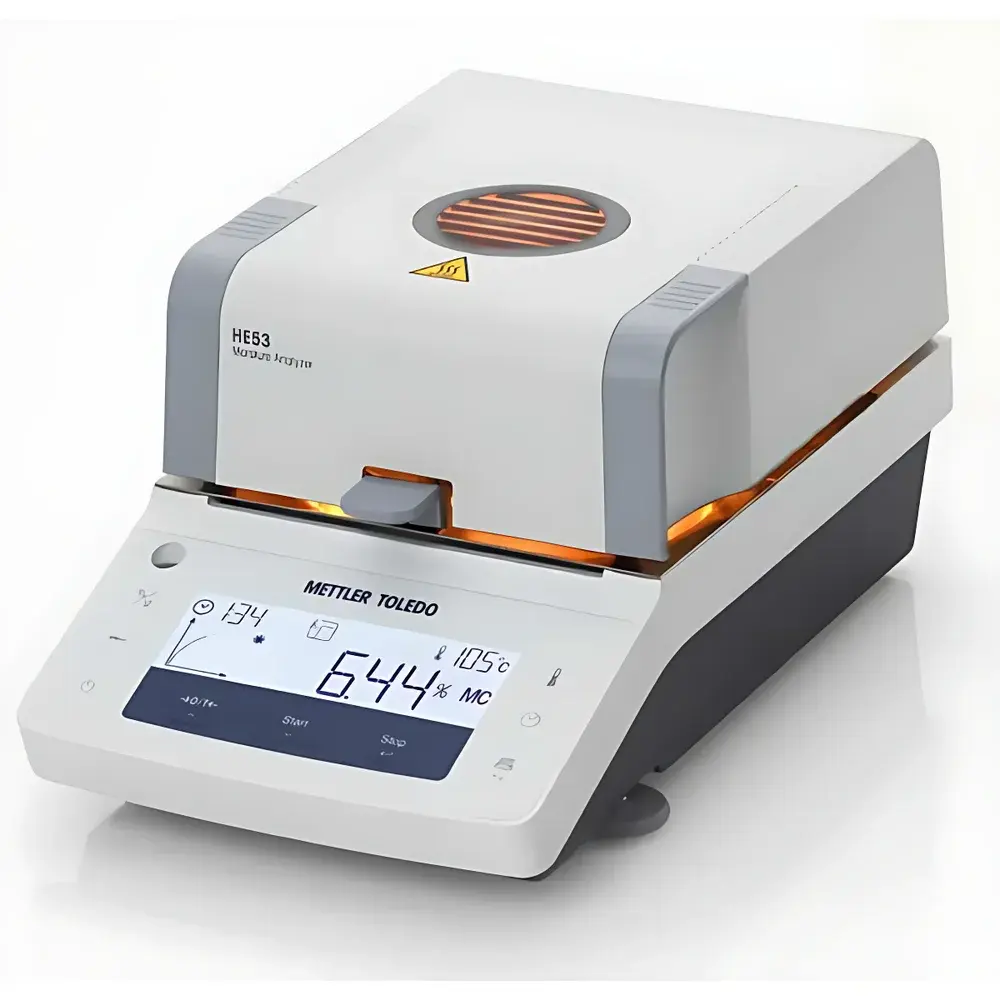
METTLER TOLEDO HE83 Halogen Moisture Analyzer
| Brand | METTLER TOLEDO |
|---|---|
| Origin | Shanghai, China |
| Model | HE83 |
| Heating Source | Halogen Lamp |
| Weighing Range | 81 g |
| Readability | 1 mg |
| Temperature Range | 50–200 °C (adjustable in 1 °C increments) |
| Moisture Determination Accuracy | ±0.01% |
| Heating Uniformity | Enhanced via Gold-Coated Radiator |
| Calibration | Integrated Balance & Heater Calibration Routines |
| Method Development | Automated Three-Step Method Optimization |
| Security | Three-Tier Password Protection |
Overview
The METTLER TOLEDO HE83 Halogen Moisture Analyzer is a precision benchtop instrument engineered for rapid, reliable, and traceable moisture content determination in solid and semi-solid samples across pharmaceutical, food, chemical, and materials science laboratories. It operates on the principle of thermogravimetric analysis (TGA): a sample is heated under controlled conditions using a high-intensity halogen lamp, and mass loss due to volatilization—primarily water—is continuously monitored by an integrated analytical balance. The resulting percentage moisture is calculated in real time based on the initial and final dry mass. Unlike conventional oven-drying methods, the HE83 delivers results in minutes rather than hours, with superior repeatability and reduced operator dependency. Its design complies with core regulatory expectations for quantitative moisture testing, including alignment with USP <921>, ASTM E1447, and ISO 15512, supporting data integrity in GLP and GMP environments.
Key Features
- Halogen heating system: A 400 W ring-shaped halogen lamp provides rapid, symmetric thermal energy transfer—reducing drying time without thermal degradation of heat-sensitive matrices.
- Gold-coated radiator: Reflects infrared radiation uniformly across the sample pan surface, minimizing edge effects and ensuring consistent heating profiles across diverse sample geometries and densities.
- Integrated analytical balance: High-resolution 1 mg readability sensor with automatic internal calibration and drift compensation ensures gravimetric accuracy throughout the entire drying cycle.
- Embedded calibration and verification routines: Onboard procedures validate both weighing performance (using certified test weights) and heater output (via reference temperature sensors), fulfilling routine instrument qualification requirements per ISO/IEC 17025.
- Automated method development: The three-stage optimization protocol (drying temperature screening, ramp profiling, and endpoint validation) generates robust, sample-specific drying protocols—reducing method development time by up to 70% compared to manual approaches.
- Three-level access control: Distinct user roles (Operator, Supervisor, Administrator) restrict modification of critical parameters—including temperature setpoints, drying time limits, and calibration settings—supporting compliance with FDA 21 CFR Part 11 when paired with METTLER TOLEDO LabX software.
Sample Compatibility & Compliance
The HE83 accommodates standard 90 mm aluminum or stainless-steel sample pans and supports heterogeneous, granular, powdered, and paste-like specimens up to 81 g total mass. Its temperature range (50–200 °C in 1 °C increments) enables tailored drying profiles for hygroscopic polymers, herbal extracts, dairy powders, and active pharmaceutical ingredients (APIs). All measurement outputs include full audit trails when connected to LabX, recording operator ID, timestamp, method version, raw mass vs. time data, and calibration history. The instrument meets electromagnetic compatibility (EMC) requirements per IEC 61326-1 and safety standards per IEC 61010-1, and its firmware architecture supports periodic requalification per pharmaceutical quality systems (ICH Q5A, Annex 15).
Software & Data Management
While the HE83 operates autonomously via its intuitive touchscreen interface, full data governance is achieved through integration with METTLER TOLEDO LabX™ software. LabX provides centralized method storage, electronic signatures, automated report generation (PDF/CSV), and secure database archiving with configurable retention policies. All raw data—including intermediate mass readings at 1-second intervals—are preserved without compression or summarization, enabling retrospective analysis and root-cause investigation. Audit trail functionality satisfies ALCOA+ principles (Attributable, Legible, Contemporaneous, Original, Accurate) and facilitates inspection readiness for regulatory audits by FDA, EMA, or PMDA.
Applications
- Quantitative moisture assessment of excipients and finished dosage forms in pharmaceutical manufacturing (e.g., tablets, capsules, lyophilized powders).
- Batch release testing of food-grade starches, flour, coffee beans, and pet food pellets per AOAC Official Methods.
- Quality control of industrial catalysts, battery electrode slurries, and ceramic precursors where residual solvent or hydration water affects performance.
- Research-scale dehydration kinetics studies requiring high temporal resolution of mass loss profiles.
- Verification of desiccant efficacy and packaging seal integrity in stability chambers.
FAQ
What is the maximum sample weight the HE83 can handle?
The HE83 has a weighing capacity of 81 g, optimized for typical moisture analysis sample sizes ranging from 0.5 g to 15 g depending on expected moisture content and required precision.
Does the HE83 support GLP-compliant reporting?
Yes—when used with LabX software, it generates fully compliant reports with electronic signatures, full audit trails, and metadata required for GLP audits.
Can the instrument be calibrated internally without external weights?
It performs automatic internal calibration of the balance sensor; however, external verification using traceable test weights is required for formal calibration documentation per ISO/IEC 17025.
Is the halogen lamp replaceable by the user?
Yes—the lamp is a field-replaceable module with standardized mounting and electrical interface; replacement requires no tools and takes under two minutes.
How does the HE83 ensure temperature uniformity across the sample pan?
Through a combination of the annular halogen geometry and the gold-coated reflector, which directs >92% of emitted IR radiation downward with angular dispersion <±5°, verified per manufacturer’s thermal mapping protocol.





