
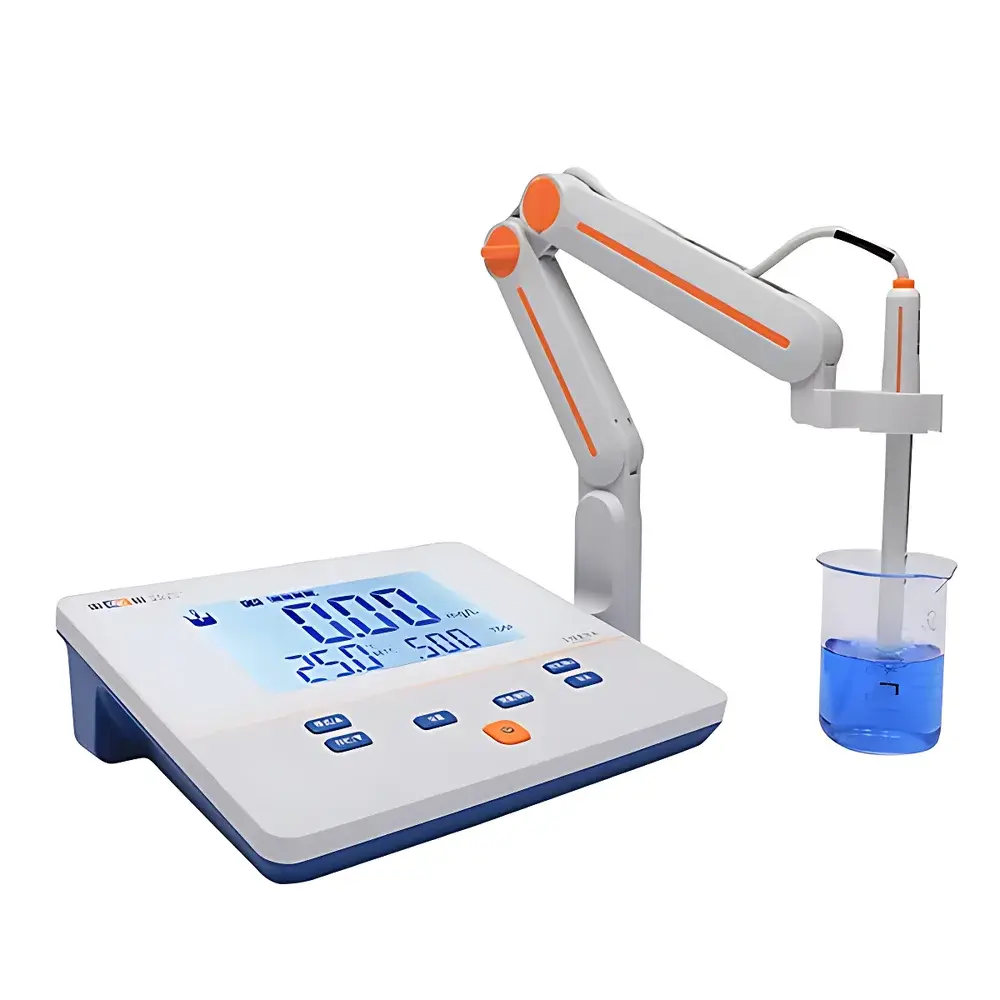
Leici DDS-307A Benchtop Conductivity Meter
| Brand | Leici |
|---|---|
| Origin | Shanghai, China |
| Model | DDS-307A |
| Instrument Type | Benchtop Single-Parameter Conductivity Meter |
| Conductivity Range | 0.00 μS/cm to 100 mS/cm |
| TDS Range | 0–1000 mg/L |
| Resistivity Range | 0.00 Ω·cm to 100 MΩ·cm (derived from conductivity) |
| Salinity Range | 0–1000 mg/L NaCl equivalent |
| Temperature Range | 0–60 °C |
| Accuracy | ±1% FS (conductivity & TDS), ±0.3 °C (temperature) |
| Minimum Resolution | 0.01 μS/cm |
| Temperature Compensation | Manual or Automatic (0–40 °C) |
| Electrode Compatibility | DJS-1C platinized platinum conductivity cell (K = 1.0 cm⁻¹), T-818-B-6 thermistor probe |
| Cell Constant Options | 0.01 cm⁻¹ titanium alloy electrode for ultrapure water measurement |
| Display | LCD segment-type, large-character format |
Overview
The Leici DDS-307A is a benchtop conductivity meter engineered for precision and reliability in routine laboratory water quality analysis. It operates on the principle of two-electrode AC conductometry, applying a low-frequency alternating current across a defined electrode geometry to measure solution conductance—directly proportional to ionic concentration. The instrument calculates conductivity (σ), total dissolved solids (TDS), resistivity, and salinity using standardized conversion algorithms compliant with ISO 7888 and ASTM D1125. Designed for stable operation in controlled laboratory environments, the DDS-307A supports both general-purpose aqueous analysis and high-purity water applications—including pharmaceutical purified water (PW), clean steam condensate, and semiconductor rinse water—when equipped with the optional 0.01 cm⁻¹ titanium alloy sensor. Its fixed-frequency excitation minimizes polarization effects and ensures reproducible measurements across dilute and moderately concentrated electrolyte solutions.
Key Features
- Benchtop form factor with robust ABS housing and integrated electrode stand for stable positioning during calibration and measurement
- Large-segment LCD display with high-contrast characters optimized for readability under standard lab lighting conditions
- Dual temperature compensation modes: manual entry or automatic real-time correction via integrated T-818-B-6 NTC thermistor (±0.3 °C accuracy)
- Interchangeable electrode support: compatible with standard DJS-1C platinized platinum cells (cell constant K = 1.0 cm⁻¹) and specialized low-conductivity sensors (K = 0.01 cm⁻¹) for ultrapure water testing
- Fixed 1 kHz excitation frequency to suppress electrode polarization and enhance measurement stability in low-conductivity samples
- No internal data storage or USB interface—designed for direct operator readout and external logging via analog output or manual transcription
Sample Compatibility & Compliance
The DDS-307A is validated for use with aqueous samples exhibiting conductivity values between 0.00 μS/cm and 100 mS/cm, covering distilled water, deionized water, boiler feedwater, wastewater effluents, and process brines. Its 0.01 cm⁻¹ titanium electrode enables trace-level conductivity monitoring down to sub-μS/cm levels without significant capacitive interference. The instrument conforms to basic electrical safety requirements per GB/T 28290 (Chinese national standard for electrochemical analyzers) and meets functional equivalence to IEC 61010-1 for laboratory electrical equipment. While not certified to FDA 21 CFR Part 11 or ISO/IEC 17025 out-of-the-box, its measurement traceability supports GLP-compliant documentation when used with calibrated reference standards (e.g., KCl solutions traceable to NIST SRM 3600 series) and maintained logbooks.
Software & Data Management
The DDS-307A operates as a standalone hardware meter without embedded firmware-based data logging, cloud connectivity, or PC synchronization capabilities. All measurements are displayed in real time and must be recorded manually or interfaced externally via optional analog voltage output (0–1 V corresponding to full-scale conductivity range). No proprietary software is supplied; users requiring digital archiving may integrate the unit into existing LIMS or SCADA systems using third-party analog-to-digital converters. Calibration history, electrode verification checks, and daily performance verification records must be maintained per internal QA protocols—particularly in regulated environments where audit trails for conductivity testing of purified water systems (e.g., USP ) are required.
Applications
- Pharmaceutical water system validation: conductivity verification of Purified Water (PW) and Water for Injection (WFI) per USP Stage 1 and Stage 2 limits
- Power generation: monitoring condensate purity and demineralizer effluent in thermal and nuclear facilities
- Environmental labs: field-prepared sample screening prior to ion chromatography or ICP-MS analysis
- Academic teaching laboratories: foundational electrochemistry experiments demonstrating Kohlrausch’s law and ion mobility relationships
- Food & beverage QC: batch consistency checks for brewing water, dairy processing rinse solutions, and syrup dilution control
FAQ
Does the DDS-307A support automatic calibration recognition?
No. Calibration is fully manual: users must enter known standard values (e.g., 1413 μS/cm KCl) and confirm acceptance after immersion.
Can the instrument measure resistivity directly?
No. Resistivity is calculated in real time from measured conductivity (ρ = 1/σ) and displayed alongside conductivity and TDS—no separate sensor or mode is required.
Is the 0.01 cm⁻¹ titanium electrode included with the base unit?
No. The DDS-307A ships standard with the DJS-1C (K = 1.0 cm⁻¹) cell. The low-conductivity titanium electrode is an optional accessory for ultrapure water applications.
What is the warm-up time before first measurement?
Stabilization is achieved within 15 minutes of power-on under ambient lab conditions (20–25 °C); no extended preconditioning is specified in the technical documentation.
How often should the conductivity cell be cleaned and reconditioned?
Platinized electrodes require periodic cleaning with mild detergent or 0.1 M HNO₃ followed by thorough rinsing; frequency depends on sample matrix—typically every 10–20 measurements in fouling-prone waters.





