
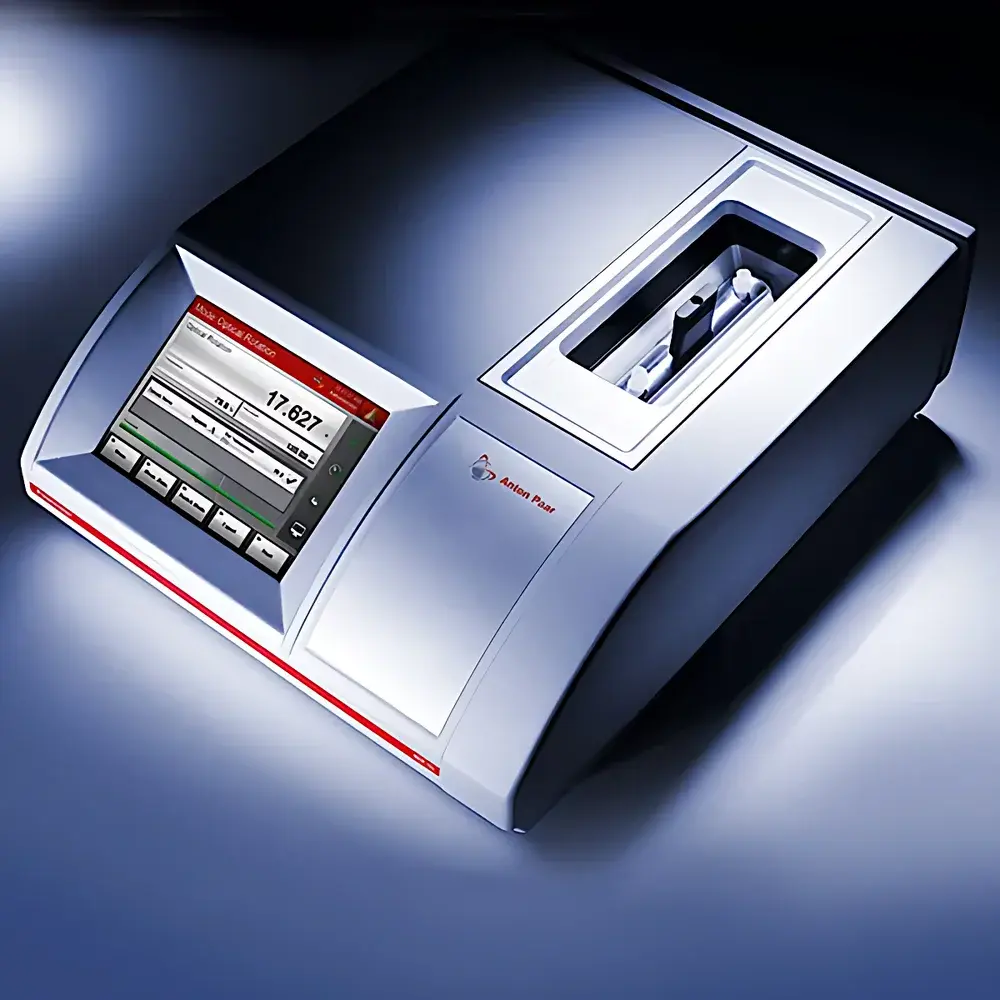
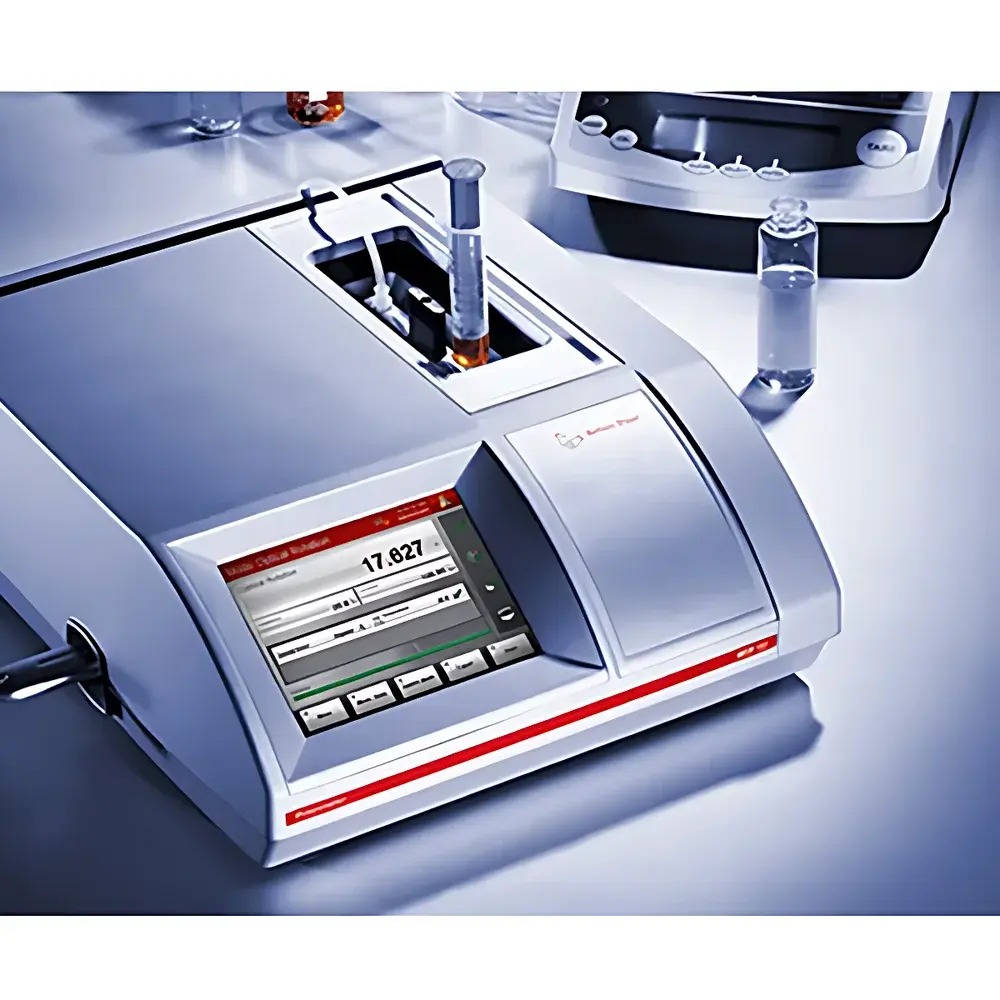
Anton Paar MCP 150 Automatic Polarimeter
| Brand | Anton Paar |
|---|---|
| Origin | Austria |
| Model | MCP 150 |
| Product Type | Automatic Polarimeter |
| Temperature Control | Peltier-based (15 °C to 35 °C) |
| Display | 5.7" TFT touchscreen (640 × 480 px) |
| Light Source | LED (589 nm, 100,000 h lifetime) |
| Measurement Range | ±89.9° |
| Resolution | 0.001° |
| Accuracy | ±0.004° |
| Repeatability | ±0.004° |
| Response Time | ≤12 s |
| Optical Density Compensation | up to OD 2.0 |
| Temperature Sensor | Integrated PT100 |
| Temp. Accuracy | ±0.1 °C |
| Temp. Resolution | 0.1 °C |
| Sample Cell Recognition | Toolmaster™ RFID auto-identification |
| Cell Length Compatibility | 2.5 mm to 100 mm |
| Interfaces | 3× USB-A, USB-B, RS232, Ethernet, CAN bus |
| Dimensions (L×W×H) | 370 × 320 × 130 mm |
| Weight | 8.6 kg |
| Power Supply | 100–240 VAC, 50/60 Hz, max. 120 VA |
Overview
The Anton Paar MCP 150 Automatic Polarimeter is a high-precision optical instrument engineered for the quantitative measurement of optical rotation in chiral substances—principally used to determine enantiomeric composition, concentration, and purity in transparent, optically active solutions. Based on the fundamental principle of plane-polarized light rotation upon transmission through asymmetric molecular structures, the MCP 150 employs a stable, long-life 589 nm LED light source aligned with a high-stability polarizing optics system. Its measurement architecture follows the classical double-beam null-balance method, ensuring minimal drift and high reproducibility across extended operation cycles. Designed as a compact, benchtop solution for regulated environments, the MCP 150 integrates Peltier-based temperature control (15–35 °C), real-time photometric compensation for optical density up to OD 2.0, and built-in PT100 temperature sensing with ±0.1 °C accuracy—enabling traceable, thermally stabilized measurements critical for pharmacopeial compliance.
Key Features
- Toolmaster™ RFID technology for automatic recognition and calibration validation of sample cells and quartz standards—eliminating manual entry errors and supporting full audit trail integrity
- Peltier-driven temperature regulation with precise setpoint control (0.1 °C resolution) and integrated thermal stabilization, compliant with USP & EP requirements for temperature-sensitive assays
- 5.7-inch high-contrast TFT touchscreen interface with intuitive icon-driven navigation, supporting multilingual UI and role-based access control
- Comprehensive measurement modes: optical rotation (°), specific rotation ([α]), concentration (% w/w or w/v), and user-defined calculation formulas with real-time result derivation
- Robust data security architecture: password-protected user groups, electronic signatures per ICH GCP and FDA 21 CFR Part 11, immutable audit logs, and tamper-evident PDF reporting
- Extensive connectivity suite—including USB-A (for peripherals), USB-B (service), RS232, Ethernet (for LIMS integration), and CAN bus—for seamless laboratory network deployment and remote diagnostics
Sample Compatibility & Compliance
The MCP 150 accommodates standard and custom-length sample cells ranging from 2.5 mm to 100 mm pathlength, enabling flexibility across low-volume R&D screening and high-throughput QC workflows. Its optical design supports samples with absorbance up to OD 2.0 via dynamic light-intensity compensation, minimizing baseline instability in colored or turbid matrices. The instrument conforms to international regulatory frameworks including ISO/IEC 17025, OIML R 130, and pharmacopeial monographs (USP , EP 2.2.7, JP 6.05). Full 21 CFR Part 11 compliance is achieved through role-based authentication, electronic signature enforcement, time-stamped audit trails, and encrypted data storage—ensuring suitability for GMP, GLP, and clinical trial environments.
Software & Data Management
Operation is managed via Anton Paar’s proprietary mPConnect™ software platform, which provides method development, instrument control, and raw data export in CSV, XML, and PDF formats. All measurement records include embedded metadata: timestamp, operator ID, cell ID, temperature, wavelength, and calibration history. The system supports automated report generation with configurable templates, digital signature workflows, and direct integration into enterprise LIMS or ELN systems via standardized API protocols. Data integrity safeguards include write-once storage options, checksum verification, and export logs that record all user-initiated actions—including edits, deletions, or reprocessing events.
Applications
The MCP 150 serves as a primary analytical tool in quality control laboratories across pharmaceuticals (e.g., assay of chiral APIs like levodopa or escitalopram), fine chemicals (e.g., monitoring asymmetric synthesis yield), food & beverage (e.g., sucrose content in syrups per ICUMSA methods), cosmetics (e.g., active ingredient quantification), and academic research (e.g., kinetic studies of enzymatic racemization). Its precision and regulatory readiness make it suitable for release testing, stability studies, reference standard verification, and compendial method validation per ICH Q2(R2) guidelines.
FAQ
Does the MCP 150 support multi-wavelength measurement?
No—the MCP 150 operates exclusively at the sodium D-line (589 nm), optimized for pharmacopeial and industrial standardization. For multi-wavelength polarimetry, consider the Anton Paar MCP 500 or MCP 600 series.
Can the instrument be validated according to GMP requirements?
Yes—Anton Paar provides IQ/OQ/PQ documentation packages, along with hardware and software validation support tools compatible with ASTM E2500 and Annex 11 frameworks.
What sample cell materials are supported?
Standard quartz and glass cells are fully recognized via Toolmaster™; custom cells must be pre-registered in the system database with defined pathlength and calibration coefficients.
Is remote monitoring or control possible?
Yes—via Ethernet connection and mPConnect™ Remote Access mode, authorized users can monitor status, initiate measurements, and retrieve reports without local physical presence.
How frequently does the system require recalibration?
Factory calibration is valid for 12 months under normal use; however, daily verification using certified quartz control plates is recommended prior to critical measurements per USP general chapter .




