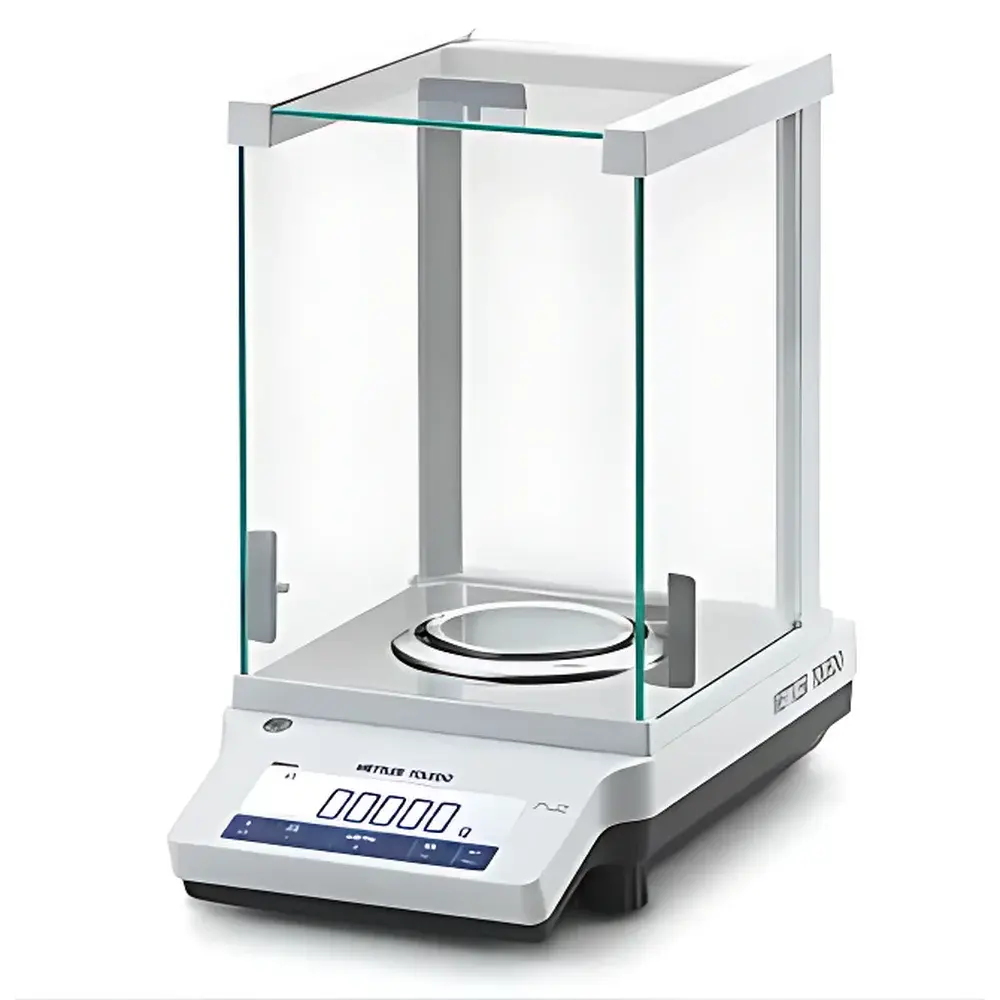
METTLER TOLEDO ME203 Precision Balance
| Brand | METTLER TOLEDO |
|---|---|
| Origin | Shanghai, China |
| Model | ME203 |
| Instrument Type | Precision Balance |
| Maximum Capacity | 220 g |
| Readability | 0.001 g |
| Repeatability | 0.001 g |
| Linearity | ±0.002 g |
| Internal Calibration | Yes |
| Pan Size | 120 mm (diameter) |
| Draft Shield Height | 170 mm |
| Dimensions (W×D×H) | 210 × 319 × 289 mm |
| Construction | Die-cast metal base with reinforced housing |
Overview
The METTLER TOLEDO ME203 Precision Balance is an entry-level analytical-grade instrument engineered for routine laboratory weighing tasks requiring consistent 1 mg readability and high operational reliability. Built upon METTLER TOLEDO’s proven electromagnetic force compensation (EMFC) transduction principle, the ME203 delivers stable, drift-resistant measurements under typical ambient lab conditions—without requiring external vibration isolation tables in most standard environments. Its design prioritizes robustness, ease of integration into GLP-compliant workflows, and long-term metrological stability. The balance operates within a defined environmental envelope (temperature range: 10–30 °C; relative humidity: ≤80 % RH, non-condensing), and its internal temperature compensation system minimizes thermal drift during warm-up and extended use.
Key Features
- Electromagnetic force compensation (EMFC) sensor architecture ensuring high linearity and low hysteresis across the full 220 g capacity range.
- One-touch internal calibration via integrated weight mechanism—no manual calibration weights required; traceable to national standards when performed in accordance with ISO/IEC 17025 procedures.
- Die-cast metal base and reinforced polymer housing provide mechanical rigidity and resistance to impact, dust, and incidental spills—suitable for shared lab environments and QC laboratories operating under moderate throughput demands.
- Bright, backlit LCD display with 18-mm high digits ensures legibility under varied lighting conditions—including glovebox or fume hood installations.
- Ergonomic front-panel layout with tactile keys and intuitive menu navigation reduces operator training time and minimizes input errors during repetitive tasks.
- Front-access leveling feet with visual bubble indicator simplify setup and verification of level orientation—a prerequisite for measurement integrity per ASTM E1153 and ISO 9001 requirements.
- IP42-rated enclosure offers protection against dripping water and solid particulates, supporting cleaning protocols compliant with pharmaceutical facility hygiene standards.
Sample Compatibility & Compliance
The ME203 accommodates samples up to 220 g on its 120 mm diameter stainless-steel pan, compatible with standard weighing boats, vials, crucibles, and filter papers. Its 170 mm effective draft shield height permits stable weighing of low-density or static-prone materials (e.g., powders, fibers, polymers) while minimizing air current interference. The balance meets essential regulatory expectations for routine quality control: it supports audit-ready documentation through optional RS232 or USB interface (with compatible software), enables user-defined password protection for calibration and configuration access, and maintains full traceability of calibration events—including date, time, operator ID, and deviation logs. While not pre-certified for FDA 21 CFR Part 11 compliance out-of-the-box, its firmware architecture supports electronic signature implementation and secure data export when deployed with validated third-party data management systems aligned with GxP environments.
Software & Data Management
Data output is supported via RS232 serial interface (standard) or optional USB connection, enabling seamless integration with LIMS, ELN, or custom Excel-based reporting tools. METTLER TOLEDO’s free MT-SICS software provides basic data logging, statistical analysis (mean, SD, CV%), and export to CSV or TXT formats. For regulated labs, the ME203 can be configured to generate timestamped, tamper-evident records—including calibration history, zero tracking, and overload events—supporting internal audit readiness and alignment with ISO/IEC 17025 clause 7.7 (Measurement Traceability) and USP Analytical Instrument Qualification guidelines.
Applications
- Raw material and intermediate batch release testing in pharmaceutical and chemical manufacturing.
- Formulation development and excipient dispensing in R&D laboratories.
- Environmental sample preparation (e.g., soil, sediment, filter weights) per EPA Method 1664 and ASTM D2974.
- Education and teaching labs where durability, safety, and pedagogical clarity are prioritized.
- Food and beverage QA/QC for portion control, ingredient dosing, and net content verification per NIST Handbook 133.
FAQ
What is the recommended calibration frequency for the ME203 in a regulated environment?
Calibration should be performed at startup, after relocation, following significant temperature shifts (>5 °C), and at defined intervals (e.g., daily or per shift) as established in your site’s SOP—aligned with ISO/IEC 17025 requirement 7.7.2.
Does the ME203 support external calibration weights?
No—the ME203 is designed exclusively for internal calibration; external weight calibration is neither supported nor required by its type approval.
Can the balance be connected to a networked LIMS system?
Yes—via RS232-to-Ethernet or USB-to-serial adapters, provided the host system accepts ASCII-based weigh data streams compliant with MT-SICS protocol.
Is the draft shield removable for cleaning?
Yes—the acrylic draft shield assembly detaches without tools and is compatible with 70% isopropyl alcohol wipes per manufacturer-recommended cleaning protocols.
What is the warm-up time required before first use?
Minimum 30 minutes at stable ambient temperature (20 ±2 °C) to achieve thermal equilibrium and optimal repeatability performance.