
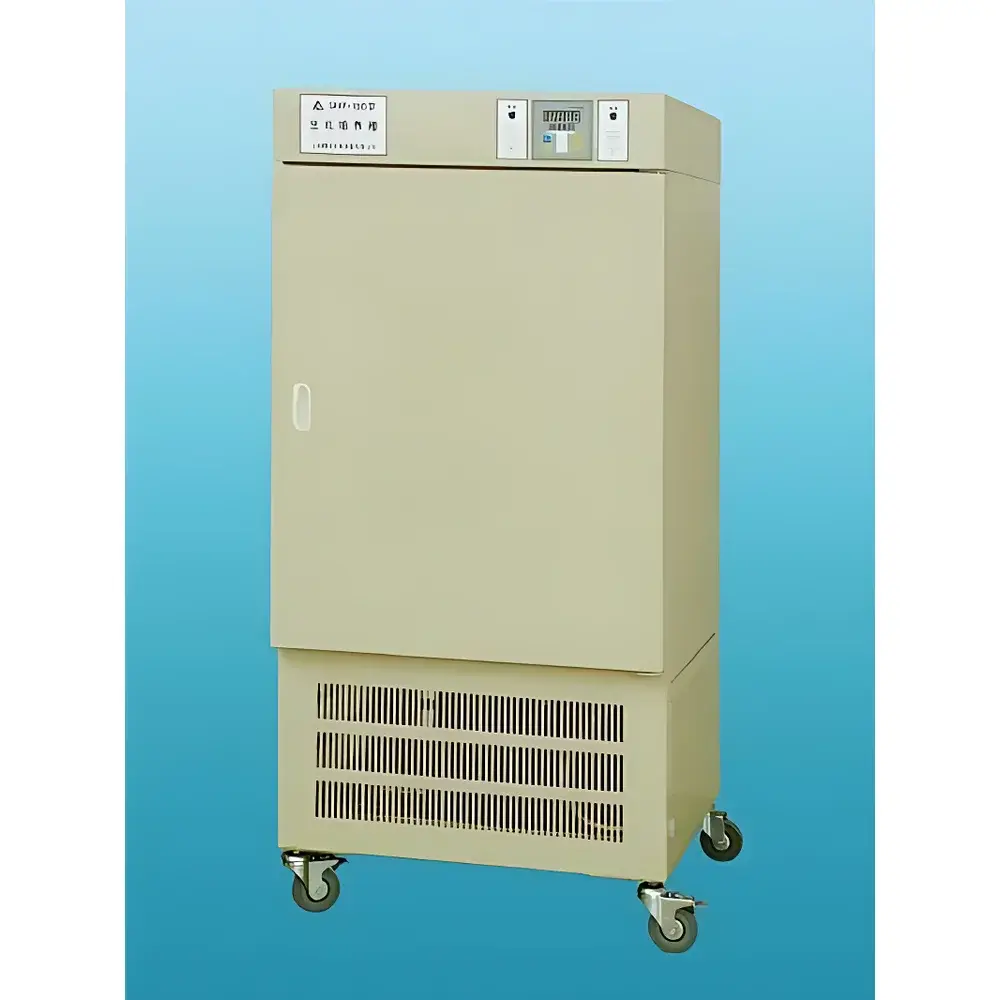
JingHong SHP-150 Biochemical Incubator
| Brand | JingHong |
|---|---|
| Origin | Shanghai, China |
| Model | SHP-150 |
| Temperature Range | 5–50 °C (operational), 5–60 °C (control range) |
| Interior Dimensions | 500 × 450 × 650 mm (W × D × H) |
| Chamber Material | Mirror-finish stainless steel |
| Door Configuration | Dual-door system with tempered glass inner door |
| Control System | Microprocessor-based PID controller with dual digital display (setpoint & actual), timer, power modulation, and auto-tuning |
| Cooling System | Modular refrigeration unit with delayed startup, high/low pressure protection |
Overview
The JingHong SHP-150 Biochemical Incubator is a precision-engineered, benchtop environmental chamber designed for stable, long-term temperature-controlled cultivation of biological samples in research, quality control, and production environments. It operates on a convection-based thermal regulation principle—utilizing forced-air circulation to ensure uniform temperature distribution across the entire working chamber—with typical spatial uniformity ≤ ±0.5 °C at 37 °C (per ISO 15270:2018 guidelines for incubator performance verification). The unit is calibrated for operation within a nominal control range of 5–60 °C, with a rated operational envelope of 5–50 °C under standard ambient conditions (23 ±2 °C, 40–60% RH), making it suitable for BOD incubation, microbial growth studies, fungal culture maintenance, seed germination assays, and short-term sample storage protocols compliant with APHA Standard Methods 20th Ed., USP , and ISO 8573-1 Annex C for microbiological testing environments.
Key Features
- Mirror-polished 304 stainless steel interior chamber with seamless, radius-rounded corners and semi-circular wall transitions—minimizing dust accumulation and enabling rapid, residue-free decontamination using ethanol, hydrogen peroxide vapor, or quaternary ammonium disinfectants.
- Dual-door architecture: outer insulated door with magnetic seal and inner full-surface tempered glass door—reducing thermal load during observation and maintaining chamber stability (typical temperature recovery time ≤ 8 min after 30-sec door opening at 37 °C).
- Microprocessor-controlled PID temperature regulation system featuring dual 4-digit LED display (setpoint and real-time chamber temperature), programmable 0–999-minute timer, adjustable heating/cooling power suppression, and self-tuning algorithm for adaptive response to load changes or ambient fluctuations.
- Modular vapor-compression refrigeration module integrated with compressor delay circuitry (≥ 3-min restart interval), high-pressure cut-off switch, low-pressure safety switch, and refrigerant leak detection interface—ensuring compliance with IEC 61000-6-2 EMC immunity standards and safe operation under variable line voltage (220 V ±10%, 50 Hz).
- Three-tier adjustable stainless steel shelving system (standard configuration: 2 shelves + base plate), with 30-mm vertical increment adjustment and load capacity ≥ 15 kg per shelf—supporting heterogeneous vessel arrangements including Petri dishes, Erlenmeyer flasks, multi-well plates, and tissue culture bottles.
Sample Compatibility & Compliance
The SHP-150 accommodates standard laboratory consumables up to 500 mm wide, 450 mm deep, and 650 mm tall—compatible with ISO/IEC 17025-accredited workflows requiring documented environmental traceability. Its thermal performance meets key criteria referenced in GLP Annex III (OECD Principles), FDA 21 CFR Part 11 (when paired with validated data logging software), and EN 60335-2-89 for safety of heating appliances. While not certified for Class II biosafety applications, it is routinely deployed in non-sterile BSL-1 and BSL-2 support areas for pre-incubation, post-assay holding, and strain preservation where containment is managed externally (e.g., laminar flow cabinets or isolators).
Software & Data Management
The embedded controller supports analog output (0–5 V DC or 4–20 mA) for integration into centralized building management systems (BMS) or SCADA networks. Optional RS-485 Modbus RTU interface enables connection to third-party data loggers (e.g., Omega OM-DAQPRO or Testo Saveris 2) for continuous temperature recording, alarm event timestamping, and PDF report generation. When configured with audit-trail-enabled firmware (v2.3+), the system records operator ID, parameter changes, door-open events, and calibration interventions—satisfying ALCOA+ data integrity principles required by EU Annex 11 and WHO TRS 996.
Applications
- Biochemical oxygen demand (BOD5) incubation per ASTM D5210 and ISO 5815-1
- Enumeration and isolation of coliforms, Escherichia coli, and Salmonella spp. per ISO 16649-2 and FDA BAM Chapter 4
- Fungal culture propagation and sporulation studies at 25–30 °C
- Seed viability testing and early-stage plant tissue culture under controlled photoperiod-agnostic conditions
- Stability assessment of diagnostic reagents and vaccine intermediates during accelerated aging trials
- QC hold-step incubation for pharmaceutical raw material bioburden testing (USP , Ph. Eur. 2.6.12)
FAQ
What is the minimum and maximum operating temperature?
The SHP-150 maintains stable operation between 5 °C and 50 °C; its control system is capable of setpoints from 5 °C to 60 °C, though sustained use above 50 °C may reduce compressor service life and is not recommended for routine applications.
Is the incubator suitable for CO₂ or humidity-controlled applications?
No—the SHP-150 is a dry-air, temperature-only incubator. It lacks gas mixing, humidification, or CO₂ sensing subsystems. For CO₂-dependent cell culture, consider dedicated CO₂ incubators with IR sensors and steam-jacketed chambers.
Can the unit be validated for GxP environments?
Yes—its mechanical design, repeatable thermal profile, and optional data logging interface support IQ/OQ/PQ execution per ASTM E2500 and Annex 15. Full validation packages require third-party qualification services and are not supplied by the manufacturer.
What safety certifications does the SHP-150 carry?
It complies with GB 4793.1–2019 (China’s safety standard for electrical equipment for measurement, control, and laboratory use), CE marking per 2014/35/EU (LVD) and 2014/30/EU (EMC), and RoHS 2011/65/EU. UL/CSA listing is not available.
How often should temperature mapping be performed?
Per ISO/IEC 17025 and FDA guidance, initial mapping must cover ≥ 9 locations (corners, center, mid-height); requalification is required after relocation, major maintenance, or every 12 months—whichever occurs first.





