
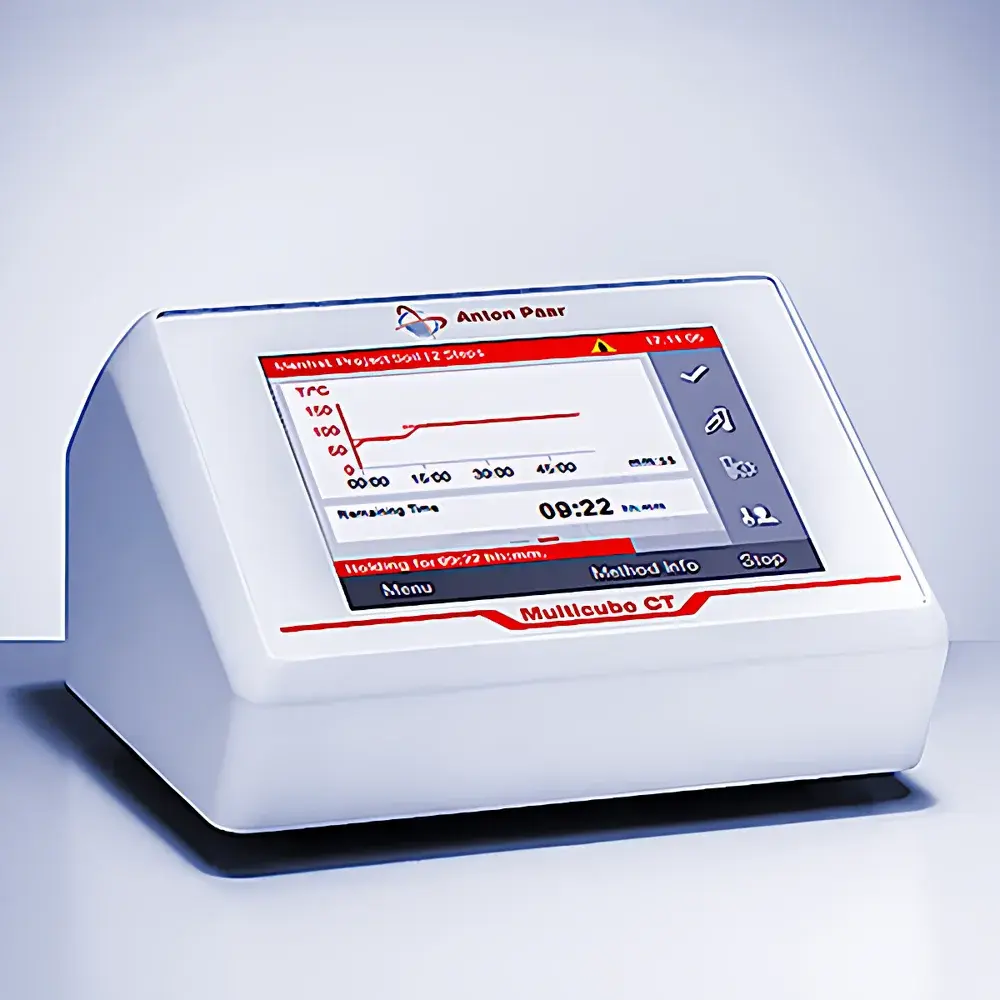
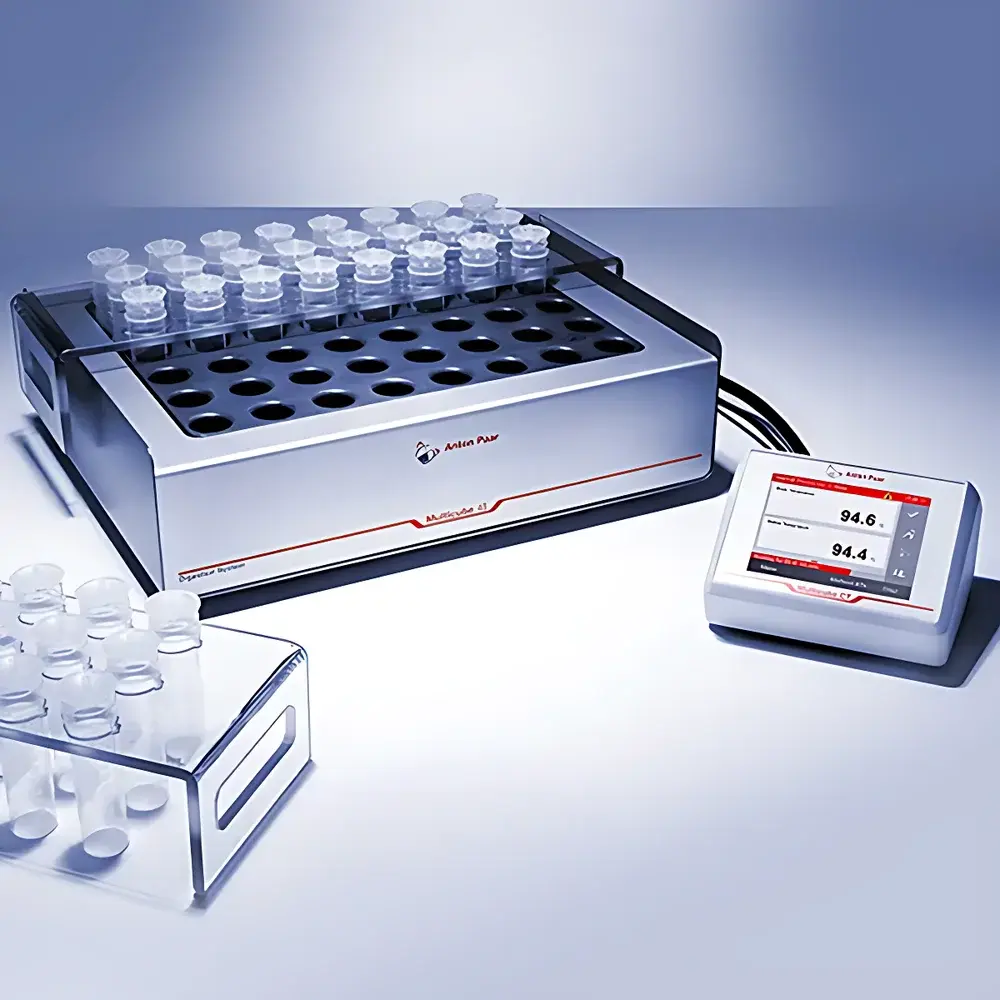
Anton Paar Multicube 48 Graphite Block Digestion System
| Brand | Anton Paar |
|---|---|
| Origin | Austria |
| Model | Multicube 48 |
| Digestion Capacity | 48 positions |
| Max. Temperature | 180 °C |
| Temperature Uniformity | ±1 °C |
| Heating Principle | PFA-coated graphite block heating |
| Power Rating | 800 W |
| Reagent Channels | 48 |
| Reaction Vessel Volume | 50 mL (A-class calibrated, dual刻度 at 25 mL and 50 mL) |
| Control Interface | 5.4″ capacitive touchscreen |
| Method Storage | up to 100 pre-programmed digestion protocols |
| Max. Continuous Operation | 450 days |
| Compliance | EPA Methods 3010a, 3020b, 3050b, 3060, 200.2, 200.7–200.9, 245.1, 365.1 |
| Software Features | 10-step programmable ramp/hold temperature profiles, 0.1 °C setpoint resolution, glove-compatible touch response, USB data export |
Overview
The Anton Paar Multicube 48 Graphite Block Digestion System is a high-precision, semi-automated electric heating platform engineered for reproducible open-vessel acid digestion, evaporation, and sample concentration in regulated analytical laboratories. It operates on the principle of uniform conductive heating via a PFA-coated, high-purity graphite block—eliminating hot spots and ensuring thermal stability across all 48 sample positions. Unlike conventional ceramic or aluminum heating blocks, the graphite architecture delivers exceptional thermal mass and low thermal inertia, enabling rapid heat-up (powered by an 800 W heating element) while maintaining ±1 °C spatial uniformity over the entire surface at temperatures up to 180 °C. This level of consistency is critical for trace metal analysis workflows where inter-sample variability directly impacts detection limits and method validation outcomes. The system is purpose-built for compatibility with flame atomic absorption spectroscopy (F-AAS), graphite furnace AAS (GF-AAS), inductively coupled plasma optical emission spectrometry (ICP-OES), and ICP-mass spectrometry (ICP-MS)—all of which require stringent control over blank levels, matrix removal efficiency, and volumetric accuracy post-digestion.
Key Features
- 48-position digestion capacity with independent, identical thermal exposure per vessel—optimized for batch processing of environmental, food, geological, petrochemical, and clinical samples.
- PFA-coated graphite heating block offering corrosion resistance against aggressive mineral acids (HNO₃, HCl, HF, H₂O₂, aqua regia) and long-term thermal stability without degradation or metal leaching.
- Capacitive 5.4″ color touchscreen interface with glove-compatible responsiveness, 0.1 °C temperature resolution, and support for up to 10-step programmable ramp-and-hold profiles.
- Integrated method library storing up to 100 validated protocols—including preloaded EPA, ISO, and Chinese HJ standard methods—as well as user-defined sequences.
- Maximum continuous runtime of 450 days, enabling unattended overnight and multi-day digestion cycles without manual intervention or cooldown interruptions.
- USB port for secure export of run logs, temperature traces, and method parameters—supporting audit-ready documentation for GLP/GMP environments.
Sample Compatibility & Compliance
The Multicube 48 is validated for use with certified high-purity polypropylene (PP) disposable digestion tubes (50 mL volume), each supplied with a Certificate of Analysis confirming ultra-low extractable metals (≤1 pg/mL for 69 elements). These tubes are calibrated to ISO/IEC 17025-accredited standards, featuring dual A-class volumetric markings at 25 mL and 50 mL—enabling direct gravimetric weighing, digestion, storage, dilution, and autosampler insertion without transfer. The system meets regulatory requirements for sample preparation under EPA Methods 3010a (acid digestion for metals), 3050b (sediment and soil), 3060a (chromium VI), 200.7 (ICP-OES), and 245.1 (mercury); as well as China’s HJ 702–2014 (solid waste) and HJ 803–2016 (soil). Its design supports full traceability and complies with data integrity principles aligned with FDA 21 CFR Part 11 when paired with Anton Paar’s optional software audit trail module.
Software & Data Management
Control firmware supports real-time temperature monitoring per zone, automatic logging of start/stop times, ramp rates, hold durations, and deviations from setpoints. All operational data—including timestamps, method IDs, and user logins—are timestamped and stored internally with tamper-resistant file structure. Exported USB logs retain metadata required for laboratory accreditation (e.g., ISO/IEC 17025 Clause 7.7). The system does not require external PCs for operation but interfaces seamlessly with LIMS via CSV or ASCII output formats. Firmware updates are delivered via encrypted USB stick, maintaining cybersecurity compliance without network connectivity.
Applications
- Regulatory environmental testing: heavy metals in soils, sediments, sludges, and wastewater solids per EPA 3050b and HJ 702.
- Food safety labs: lead, cadmium, arsenic, and mercury quantification in plant-based matrices prior to ICP-MS analysis.
- Geochemical exploration: multi-element digestion of rock powders and ore concentrates using mixed-acid protocols.
- Pharmaceutical QC: residual catalyst metal screening in active pharmaceutical ingredients (APIs) following USP /.
- Academic research: standardized sample prep for speciation studies requiring low-blank, high-recovery digestion without microwave-induced pressure risks.
FAQ
Does the Multicube 48 support HF digestion?
Yes—its PFA-coated graphite block and certified PP reaction tubes are chemically resistant to hydrofluoric acid up to 180 °C, making it suitable for silicate dissolution per EPA 3050b and ISO 11466.
Can the system be integrated into an automated ICP workflow?
Absolutely—the 50 mL tubes are designed for direct insertion into standard autosamplers (e.g., CETAC ASX-560, PerkinElmer AS93+, Agilent SPS4), eliminating intermediate transfer steps and contamination risk.
Is temperature calibration traceable to national standards?
Yes—each unit ships with a factory calibration certificate traceable to PTB (Physikalisch-Technische Bundesanstalt), and users may perform on-site verification using NIST-traceable RTD probes.
What maintenance is required for long-term reliability?
No routine maintenance beyond periodic visual inspection of the graphite block surface and cleaning of the cooling fan intake; the solid-state heating architecture has no moving parts or consumable heaters.
How is data integrity ensured during extended unattended runs?
All temperature events, method executions, and user actions are logged with cryptographic timestamps; logs cannot be edited or deleted without generating an irreversible audit flag.



