
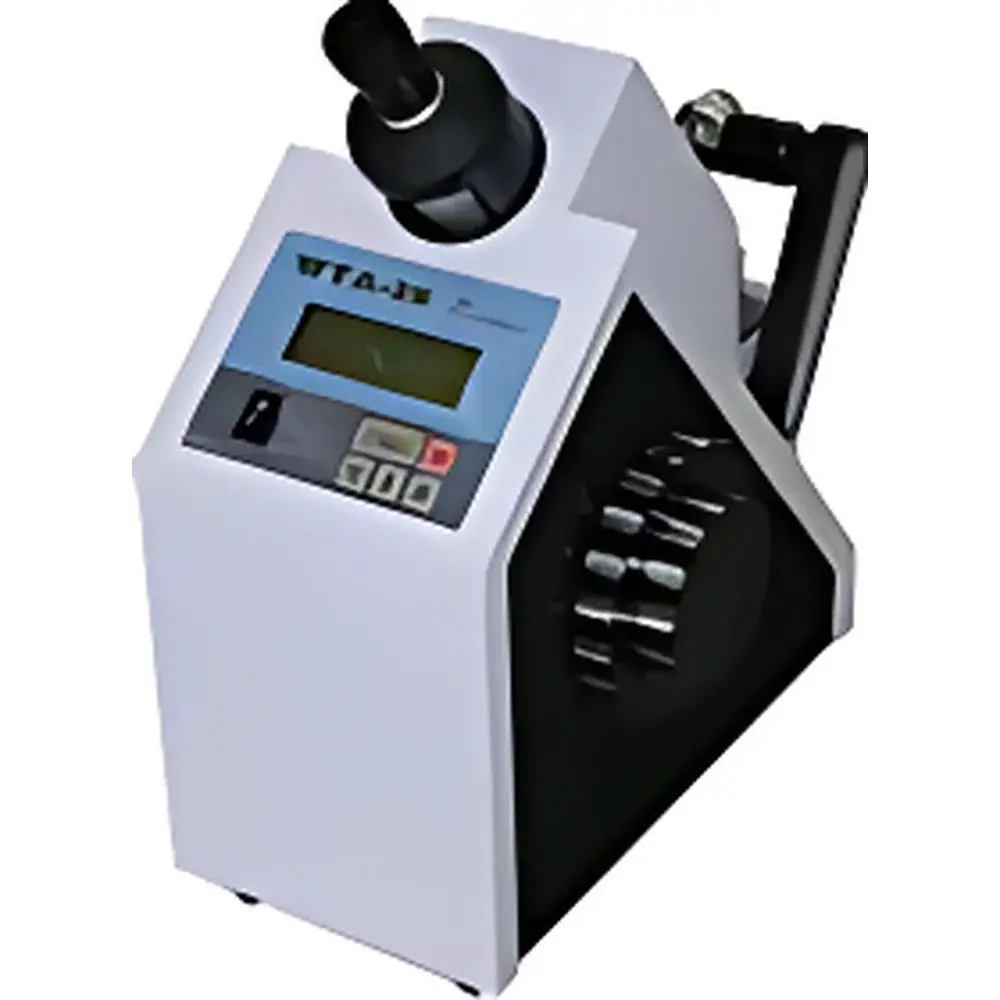
YDWE WYA-2S Abbe Refractometer
| Brand | YDWE (Yidian Wuguang) |
|---|---|
| Origin | Shanghai, China |
| Model | WYA-2S |
| Type | Benchtop Abbe Refractometer |
| Temperature Control | Yes |
| Digital Display | Yes |
| Refractive Index Range (nD) | 1.30000–1.70000 |
| Brix Range | 0–95% |
| Accuracy (nD) | ±0.0002 |
| Accuracy (Brix) | ±0.1% |
| Temperature Display Range | 0–50 °C (0.1 °C resolution) |
| Mass | 10 kg |
| Dimensions | 330 mm × 180 mm × 380 mm |
| Interface | Standard RS-232 printing port |
Overview
The YDWE WYA-2S Abbe Refractometer is a precision benchtop optical instrument engineered for accurate determination of refractive index (nD) and soluble solids content (Brix) in transparent or translucent liquid and solid samples. Based on the classical Abbe principle—utilizing total internal reflection at the prism-sample interface—the instrument delivers high reproducibility in routine quality control and research applications across food science, pharmaceuticals, chemical manufacturing, and academic laboratories. Its dual-scale capability enables direct readout of both nD (at the sodium D-line, 589.3 nm) and Brix (% w/w sucrose equivalent), with built-in temperature compensation to ensure measurement integrity across ambient conditions from 0 °C to 50 °C.
Key Features
- Benchtop design with robust aluminum alloy housing and precision-ground optical prisms for long-term stability and minimal thermal drift
- Dual digital display showing real-time refractive index (nD) and Brix values simultaneously
- Integrated Peltier-assisted temperature control system with 0.1 °C resolution and programmable setpoint (0–50 °C), enabling standardized measurements per ISO 21542 and ASTM D1218
- Manual sample loading via hinged prism assembly with ergonomic clamping mechanism; compatible with aqueous, organic, and viscous solutions
- RS-232 serial interface supporting direct data export to LIMS or spreadsheet software; optional printer driver included for GLP-compliant hardcopy records
- Calibration traceable to NIST-certified reference standards (e.g., distilled water, certified sugar solutions); factory calibration certificate provided
Sample Compatibility & Compliance
The WYA-2S accommodates a broad spectrum of homogeneous liquid samples—including syrups, juices, solvents, glycols, and pharmaceutical excipients—as well as polished solid specimens (e.g., glass, polymers, crystals) when used with contact liquid (e.g., bromonaphthalene). It complies with core international standards governing refractometric analysis: ISO 21542 (optical materials), ISO 2173 (fruit juices), AOAC 932.12 (sugar content), and USP General Chapter 〈788〉 for clarity and particulate assessment where refractive index serves as a surrogate parameter. All firmware operations adhere to audit-trail requirements aligned with FDA 21 CFR Part 11 principles when paired with validated data acquisition software.
Software & Data Management
While the WYA-2S operates as a standalone instrument with local digital readout, its RS-232 port supports bidirectional communication with third-party laboratory software platforms. Users may configure automated data logging, statistical process control (SPC) charting, and batch-level metadata tagging (operator ID, sample ID, timestamp, temperature). The instrument’s firmware stores up to 100 measurement records internally and supports CSV-formatted export for integration into ELN systems. For regulated environments, validation documentation—including IQ/OQ protocols and uncertainty budgets—is available upon request to support GMP/GLP compliance audits.
Applications
- Quality assurance of fruit juice concentration and authenticity verification (e.g., detecting dilution or adulteration)
- Concentration monitoring in pharmaceutical syrup formulations and ophthalmic solutions
- Process control of ethylene glycol/propylene glycol antifreeze mixtures in automotive and HVAC industries
- Refractive index mapping of polymer films and optical coatings during R&D
- Educational use in undergraduate physics and analytical chemistry labs for teaching dispersion, Snell’s law, and optical density relationships
- Raw material verification of solvents (e.g., ethanol, acetone) against supplier specifications
FAQ
What wavelength is used for nD measurement?
The instrument employs a built-in sodium D-line filter (589.3 nm) to ensure strict adherence to the standard definition of nD.
Can the WYA-2S measure opaque or turbid samples?
No—it requires optically homogeneous, transparent, or semi-transparent samples; suspended particles or air bubbles will compromise accuracy.
Is temperature correction applied automatically during Brix measurement?
Yes—temperature-compensated Brix values are calculated in real time using the built-in algorithm per ICUMSA Methods Book (2021), referenced to 20 °C.
Does the unit include calibration standards?
A set of two certified reference liquids (distilled water and 30% w/w sucrose solution) is supplied with each instrument, along with calibration verification procedure documentation.
What maintenance is required for long-term optical performance?
Prism surfaces should be cleaned after each use with lens-grade tissue and anhydrous ethanol; periodic inspection of prism flatness and coating integrity is recommended every 12 months in high-throughput labs.




