
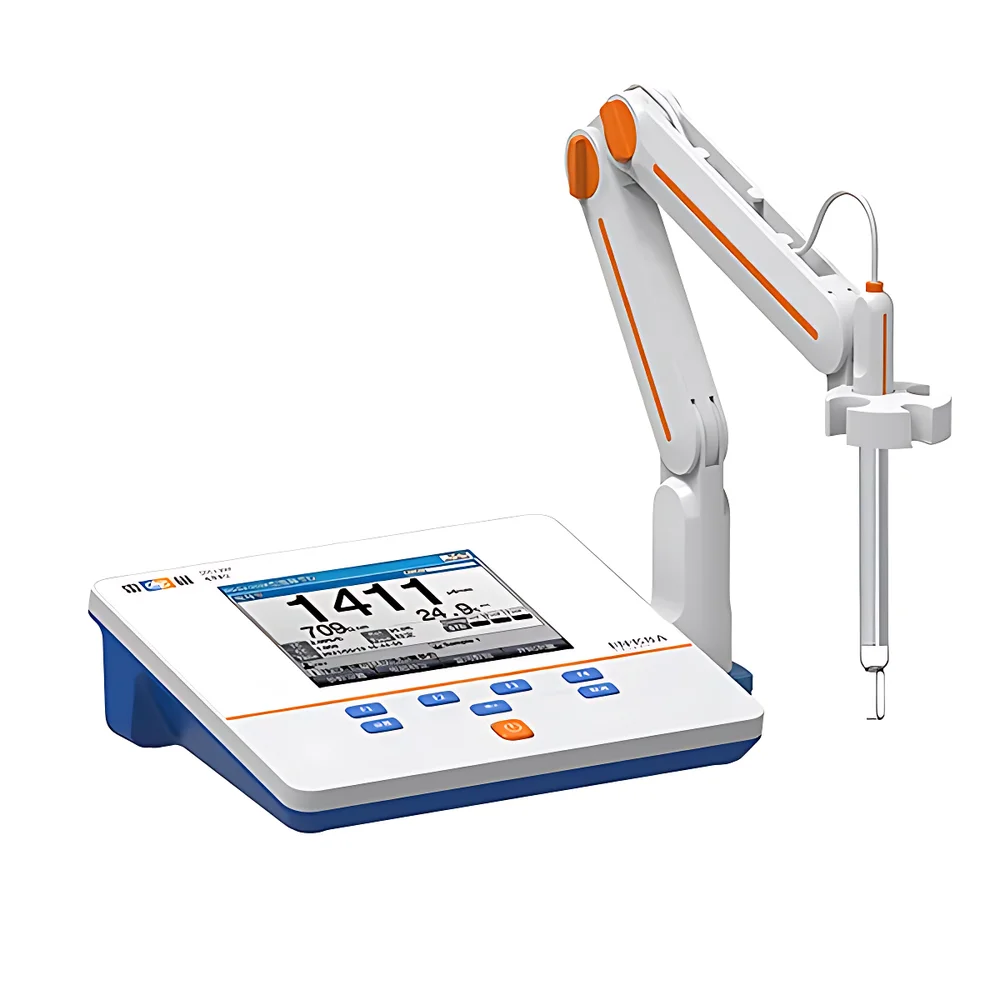
Leici DDSJ-308F Benchtop Conductivity Meter
| Brand | Leici |
|---|---|
| Origin | Shanghai, China |
| Model | DDSJ-308F |
| Form Factor | Benchtop |
| Application Environment | Laboratory |
| Conductivity Range | 0.000 µS/cm to 199.9 mS/cm |
| TDS Range | 0.000 mg/L to 99.9 g/L |
| Resistivity Range | 5.00 Ω·cm to 20.00 MΩ·cm |
| Salinity Range | 0.00–8.00 % |
| Temperature Range | −5.0 to 110.0 °C |
| Accuracy | ±0.5 % FS (Conductivity/TDS), ±0.1 % FS (Salinity), ±0.2 °C (Temperature) |
| Minimum Resolution | 0.001 µS/cm |
| Stability | ±0.3 % FS / 3 h |
| Temperature Compensation | Automatic or Manual (−5.0 to 135.0 °C) |
| Data Storage | 200 datasets per parameter (Conductivity, TDS, Salinity), GLP-compliant |
| Interface | USB |
| Power Backup | Non-volatile memory retention on power loss |
Overview
The Leici DDSJ-308F is a high-precision benchtop conductivity meter engineered for routine and regulatory-compliant measurements in quality control laboratories, environmental testing facilities, and academic research settings. It operates on the principle of two-electrode or four-electrode conductometric measurement—applying an alternating current across a defined cell geometry and calculating solution conductivity based on Ohm’s law and cell constant calibration. The instrument simultaneously determines conductivity, resistivity, total dissolved solids (TDS), salinity, and temperature—each derived from the same primary conductance signal using standardized conversion algorithms (e.g., ISO 7888, ASTM D1125, USP ). Its wide dynamic range—from ultrapure water (≥18.2 MΩ·cm) to concentrated brines—enables trace-level monitoring in pharmaceutical water systems as well as industrial process stream analysis. Designed for stability under variable thermal conditions, it features automatic temperature compensation with NTC thermistor integration and supports both manual and auto-ranging electrode frequency selection to minimize polarization error.
Key Features
- Smart-Read functionality: Adaptive endpoint detection algorithm that identifies stable electrochemical equilibrium, reducing operator subjectivity and improving inter-operator reproducibility.
- Timed-Read and Continuous-Read modes: Enable time-series profiling for kinetic studies (e.g., dialysis efficiency, membrane fouling, or reaction quenching) with programmable intervals (1 s to 99 min).
- GLP-compliant data governance: Assignable user IDs, full audit trail of calibration events (including date/time stamp, standard values used, and calculated cell constant), and immutable storage of 200 measurement records per parameter type.
- Dual calibration capability: Supports two-point conductivity calibration (using KCl standards traceable to NIST SRM 3601) and independent TDS factor adjustment per application (e.g., NaCl vs. 442™ conversion).
- Full-parameter direct readout: Simultaneous numeric display of conductivity (µS/cm, mS/cm), resistivity (Ω·cm, kΩ·cm, MΩ·cm), TDS (mg/L, g/L), salinity (%), and temperature (°C)—no manual unit conversion required.
- Robust human interface: 128 × 64 dot-matrix LCD with backlight; Chinese-language menu navigation; tactile polycarbonate keypad with sealed membrane construction for chemical resistance and long-term reliability.
- Data integrity safeguards: Non-volatile flash memory retains all settings and stored data during power interruption; USB 2.0 interface enables secure export to PC via Leici-certified communication software compliant with FDA 21 CFR Part 11 requirements for electronic records.
Sample Compatibility & Compliance
The DDSJ-308F accommodates standard DIN/ISO-compatible conductivity cells (e.g., K=0.01, 0.1, 1.0, or 10 cm−1) and supports both platinized and stainless-steel electrodes. It is validated for aqueous matrices including purified water (PW), water for injection (WFI), wastewater effluents, seawater dilutions, and buffer solutions. Regulatory alignment includes adherence to ISO/IEC 17025 documentation practices, USP verification protocols for purified water conductivity testing, and ASTM D1125 guidelines for TDS estimation. All calibration and measurement metadata—including operator ID, timestamp, electrode serial number (user-entered), ambient temperature, and atmospheric pressure (if logged externally)—are embedded in exported CSV files to support GMP/GLP audit readiness.
Software & Data Management
Leici’s proprietary PC software (v3.2+) provides secure bidirectional communication: uploading instrument configurations (e.g., temperature coefficient β, TDS factor, auto-hold timeout), downloading full datasets with GLP headers, and generating PDF reports with digital signature fields. Raw data exports include ISO 8601 timestamps, measurement uncertainty estimates (based on ±0.5 % FS specification and cell constant tolerance), and traceable calibration history. The software enforces role-based access control (administrator/operator modes) and maintains an immutable system log of all file operations—meeting minimum requirements for FDA 21 CFR Part 11 Subpart B (electronic signatures) when deployed with Windows domain authentication.
Applications
- Pharmaceutical water system validation: Real-time monitoring of conductivity excursions in PW/WFI loops per EU Annex 1 and USP .
- Environmental compliance: Field-deployable lab verification of surface water TDS and salinity against EPA Method 120.1 and ISO 7888.
- Academic electrochemistry labs: Teaching fundamental relationships between ion mobility, concentration, and conductance in strong/weak electrolyte solutions.
- Food & beverage QC: Batch verification of brine concentration in canned goods or dairy processing rinse water.
- Power plant chemistry: Monitoring condensate purity and detecting steam cycle leaks via ultra-low conductivity detection (down to 0.001 µS/cm).
FAQ
Does the DDSJ-308F support four-electrode conductivity measurement?
No—it is optimized for two-electrode cells with automatic frequency switching (10 Hz to 1 kHz) to mitigate polarization effects in moderate-conductivity samples. For high-accuracy ultra-pure water measurement (<0.1 µS/cm), a dedicated four-electrode sensor (e.g., Leici DJS-1C) must be used with compatible instrumentation.
Can calibration data be exported independently of measurement records?
Yes—calibration logs are stored separately and can be exported as standalone CSV files containing standard values, measured responses, calculated cell constants, and operator annotations.
Is the instrument suitable for measuring conductivity in organic solvents?
Not recommended. The DDSJ-308F is calibrated and validated exclusively for aqueous electrolyte solutions. Conductivity measurement in non-aqueous media requires specialized cells and dielectric-compensated instrumentation.
What is the maximum allowable temperature for continuous operation?
The instrument electronics are rated for ambient operation up to 40 °C. Sample temperature may reach 110.0 °C, but prolonged exposure above 60 °C requires thermal shielding of the electrode cable and verification of sensor housing material compatibility (e.g., PEEK vs. PVC).
Related Products







