
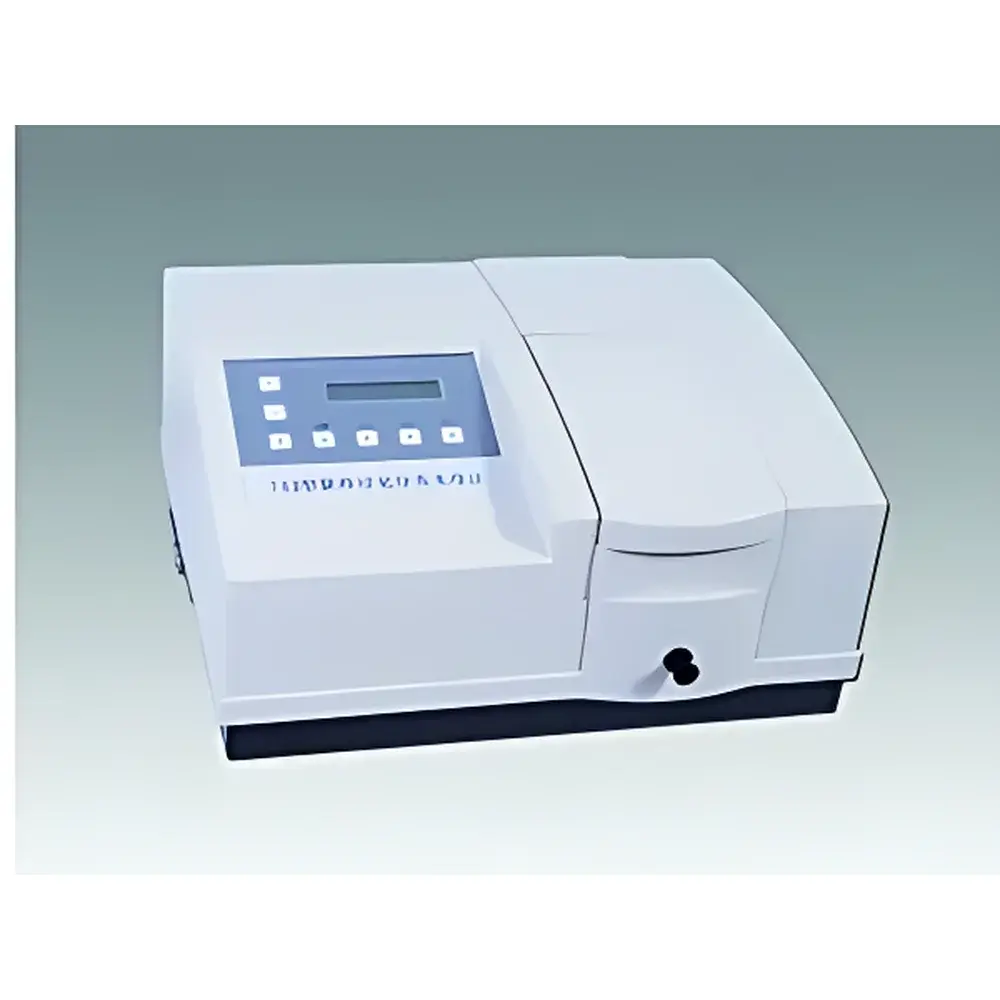
SOPTOP 752 Ultraviolet-Visible Spectrophotometer
| Brand | SOPTOP |
|---|---|
| Origin | Shanghai, China |
| Model | 752 |
| Optical System | Single-beam |
| Detector | Photomultiplier Tube (PMT) |
| Wavelength Range | 200–1000 nm |
| Spectral Bandwidth | 4 nm |
| Wavelength Accuracy | ±2.0 nm |
| Wavelength Repeatability | 1 nm |
| Stray Light | ≤0.5% T (at 220 nm and 360 nm) |
| Transmittance Accuracy | ±0.5% T |
| Transmittance Repeatability | ±0.2% T |
| Baseline Drift | ±0.003 A/h |
| Display | 128×64 LCD |
| Dimensions | 455 × 430 × 220 mm |
| Data Interface | USB |
| Wavelength Setting | Manual (keyboard-input with 6 preset wavelengths) |
Overview
The SOPTOP 752 Ultraviolet-Visible Spectrophotometer is a single-beam optical instrument engineered for quantitative analysis of analytes across the ultraviolet and visible spectral regions (200–1000 nm). Based on Beer–Lambert law principles, it measures absorbance (A), transmittance (T), and concentration (C) by detecting light attenuation through liquid or solution-phase samples. Its photomultiplier tube (PMT) detector delivers high sensitivity and low-noise signal acquisition, particularly critical in low-light UV regions where stray light suppression and signal-to-noise ratio directly impact measurement fidelity. Designed for routine laboratory use—not research-grade scanning—the 752 prioritizes operational robustness, intuitive manual wavelength selection, and reproducible endpoint quantification under stable ambient conditions. It does not incorporate automated wavelength scanning or diode array detection; instead, users manually set discrete wavelengths via an 8-key membrane keyboard, including six factory-preset positions optimized for common assays (e.g., 280 nm for protein, 405 nm for ELISA, 600 nm for microbial growth).
Key Features
- Single-beam optical architecture with fixed-path cuvette holder—engineered for simplicity, thermal stability, and minimal alignment drift during extended operation.
- Photomultiplier tube (PMT) detector offering superior quantum efficiency in the UV range (200–350 nm) compared to silicon photodiodes, enabling reliable detection at low absorbance levels.
- 4 nm spectral bandwidth ensures adequate resolution for broad-band absorption peaks while maintaining sufficient radiant throughput for rapid measurements.
- Manual wavelength selection with keyboard input and six programmable shortcut keys—reducing operator error and accelerating repetitive assay workflows.
- Onboard calibration functions: automatic dark current correction, wavelength verification (via built-in holmium oxide or didymium filter reference points), and zero-absorbance baseline reset.
- Integrated data management: stores up to 50 standard curves (12-point linear or zero-order fit), 200 individual measurement records, and user-defined concentration factors—all retained after power cycling.
- Compliant display interface: 128×64 dot-matrix LCD with contrast adjustment, supporting simultaneous readout of A/T/F/C values and real-time status indicators (lamp status, calibration mode, error codes).
Sample Compatibility & Compliance
The SOPTOP 752 accommodates standard 10 mm pathlength quartz or glass cuvettes (1.0 mL minimum volume) and supports both transmission and blank-subtracted measurement modes. It is suitable for aqueous, organic, and mildly corrosive solutions—provided sample matrices do not exceed PMT window compatibility limits (e.g., strong acids below pH 2 or halogenated solvents require quartz cuvettes and careful handling). While not certified for GLP/GMP-regulated environments out-of-the-box, its design aligns with foundational ISO/IEC 17025 metrological practices: traceable wavelength accuracy (±2.0 nm), documented stray light performance (≤0.5% T at 220 nm and 360 nm), and transmittance repeatability (±0.2% T) meet typical requirements for educational, QC, and environmental screening labs. No FDA 21 CFR Part 11 compliance features (e.g., electronic signatures, audit trails) are implemented.
Software & Data Management
Data export is facilitated exclusively via USB interface to external storage devices (FAT32-formatted USB flash drives). The instrument writes plain-text CSV files containing wavelength, absorbance, transmittance, and concentration values—compatible with Excel, Origin, and Python-based analysis pipelines. No proprietary software suite is bundled; however, exported datasets conform to ASTM E275-22 conventions for spectrophotometric reporting. Internal memory retains calibration parameters, curve coefficients, and time-stamped measurements (system clock synchronized at power-on). Firmware updates—when available—are applied via USB firmware loader; version history and checksum validation are accessible in service mode.
Applications
- Quantitative determination of nucleic acids (A260) and proteins (A280/A260 ratio) in molecular biology teaching labs.
- Colorimetric assays in food safety (e.g., nitrite in cured meats, sulfite in wine) and environmental monitoring (e.g., phosphate, nitrate, COD).
- Quality control of dyes, pigments, and pharmaceutical excipients where batch-to-batch consistency is verified against reference standards.
- Teaching fundamental spectroscopic concepts: Lambert–Beer law validation, spectral scanning (manual stepwise), and interference assessment via stray light evaluation.
- Industrial process support in metallurgy (metal ion titration), petrochemicals (hydrocarbon saturation index), and agriculture (chlorophyll extraction assays).
FAQ
Is the SOPTOP 752 compliant with ISO 9001 or ISO/IEC 17025 for accredited testing?
No—this model is not supplied with a manufacturer’s ISO 17025 calibration certificate or uncertainty budget. Users requiring accreditation must perform third-party verification and maintain their own metrological traceability records.
Can the instrument perform kinetic or multi-wavelength scanning?
No—it lacks motorized grating drive and time-resolved acquisition capability. All measurements are static, single-wavelength endpoints.
What cuvette materials are supported at 200 nm?
Only UV-grade fused silica (quartz) cuvettes are suitable below 220 nm; standard BK7 glass absorbs strongly in deep UV.
Does the USB interface support real-time data streaming to a PC?
No—USB is read-only for file export. Live communication protocols (e.g., RS-232, USB CDC) are not implemented.
How often should wavelength calibration be performed?
Recommended before each analytical session when high-accuracy work is required; factory calibration uses holmium oxide reference peaks at 241.0, 279.4, 287.5, and 333.7 nm.





