
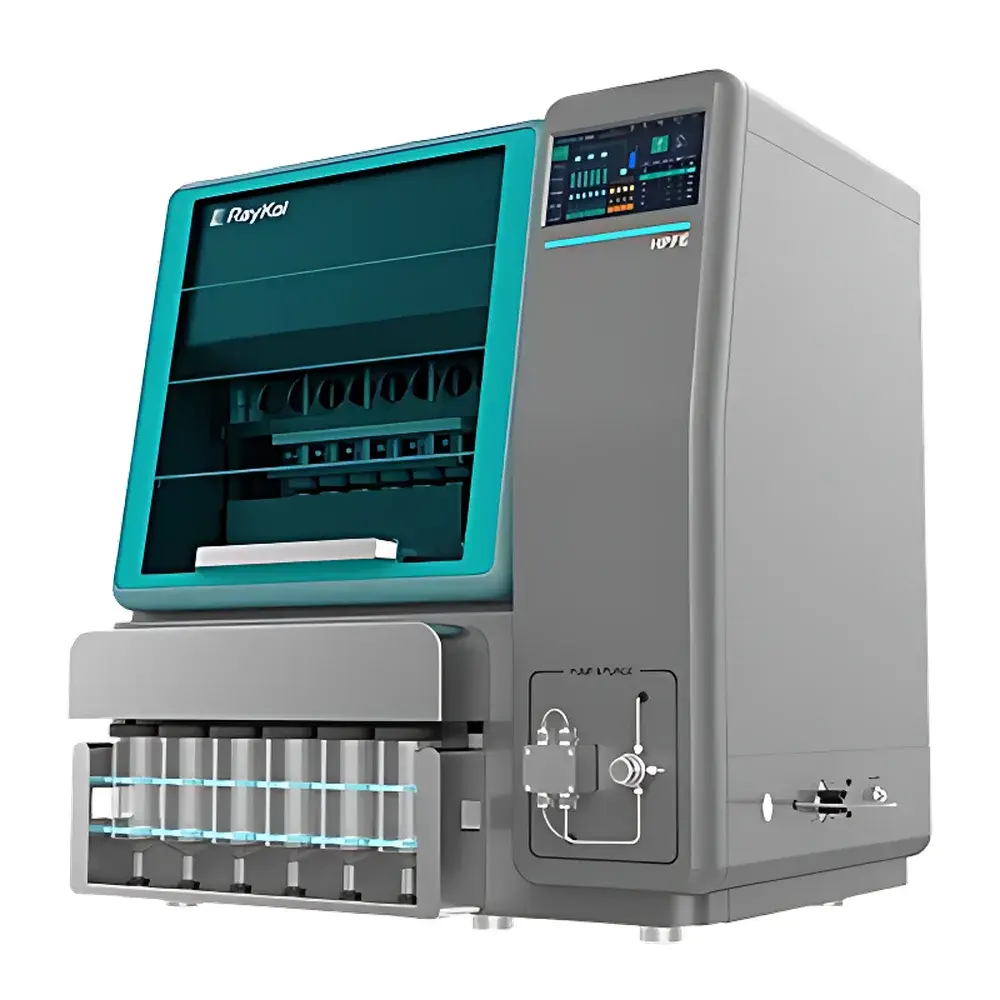
Raykol HPFE 06 High-Throughput Pressurized Fluid Extractor
| Brand | Raykol |
|---|---|
| Origin | Fujian, China |
| Manufacturer Type | Original Equipment Manufacturer (OEM) |
| Country of Origin | China |
| Model | HPFE 06 |
| Instrument Type | Solid-Liquid Extraction |
| Temperature Range | Ambient to 200 °C |
| Pressure Range | Atmospheric to 20 MPa |
| Extraction Cell Volumes | 11, 22, 33, 66, 80, 120 mL |
| Extraction Time | ≤15 min per cycle |
| Dimensions (L×W×H) | 720 × 560 × 790 mm |
| Sample Capacity | 96 positions |
| Solvent Options | 4 independent solvent channels with programmable mixing ratios |
| Collection Vial Compatibility | 60–240 mL |
| Safety Features | Over-pressure, over-temperature, and leak detection with active ventilation and sealed chamber architecture |
| Software Interface | Built-in 10-inch fixed industrial touchscreen with method editor and audit trail logging |
Overview
The Raykol HPFE 06 High-Throughput Pressurized Fluid Extractor is an engineered solid-liquid extraction platform designed for rapid, reproducible, and scalable isolation of organic analytes from complex solid and semi-solid matrices. It operates on the principle of pressurized fluid extraction (PFE), a technique standardized under EPA Method 3545A, ASTM D7567, and multiple Chinese environmental and food safety standards (e.g., HJ-782, HJ-783, GB/T 23376). By elevating solvent pressure up to 20 MPa, the system suppresses solvent volatility—enabling operation above normal boiling points without phase transition. This thermodynamic control enhances solute diffusivity and solvent penetration into matrix pores, significantly accelerating mass transfer kinetics. As a result, extraction cycles are completed in ≤15 minutes per batch—reducing typical Soxhlet durations (16–24 h) by >95%—while minimizing solvent consumption to 20–50 mL per run. The instrument supports fully automated, unattended processing of up to 96 samples per day across six parallel extraction channels, making it suitable for high-volume regulatory laboratories performing routine analysis of persistent organic pollutants (POPs), pesticides, pharmaceutical residues, and natural product compounds.
Key Features
- Six independent extraction channels operating synchronously, each with individual pressure and temperature control for method flexibility and cross-method validation.
- Modular cell configuration supporting six standard extraction vessel volumes (11, 22, 33, 66, 80, and 120 mL) to accommodate diverse sample masses—from trace environmental soils (1–5 g) to bulk agricultural commodities (up to 20 g).
- Four solvent reservoirs with precision metering pumps enabling on-the-fly binary or ternary solvent blending (e.g., hexane:acetone, dichloromethane:methanol), eliminating manual pre-mixing and ensuring inter-batch consistency.
- Integrated collection module compatible with 60–240 mL vials; designed for direct coupling with downstream concentration systems (e.g., nitrogen evaporators or TurboVap® interfaces) without sample transfer.
- Industrial-grade 10-inch fixed capacitive touchscreen with embedded Linux-based controller, offering offline method storage, real-time parameter monitoring, and password-protected user roles (operator, supervisor, administrator).
- Comprehensive hardware-level safety architecture including redundant pressure transducers, dual thermal cutoffs, automatic vent-and-purge sequence upon fault detection, and continuous chamber integrity monitoring via differential pressure sensing.
Sample Compatibility & Compliance
The HPFE 06 accommodates heterogeneous solid and semi-solid samples—including soil, sediment, sludge, plant tissue, animal feed, polymer pellets, tea leaves, grain, and pharmaceutical tablets—without requiring extensive homogenization or drying. Its robust sealing mechanism and inert wetted path (316L stainless steel cells, PTFE-coated valves, and Kalrez® seals) ensure compatibility with aggressive solvents (e.g., chlorinated hydrocarbons, polar protic mixtures) and prevent analyte degradation or adsorption. The system complies with ISO/IEC 17025:2017 requirements for method validation documentation, supports GLP-compliant data integrity through time-stamped audit trails, and meets key regulatory criteria for electronic records under FDA 21 CFR Part 11 when deployed with validated software configurations. It is routinely referenced in accredited methods including HJ-77 (dioxins), HJ-782/783 (solid waste and soil organics), GB 23200.9 (pesticide multiresidue in cereals), and ASTM D7567 (gel content in crosslinked polymers).
Software & Data Management
The embedded control software provides full lifecycle method management: creation, editing, versioning, and execution. Each method stores complete metadata—including temperature ramp profiles, pressure hold sequences, flush volumes, and solvent composition gradients—enabling strict protocol adherence across shifts and operators. All system events (start/stop times, alarms, parameter deviations, maintenance logs) are recorded in an immutable SQLite database with SHA-256 hashing. Export options include CSV-formatted extraction reports and XML-based method files compatible with LIMS integration. Optional remote diagnostics support allows authorized service engineers to perform firmware updates and calibration verification without physical access—reducing instrument downtime in multi-site laboratory networks.
Applications
- Environmental Analysis: Extraction of PAHs, PCBs, OCPs, dioxins/furans, and brominated flame retardants from contaminated soils, sediments, and fly ash per EPA 3545A and HJ-783.
- Food & Agriculture: Multi-residue pesticide screening in fruits, vegetables, grains, and herbs (GB/T 23376, GB 23200.9); lipid extraction from oilseeds; mycotoxin recovery from feedstuffs.
- Pharmaceutical & Natural Products: Isolation of saponins, alkaloids, flavonoids, and cannabinoids from botanical matrices (e.g., ginseng, cannabis, St. John’s wort) with minimal thermal degradation.
- Polymer & Petrochemical Testing: Gel content quantification in crosslinked polyethylene (ASTM D7567); additive leaching studies (antioxidants, plasticizers) from packaging materials.
- Clinical & Forensic Toxicology: Recovery of lipophilic drugs and metabolites from biological tissues (liver, adipose) prior to GC-MS or LC-MS/MS analysis.
FAQ
What regulatory standards does the HPFE 06 support?
The system is validated for use in methods specified by the Chinese Ministry of Ecology and Environment (HJ-77, HJ-782, HJ-783), national standards (GB/T and GB series), and international protocols including ASTM D7567 and EPA Method 3545A.
Can extraction cells be cleaned in situ between runs?
Yes—the system includes an automated solvent rinse cycle with configurable volume and dwell time, followed by nitrogen purge to remove residual solvent prior to next sample loading.
Is method transfer possible between different HPFE models or third-party PFE systems?
Method parameters (temperature, pressure, static/dynamic time, flush volume) are exportable as plain-text protocols and can be adapted to other PFE platforms, though cell geometry and heating dynamics may require empirical re-optimization.
Does the instrument support 21 CFR Part 11 compliance out-of-the-box?
The base software includes audit trail, electronic signatures, and role-based access control; full Part 11 compliance requires site-specific validation documentation and optional PKI certificate integration.
What maintenance intervals are recommended for long-term reliability?
Daily visual inspection of seals and tubing; quarterly calibration of pressure and temperature sensors; annual replacement of high-pressure pump check valves and cell O-rings—documented in the included maintenance logbook and accessible via the touchscreen interface.



