
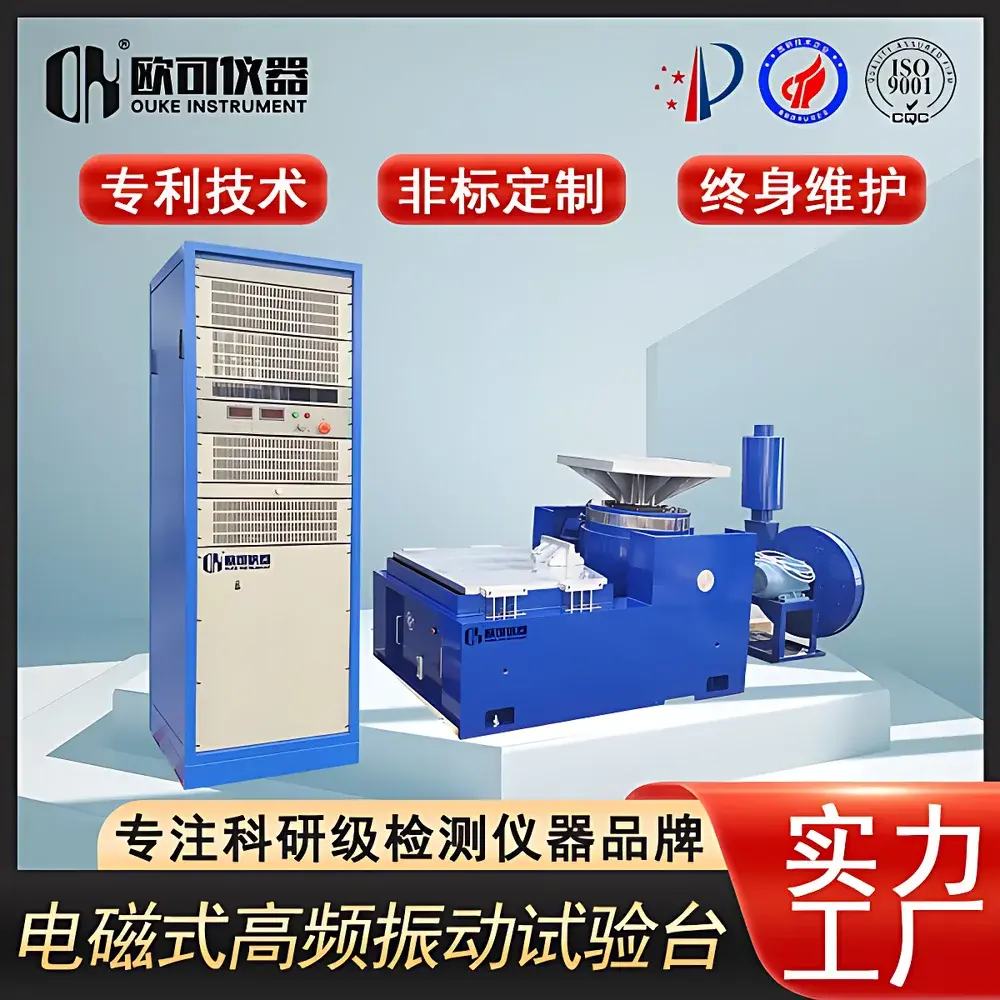
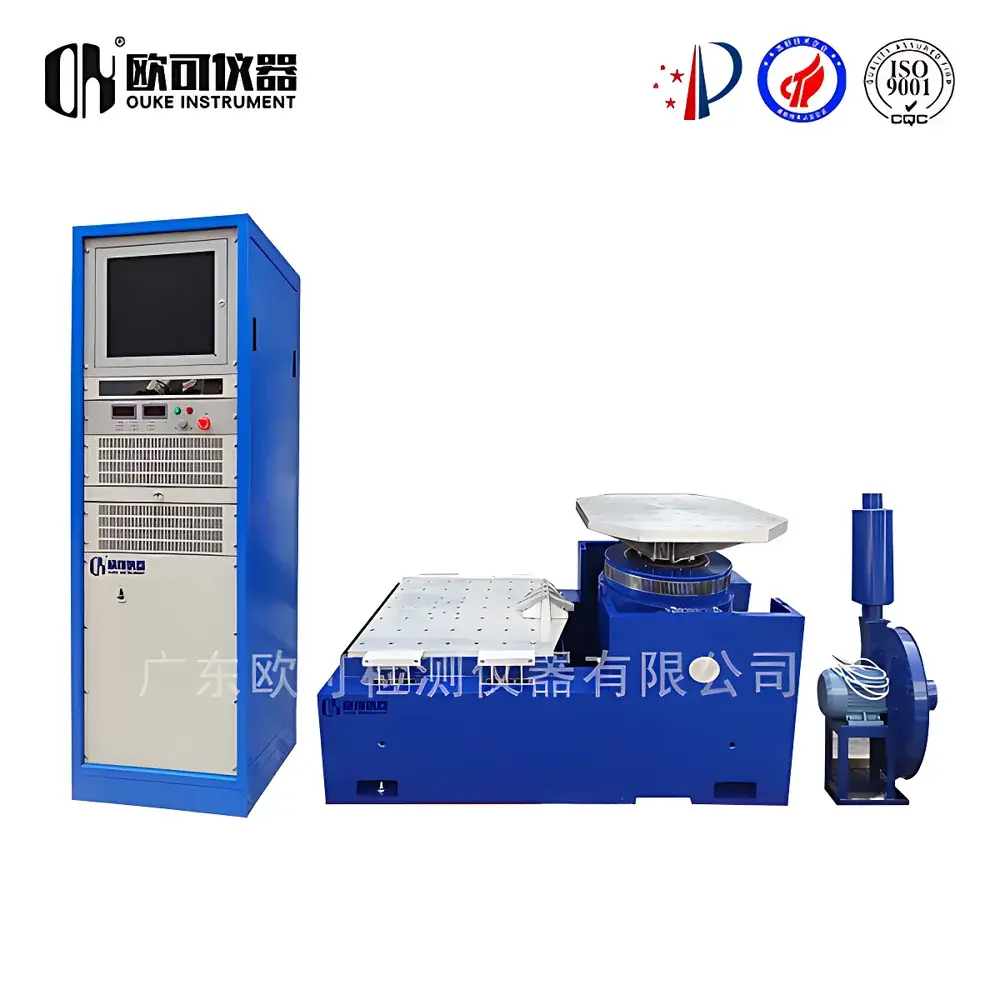
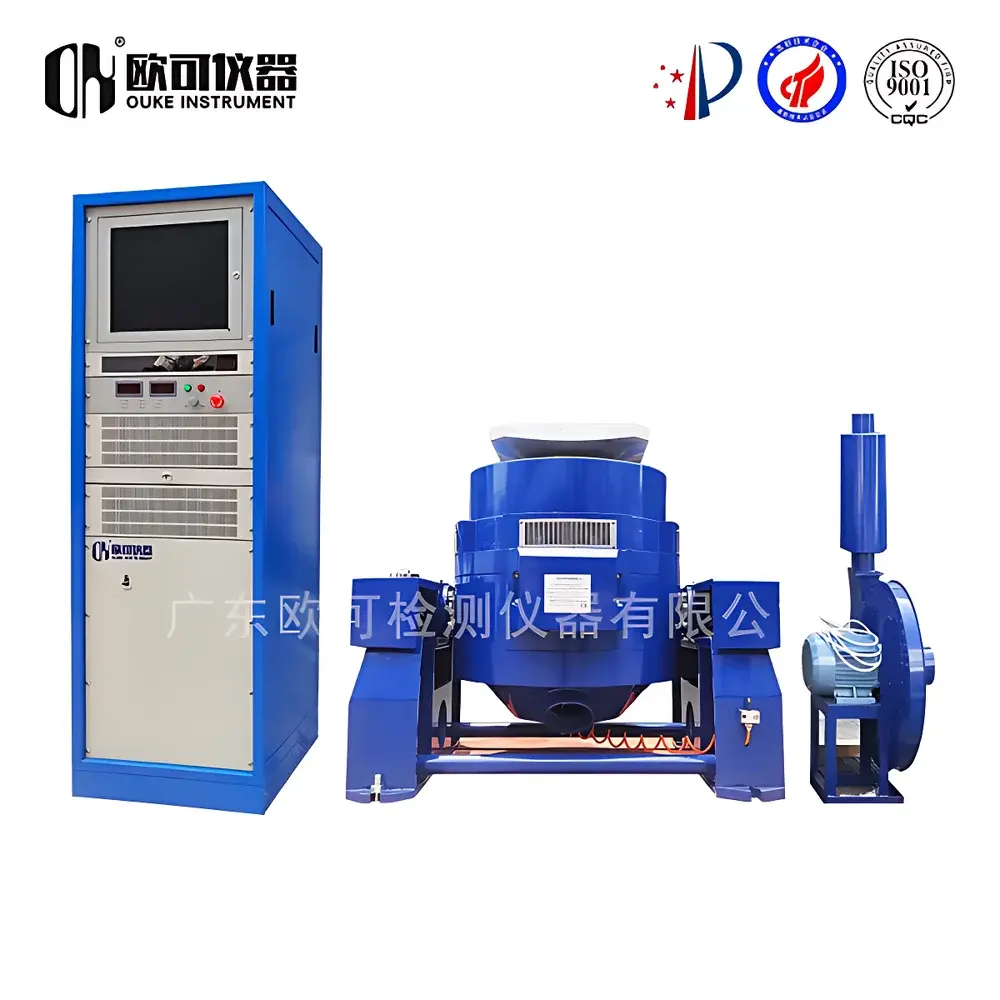
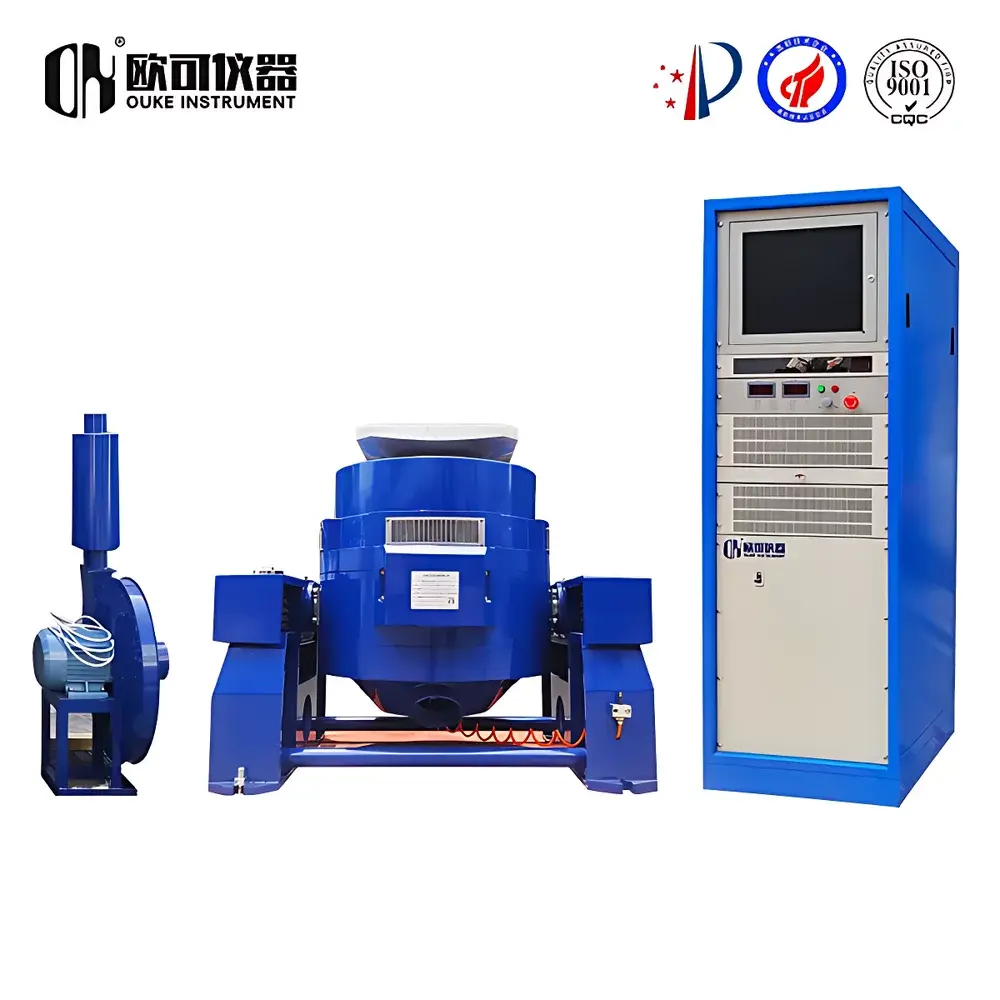
OK-ES-3.2 Electromagnetic Vibration Shaker System
| Brand | OK Instruments |
|---|---|
| Origin | Guangdong, China |
| Manufacturer Type | Direct Manufacturer |
| Instrument Type | Electromagnetic Vibration Shaker |
| Rated Force | 1.98 kN |
| Frequency Range | 5–5000 Hz |
| Max. Test Load | 70 kg |
| Tabletop Dimensions | 300 × 300 × 30 mm |
| Peak Acceleration | 10 g |
Overview
The OK-ES-3.2 Electromagnetic Vibration Shaker System is a precision-engineered, single-axis electrodynamic shaker designed for laboratory-based environmental simulation and dynamic mechanical testing. It operates on the principle of Lorentz force actuation—applying controlled alternating current to a moving coil suspended within a high-intensity permanent magnetic field—to generate highly reproducible sinusoidal, random, shock, and transient vibration profiles. Engineered for compliance with international reliability test standards—including ISO 10816 (vibration severity evaluation), ISO 2247 (packaging vibration testing), IEC 60068-2-6 (sinusoidal vibration), and IEC 60068-2-64 (random vibration)—the system serves as a foundational tool for accelerated life testing, structural integrity validation, and modal characterization across R&D, quality assurance, and production environments.
Key Features
- High-fidelity electromagnetic actuation delivering linear force response and minimal harmonic distortion across the full 5–5000 Hz operational bandwidth.
- Robust force-to-mass ratio enabling stable acceleration performance up to 10 g (peak) under 70 kg total load (including fixture and test article).
- Optimized armature suspension and thermal management architecture supporting extended-duty-cycle operation without derating.
- Standard 300 × 300 mm aluminum tabletop with 12 M8 threaded mounting holes (grid spacing: 50 mm) for rigid, low-resonance fixture integration.
- Integrated cooling interface compatible with optional forced-air or recirculating water-cooling systems for sustained high-power testing.
- Modular control interface compliant with IEEE 1394 (FireWire) and Ethernet TCP/IP protocols for seamless integration into automated test benches.
Sample Compatibility & Compliance
The OK-ES-3.2 accommodates test specimens ranging from small electronic modules (<1 kg) to medium-scale assemblies such as automotive ECUs, aerospace avionics enclosures, and packaged consumer electronics. Fixture design must ensure center-of-gravity alignment within ±15 mm of the table’s geometric center to maintain axial fidelity and minimize rocking moments. The system meets mechanical safety requirements per EN 61000-6-2 (immunity) and EN 61000-6-4 (emission), and its control architecture supports audit-ready data traceability in accordance with FDA 21 CFR Part 11 when paired with validated software. Calibration certificates are traceable to NIM (National Institute of Metrology, China) and internationally recognized metrological institutes via ISO/IEC 17025-accredited laboratories.
Software & Data Management
The shaker is operated via OK-VibControl™ — a real-time deterministic control platform supporting closed-loop acceleration control with <±0.5 dB amplitude tolerance and <±1° phase error across the rated frequency range. The software implements standard test profiles including swept-sine, fixed-frequency dwell, power spectral density (PSD)-based random vibration, classical shock (half-sine, trapezoidal, sawtooth), and time-domain waveform replay (e.g., road profile emulation). All test sessions generate timestamped, metadata-embedded HDF5-formatted datasets containing raw sensor traces, control feedback signals, thermal telemetry, and system status logs. Export options include CSV, MATLAB .mat, and UFF58 formats. Optional GLP/GMP-compliant mode enables electronic signatures, user access tiers, and immutable audit trails for regulated industries.
Applications
- Reliability Qualification: Execution of HALT/HASS protocols, MIL-STD-810H Method 514.8 vibration sections, and automotive OEM-specific durability specifications (e.g., GMW14872, Ford CETP 00.00-L-467).
- Packaging Validation: Simulation of freight transport vibration spectra per ASTM D999 and ISTA 3A/3E protocols to assess package integrity and product damage thresholds.
- Modal Parameter Identification: Resonance search, frequency response function (FRF) acquisition, and experimental modal analysis using impact hammer or shaker excitation.
- Structural Fatigue Assessment: Accelerated fatigue cycling at resonant frequencies to evaluate solder joint integrity, connector retention, and weld seam durability.
- Environmental Stress Screening (ESS): In-line screening of electronic assemblies to precipitate latent defects prior to final shipment.
- Research & Development: Dynamic characterization of composite materials, damping treatments, and active/passive vibration isolation systems.
FAQ
What standards does the OK-ES-3.2 support out of the box?
The system natively executes test profiles defined in ISO 2247, IEC 60068-2-6, IEC 60068-2-64, ASTM D999, and MIL-STD-810H. Custom PSDs and time histories can be imported for proprietary or customer-specific standards.
Can this shaker be integrated into a temperature–humidity–vibration (triple-combined) chamber?
Yes—the OK-ES-3.2 is mechanically and electrically compatible with standard climatic chamber feedthrough configurations. Optional low-profile inertial mass adapters and vacuum-compatible cabling kits are available for environmental chamber integration.
Is third-party calibration included with purchase?
A factory calibration certificate (traceable to NIM) is provided with each unit. On-site or accredited lab recalibration services are available under annual maintenance contracts.
What is the maximum allowable off-center loading condition?
For optimal axial linearity and minimized cross-axis motion, the center of gravity of the combined test article and fixture must remain within ±15 mm of the tabletop center in both X and Y directions. Off-center loads exceeding this threshold require custom dynamic balancing assessment.
Does the system support multi-axis testing?
The OK-ES-3.2 is a single-axis vertical shaker. Horizontal testing is achievable using an optional low-resonance horizontal slip table (OK-HT-300). For true triaxial simultaneous excitation, OK Instruments offers the OK-MX series multi-shaker platforms with synchronized controller architecture.



