
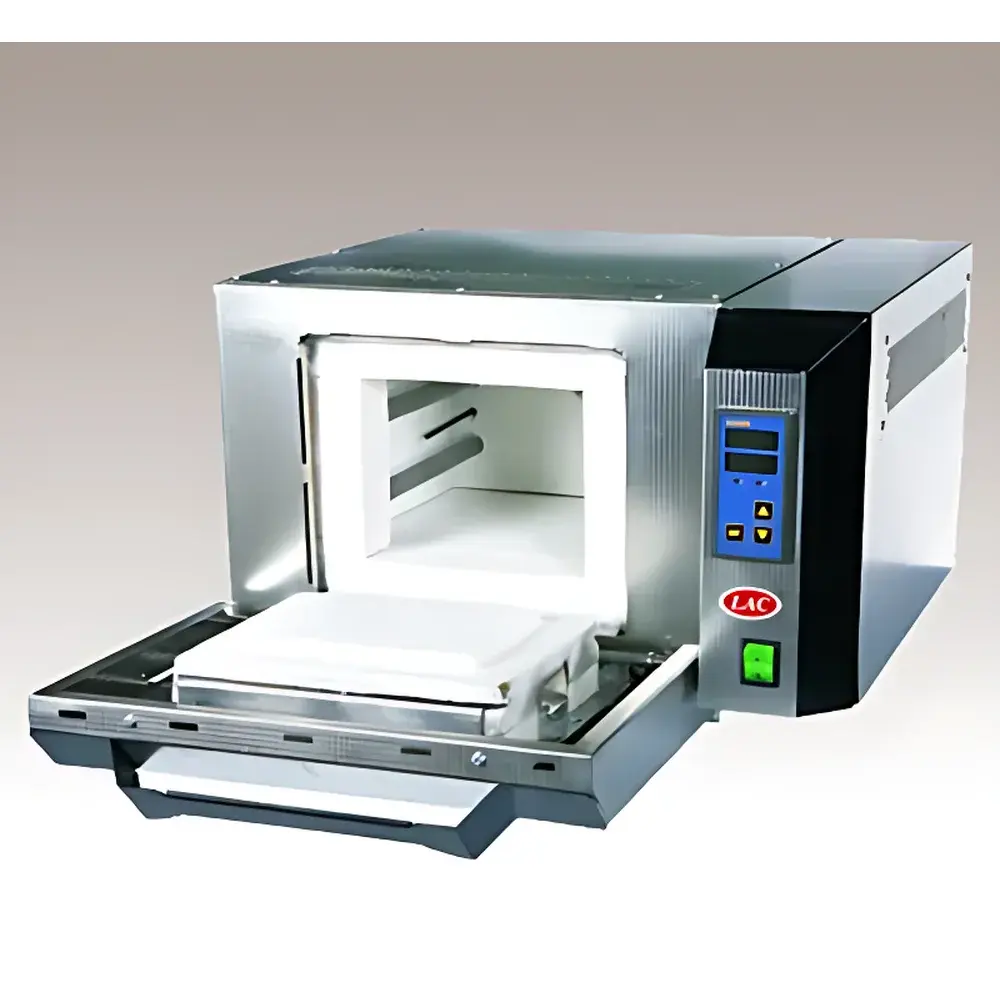
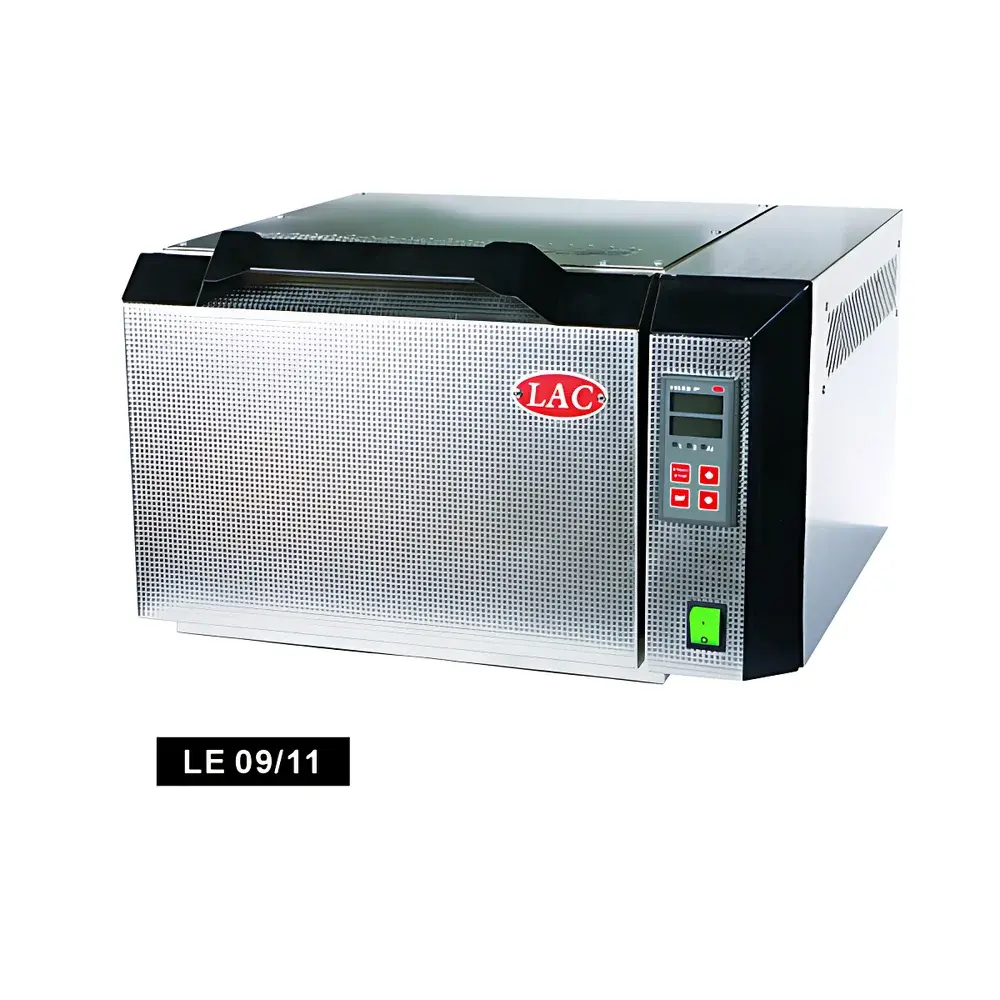
LAC LE Series Laboratory Box Furnace
| Brand | LAC |
|---|---|
| Origin | Czech Republic |
| Model | LE |
| Type | Box-type Muffle Furnace |
| Max Temperature | 1100 °C |
| Temperature Control Accuracy | ±1 °C |
| Max Power | 2.3 kW |
| Heating Time to Max Temp | 55 min |
| Heating Method | Resistance Wire (NiCr) in Silica Glass Tubes |
| Internal Dimensions (W×H×D) | 190×170×290 mm |
| External Dimensions (W×H×D) | 490×370×515 mm |
| Weight | 23 kg |
| Voltage | 230 V AC, Single-phase |
| Controller | HT60B Programmable Digital Controller |
| Safety Features | Downward-Manual Door with Interlocked Limit Switch, Mineral Fiber Door Insulation, K-Type Thermocouple (rear-mounted) |
| Compliance | Designed per DIN 17052-1 for dynamic temperature curve regulation |
Overview
The LAC LE Series Laboratory Box Furnace is a precision-engineered muffle furnace designed for controlled thermal processing in research, quality control, and industrial R&D laboratories. Operating on the principle of radiant and convective heat transfer via shielded resistance heating elements, the LE furnace isolates samples from direct contact with heating components—ensuring chemical inertness, reproducible thermal profiles, and minimal contamination risk. Its muffle architecture features heating spirals fully encapsulated in fused silica glass tubes, embedded within high-purity refractory insulation. This configuration prevents corrosion from aggressive volatiles (e.g., fluorides, chlorides, or acidic fumes) released during sintering, calcination, ashing, or enamel firing—making it especially suitable for metallurgical heat treatment, ceramic development, dental prosthesis firing, and pharmaceutical residual ash analysis.
Key Features
- Refractory chamber constructed from high-density, low-conductivity insulating firebrick with mineral fiber door lining—ensuring uniform internal temperature distribution and surface jacket temperatures below 60 °C at 1100 °C operation.
- Heating elements: NiCr resistance wire wound into helical coils and hermetically sealed inside transparent fused silica tubes—resistant to oxidation, halogen attack, and thermal shock up to 1100 °C.
- Downward-swinging manual door with integrated safety limit switch: automatically de-energizes heating circuit upon door opening, complying with EN 61000-6-2 (EMC) and IEC 61010-1 (electrical safety) requirements.
- HT60B programmable digital controller: supports up to 16 segments with ramp/soak capability, real-time temperature logging, and user-defined PID tuning parameters—enabling precise replication of thermal cycles per ASTM E1113, ISO 8501-1, or USP <231>.
- Integrated air management system: includes adjustable slide valve for ambient air intake and an insulated chimney flue for passive exhaust—facilitating controlled oxidative or semi-oxidative atmospheres without external gas supply.
- Robust stainless steel housing with rust-resistant epoxy-polyester coating and reinforced structural frame—designed for long-term stability in shared lab environments.
Sample Compatibility & Compliance
The LE furnace accommodates crucibles, saggars, and sample boats made from alumina, silicon carbide, platinum, or quartz—compatible with both oxidizing and mildly reducing atmospheres. Its sealed muffle design meets GLP/GMP documentation requirements when paired with optional HT40P controller upgrades and RS485 communication modules. The furnace conforms to DIN 17052-1 for temperature uniformity testing (±3 °C across working zone at 1100 °C), and its thermal performance is validated per IEC 60068-2-2 (dry heat testing). It is routinely deployed in applications requiring compliance with ISO 5660 (fire testing), ASTM C373 (ceramic moisture content), ASTM E1867 (thermal stability of polymers), and EN 12944-2 (dental porcelain firing).
Software & Data Management
While the standard HT60B controller provides local setpoint programming and onboard data retention (last 10 cycles), optional hardware and software enhancements enable full traceability. The HT40P upgrade adds RS232/RS485 serial interface, permitting integration with LabVIEW, MATLAB, or custom SCADA systems. Optional HtMonit monitoring software delivers real-time graphing, alarm-triggered email notifications, electronic signature support, and 21 CFR Part 11–compliant audit trails—including operator ID, timestamped parameter changes, and deviation alerts. All temperature logs are exportable as CSV or PDF for QA review or regulatory submission.
Applications
- Metallographic heat treatment: annealing, stress relieving, and tempering of ferrous/non-ferrous alloys.
- Ceramic and glass R&D: sintering optimization, glaze maturity testing, softening point determination (ASTM C372), and thermal expansion coefficient measurement.
- Dental laboratory workflows: firing of metal-ceramic restorations, zirconia sintering, and investment burnout.
- Environmental and pharmaceutical testing: loss-on-ignition (LOI), total organic carbon (TOC) combustion, and sulfate residue quantification per USP <281>.
- Materials science: ash content analysis (ASTM D3174), catalyst activation, and pre-oxidation of battery electrode precursors.
- Academic research: kinetic studies of solid-state reactions, phase transformation mapping, and thermogravimetric method validation.
FAQ
What type of thermocouple is used, and where is it located?
A grounded K-type thermocouple is mounted on the rear wall of the furnace chamber, ensuring representative measurement of the muffle’s thermal core—not the door or insulation surface.
Can the LE furnace operate under inert or reducing atmospheres?
The standard model supports ambient air and limited oxygen-deficient conditions via adjustable air inlet and chimney draft. For true inert (N₂, Ar) or reducing (H₂/N₂) atmospheres, a gas-tight modification kit—including flanged ports and purge flow control—is available as a factory option.
Is the HT60B controller compliant with FDA 21 CFR Part 11?
Standalone HT60B does not provide electronic signatures or audit trail functionality. Full Part 11 compliance requires the HT40P controller + HtMonit software + network authentication server configuration.
What maintenance is required for long-term accuracy?
Annual verification using NIST-traceable reference thermocouples and periodic inspection of silica tube integrity are recommended. No routine calibration of the controller is needed—the HT60B maintains ±0.5 °C linearity over its operating range.
How does the LE series compare to vacuum or tube furnaces for sintering applications?
The LE offers superior cost-efficiency and ease of use for atmospheric sintering where vacuum or gas purity is non-critical. Its muffle geometry ensures excellent temperature homogeneity across larger loads compared to cylindrical tube configurations—ideal for batch processing of irregularly shaped dental or ceramic parts.



