
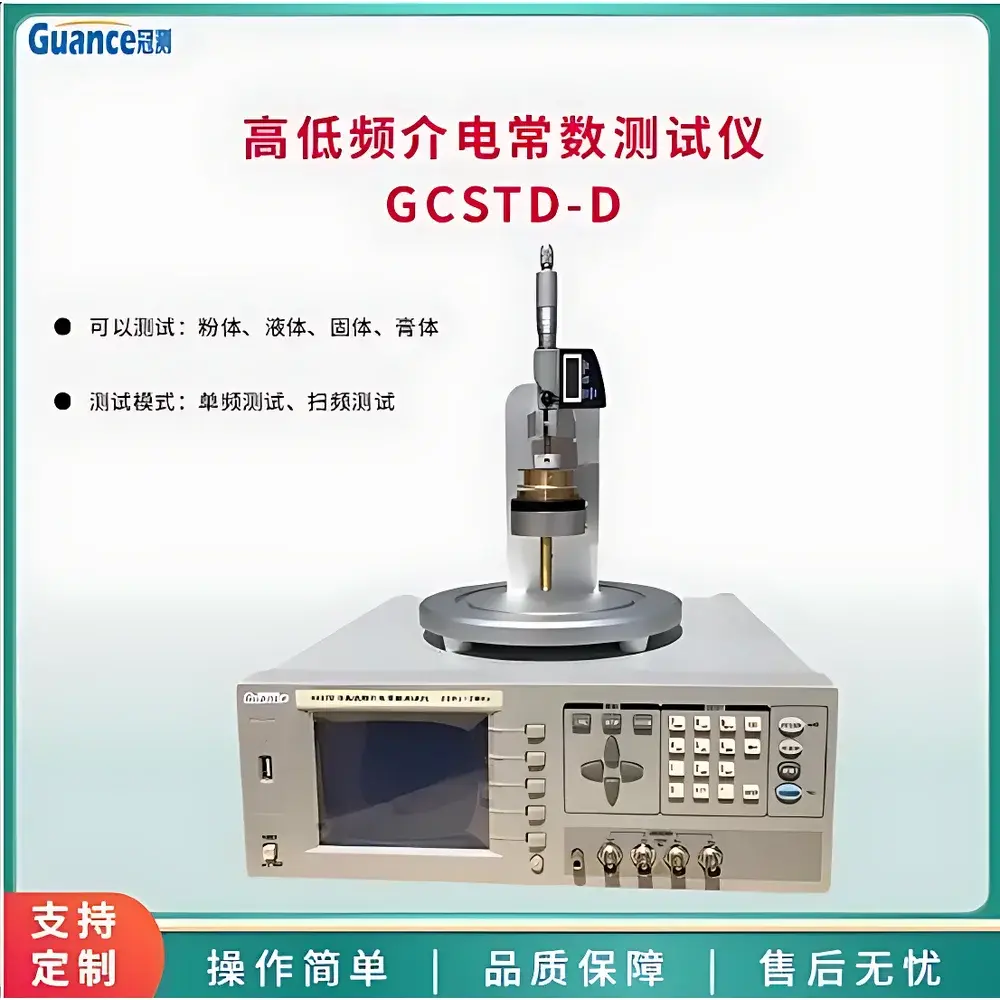
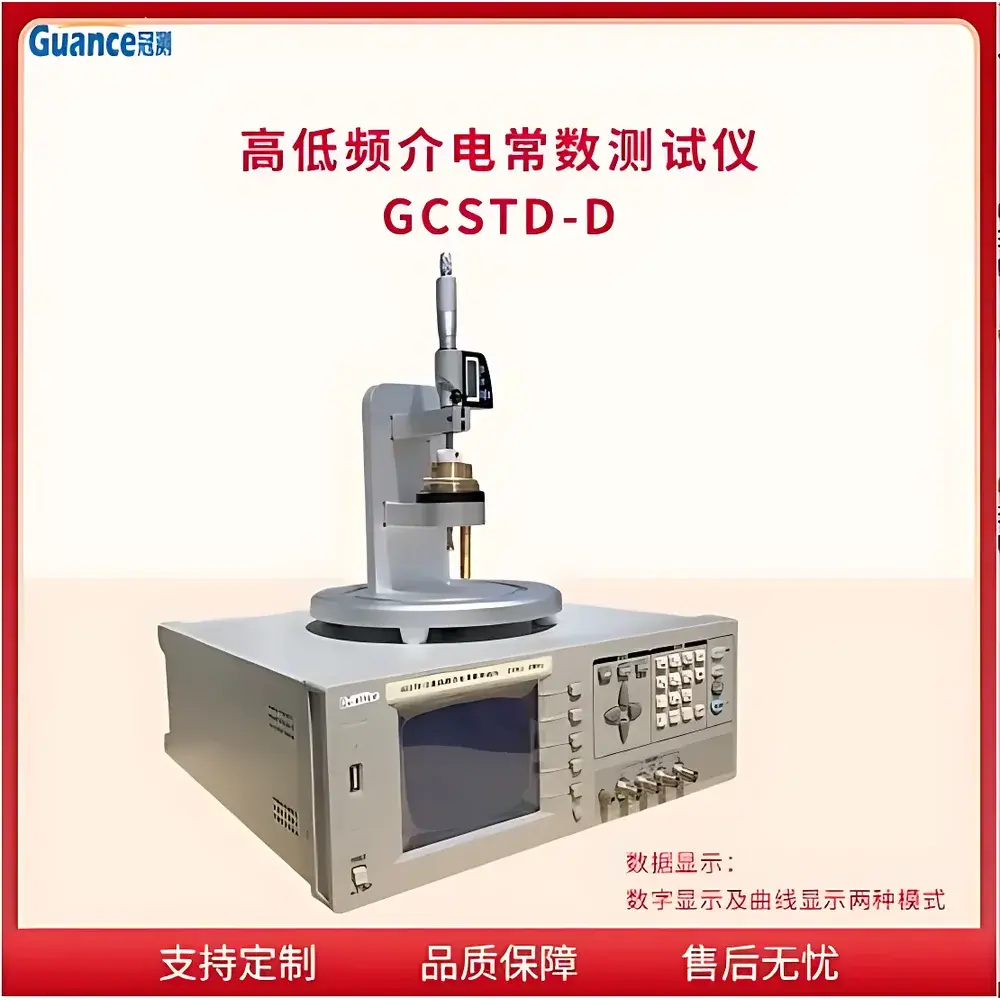
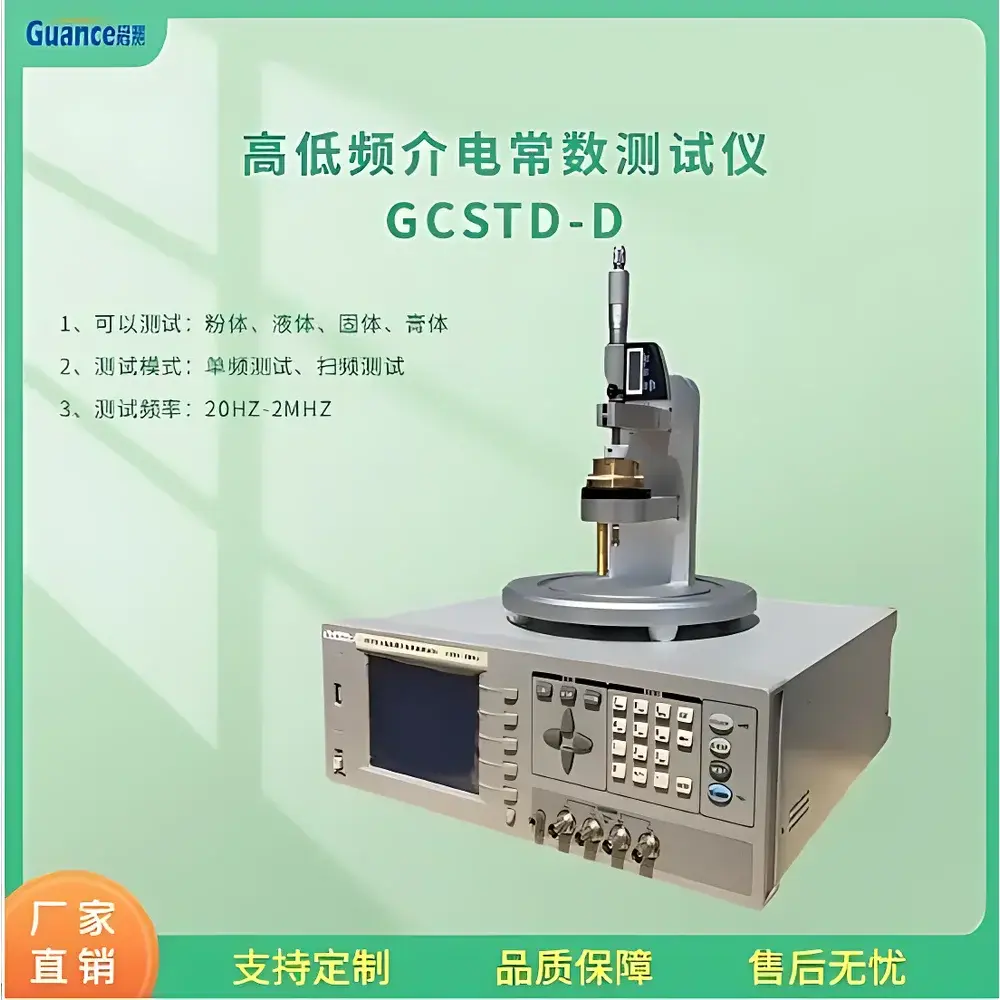
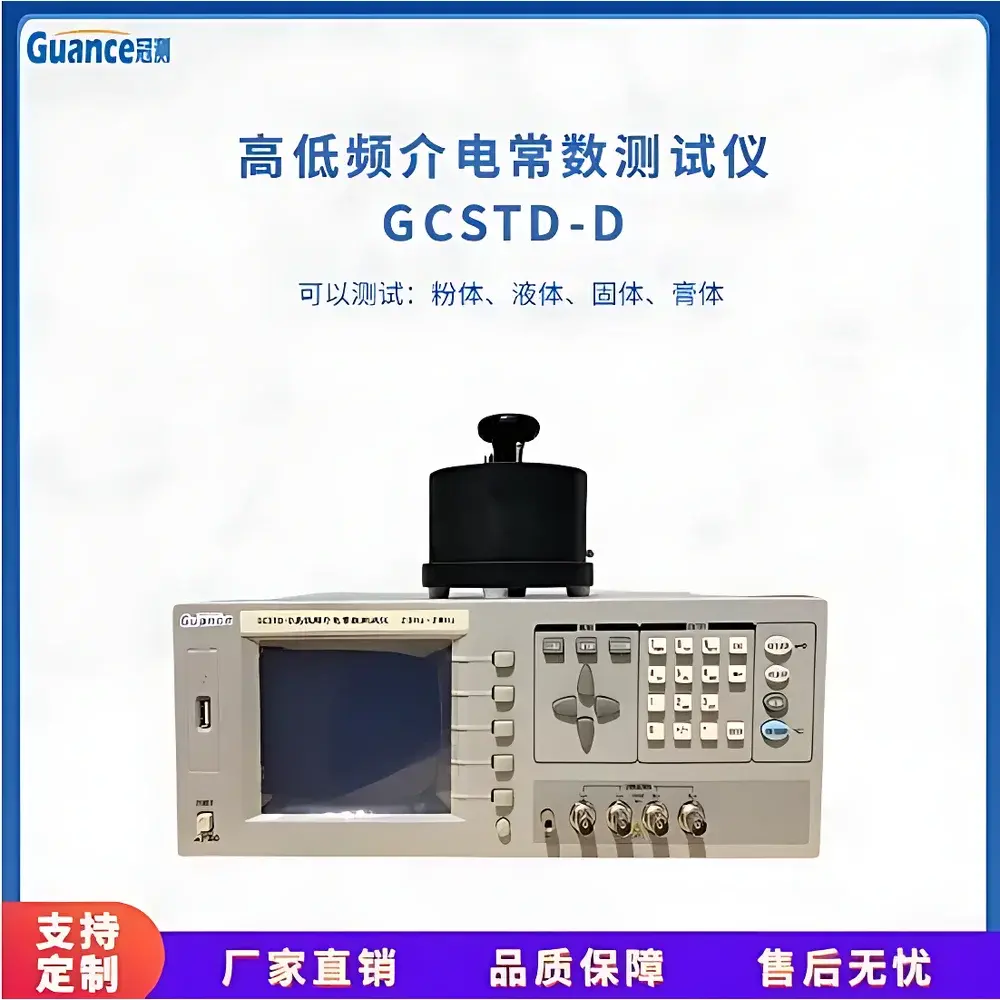
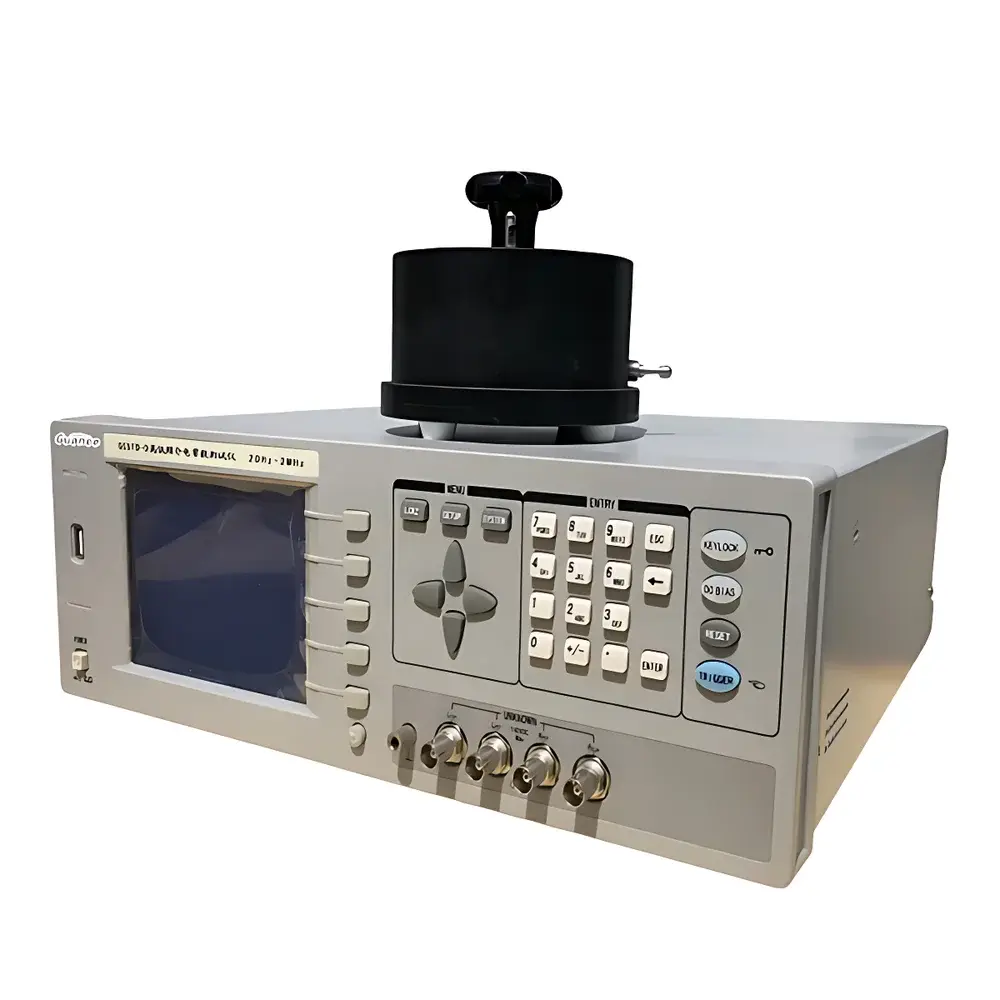
GuanCe GCSTD-D High-Low Frequency Dielectric Constant Analyzer
| Brand | GuanCe Instruments |
|---|---|
| Origin | Beijing, China |
| Manufacturer Type | Authorized Distributor |
| Country of Origin | China |
| Model | GCSTD-D |
| Price | USD 450 (FOB) |
| Frequency Range | 20 Hz – 2 MHz (10 mHz resolution) |
| Test Signal Level | 10 mV – 5 Vrms (1 mV step) |
| Basic Accuracy | ±0.1% |
| Measurement Speed | Up to 200 readings/sec |
| Display | 320×240 dot-matrix LCD |
| Impedance Parameters | 22 selectable combinations (e.g., C–D, C–Q, L–Q, R–X, Z–θ) |
| Electrode Options | Fixed disk electrodes (φ38 mm / φ50 mm standard), liquid cell (15 mL capacity), powder cell (customizable volume) |
| Sample Types | Solids, liquids, powders, pastes, regular or irregular geometries |
| Compliance | GB/T 1409–2006, GB/T 1693–2007, ASTM D150, IEC 60250 |
| Interface | USB Host, RS232, GPIB (optional), Handler I/O |
| DC Bias | Internal ±10 V / 100 mA |
| ALA/ALC | Automatic Level Control and Voltage/Current monitoring |
| Scan Modes | 10-point list sweep, graphical analysis ( |
| Memory | 20 instrument setups |
| Comparator | 10-bin sorting with pass/fail indication and counting |
Overview
The GuanCe GCSTD-D High-Low Frequency Dielectric Constant Analyzer is a precision LCR impedance analyzer engineered for the quantitative characterization of dielectric properties across a broad spectral range—from power-frequency (20 Hz) through audio and radio frequencies up to 2 MHz. It operates on the principle of AC impedance spectroscopy using a four-terminal-pair (Kelvin) measurement architecture to minimize parasitic effects and ensure high reproducibility in complex permittivity (ε′, ε″) and loss tangent (tan δ) determination. Designed specifically for materials science laboratories, quality control departments, and R&D centers evaluating insulating, polymeric, ceramic, and composite media, the GCSTD-D delivers traceable, standards-aligned measurements per GB/T 1409–2006 (equivalent to IEC 60250), GB/T 1693–2007, and ASTM D150. Its dual-mode electrode configuration—supporting contact, non-contact, and immersion methods—enables reliable data acquisition from geometrically heterogeneous samples without requiring extensive machining or surface metallization.
Key Features
- Wide frequency coverage from 20 Hz to 2 MHz with 10 mHz resolution, enabling dispersion analysis across α-, β-, and γ-relaxation regions in dielectrics.
- High-stability signal source with programmable test voltage (10 mV–5 Vrms) and automatic level control (ALC) to maintain consistent excitation amplitude across impedance ranges.
- Dual-electrode system: Standard fixed-disk electrodes (φ38 mm, compliant with GB/T 1409); optional φ50 mm, liquid cell (15 mL), and customizable powder cells for volumetric or loose-material testing.
- Simultaneous acquisition of 22 impedance parameter sets—including parallel/series capacitance (Cp/Cs), dissipation factor (D), quality factor (Q), phase angle (θ), and complex permittivity derivatives—calculated in real time using factory-trimmed calibration coefficients.
- Graphical sweep capability: 10-point frequency or voltage list scanning with on-screen |Z|, θ, C, and D plots; exportable via USB Host to CSV for post-processing in MATLAB or Python.
- Built-in DC bias source (±10 V / 100 mA) and compatibility with external current-biased configurations (up to ±40 A with dual TH1776 units) for C–V profiling of semiconductors and ferroelectric thin films.
- Firmware-upgradable architecture via USB Host interface; bilingual (English/Chinese) UI with context-sensitive soft keys and full keyboard navigation.
Sample Compatibility & Compliance
The GCSTD-D accommodates diverse physical states and morphologies without compromising metrological integrity. Solid specimens—including molded plaques, sintered ceramics, elastomeric sheets, and anisotropic composites—are measured using guarded parallel-plate electrodes under controlled pressure. Liquids (e.g., transformer oils, polymer solutions, ionic electrolytes) are evaluated in the dedicated 15 mL cell with temperature-stable PTFE insulation. Powders and granular media are analyzed in compression-tuned cells that maintain uniform density and interparticle contact. Irregular or curved surfaces may be assessed via non-contact mode using guarded open-ended coaxial probes (optional accessory). All measurement protocols adhere to the uncertainty budgets defined in ISO/IEC 17025-accredited environments and satisfy documentation requirements for GLP-compliant reports under FDA 21 CFR Part 11 when paired with validated software and audit-trail-enabled PC control.
Software & Data Management
The instrument supports direct data logging and remote operation via RS232, GPIB (IEEE-488.2), or USB-TMC interfaces. Optional PC software provides automated compliance reporting against ASTM D150 Annexes, including tan δ vs. frequency regression, Cole–Cole plot generation, and Debye model fitting. Raw datasets include timestamped metadata (operator ID, sample ID, ambient T/RH, electrode type, calibration date), supporting full traceability. Internal memory stores 20 complete instrument configurations—including frequency lists, bias settings, and limit tables—for rapid reconfiguration between test standards. Firmware updates preserve all user-defined calibration offsets and require no hardware recalibration.
Applications
- Determination of relative permittivity (εr) and dielectric loss (tan δ) in electrical insulation systems per IEC 60270 and IEEE Std 930.
- Quality screening of polymer films, laminates, and encapsulants used in PCB substrates and aerospace composites.
- C–V characterization of gate oxides, ferroelectric capacitors, and perovskite solar cell layers.
- Monitoring moisture uptake and aging-induced polarization losses in epoxy resins and silicone rubbers.
- Quantification of ionic conductivity and relaxation dynamics in solid-state electrolytes for battery development.
- Material qualification for EMI shielding effectiveness modeling and RF absorber design.
FAQ
Does the GCSTD-D comply with international regulatory requirements for laboratory accreditation?
Yes—it meets the metrological traceability and uncertainty reporting requirements of ISO/IEC 17025 and supports audit-ready documentation when operated with version-controlled firmware and calibrated electrodes.
Can the instrument measure anisotropic dielectrics such as unidirectional fiber composites?
Yes, using orthogonal electrode alignment and directional field application; users must define principal axis orientation in test setup parameters.
Is NIST-traceable calibration available for the GCSTD-D?
Factory calibration uses NIST-traceable LCR standards (Keysight/QuadTech reference kits); end-user calibration certificates are issued with each instrument shipment.
What is the minimum sample thickness required for accurate solid-dielectric measurement?
For contact-mode testing with φ38 mm electrodes, recommended thickness is ≥0.5 mm; thinner films require guard-ring electrodes (optional accessory) to suppress fringing-field errors.
How does the GCSTD-D handle temperature-dependent dielectric measurements?
It integrates seamlessly with commercial environmental chambers (e.g., ESPEC, Angelantoni) via analog I/O triggers; temperature metadata is embedded in exported datasets.



