
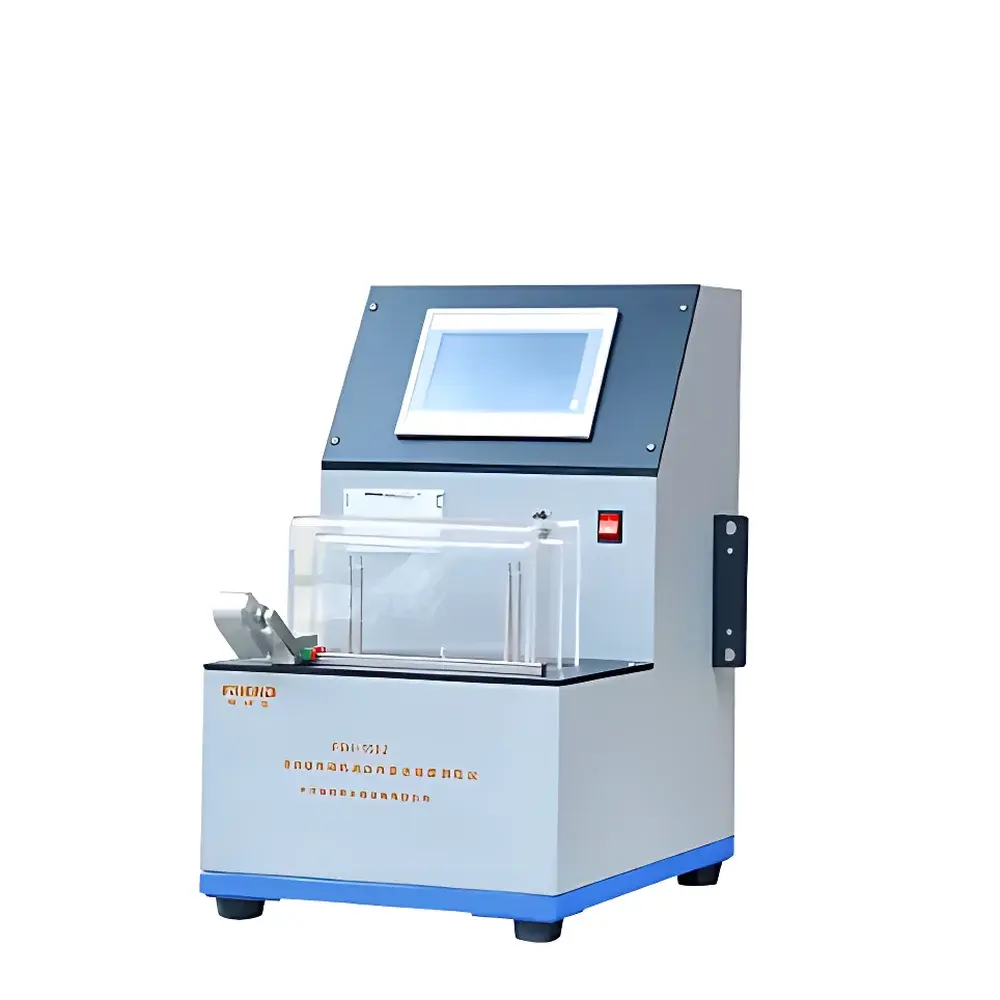
FlanD FDH-1502 Engine Oil Borderline Pumping Temperature (BPT) Tester
| Brand | FlanD / csfriend |
|---|---|
| Origin | Hunan, China |
| Model | FDH-1502 |
| Applicable Standards | GB/T 9171, ASTM D4684, SH/T 0562 |
| Temperature Range | –50 °C to +80 °C |
| Sample Capacity | 9-position test block |
| Power Supply | AC 220 V ±10%, 50 Hz |
| Cooling System | Imported compressor-based refrigeration unit |
| Detection Method | Optical encoder-based rotor speed measurement |
| Control Interface | Touchscreen with bilingual (English/Chinese) OS |
| Software | FLD proprietary BPT analysis software with real-time timing, auto-diagnosis, and single-point calibration capability |
| Optional Feature | Integrated nitrogen purge port |
| Design | Integrated monolithic chassis |
Overview
The FlanD FDH-1502 Engine Oil Borderline Pumping Temperature (BPT) Tester is an automated, thermally controlled analytical instrument engineered for precise determination of the lowest temperature at which engine oil can be pumped by an engine’s oil pump under cold-start conditions. It operates on the principle of torque-based rheological resistance measurement: as temperature decreases, the oil’s apparent viscosity increases until the rotational torque required to drive a standardized rotor exceeds a defined threshold—this transition point defines the BPT. The instrument complies with internationally recognized test methodologies including ASTM D4684 (Standard Test Method for Determination of the Borderline Pumping Temperature of Engine Oils), GB/T 9171 (Chinese national standard for low-temperature pumpability), and SH/T 0562 (Petroleum Industry Standard for engine oil low-temperature performance). Its design addresses critical limitations of legacy systems—particularly thermal drift during extended sub-zero testing—by replacing water-cooled or Peltier-based cooling with a high-efficiency imported compressor refrigeration system, ensuring stable cold-bath temperature control across the full –50 °C to +80 °C operating range.
Key Features
- Integrated 9-position test block enabling parallel evaluation of up to nine samples per cycle—significantly increasing laboratory throughput without compromising repeatability.
- Optical encoder-based rotor speed detection system, utilizing imported photoelectric sensors for non-contact, high-resolution angular velocity measurement—eliminating mechanical wear and ensuring long-term metrological stability.
- Intelligent touchscreen interface with embedded bilingual (English/Chinese) operating system; all test sequences—including temperature ramping, dwell time, rotational speed acquisition, and BPT calculation—are initiated via single-button execution.
- FLD proprietary BPT analysis software provides real-time graphical feedback: dynamic temperature vs. time plots, torque trend visualization, automatic endpoint detection per sample, and built-in diagnostic alerts for sensor anomalies or thermal deviation.
- Monolithic mechanical architecture replaces outdated modular assemblies—reducing footprint by >30% while improving thermal isolation between refrigeration circuitry and measurement chamber.
- Single-point calibration functionality allows users to validate and adjust measurement accuracy at any user-selected temperature point within the operational range, supporting traceable verification without full multi-point recalibration.
- Optional nitrogen purge inlet enables inert atmosphere operation—critical for oxidation-sensitive formulations or research-grade evaluation under controlled ambient conditions.
Sample Compatibility & Compliance
The FDH-1502 accommodates standard ASTM D4684-compliant sample cups (100 mL capacity, stainless steel) and accepts all SAE J300-classified engine oils, including conventional mineral, semi-synthetic, and fully synthetic formulations. Its hardware and firmware architecture are designed to meet functional requirements of ISO/IEC 17025-accredited laboratories. While not certified as GMP-compliant out-of-the-box, the instrument supports audit-ready data integrity when used in conjunction with validated FLD software configurations that enforce electronic signature, change history logging, and 21 CFR Part 11–compatible user access controls (requires optional software license and IT validation documentation).
Software & Data Management
The FLD BPT software suite records raw sensor outputs—including bath temperature (±0.1 °C), rotor angular velocity (0.1 rpm resolution), elapsed time, and calculated torque—at 1 Hz sampling frequency. All datasets are timestamped, tagged with operator ID and sample ID, and stored in encrypted SQLite databases. Export options include CSV (for LIMS integration), PDF test reports with embedded metadata, and XML files compatible with enterprise QA/QC systems. Audit trails capture every parameter modification, calibration event, and result override—supporting GLP-aligned record retention policies.
Applications
- Formulation development of low-temperature engine oils meeting ILSAC GF-6, API SP, and ACEA C-series specifications.
- Quality assurance screening of incoming base stocks and finished lubricants against OEM-specified BPT limits.
- Research into additive package efficacy—particularly pour point depressants and viscosity index improvers—under simulated cold-cranking conditions.
- Comparative benchmarking of alternative base fluids (e.g., PAOs, esters, bio-derived synthetics) for extreme low-temperature mobility.
- Supporting regulatory submissions requiring ASTM D4684–compliant data packages for North American and global markets.
FAQ
What standards does the FDH-1502 support?
It natively executes test protocols aligned with GB/T 9171, ASTM D4684, and SH/T 0562, with software-configurable ramp rates, dwell times, and pass/fail criteria per standard.
Is the instrument suitable for GLP-regulated environments?
Yes—when deployed with validated software configuration, electronic signatures, and documented IQ/OQ/PQ protocols, it meets core data integrity requirements for GLP and internal QA use.
Can the system operate unattended overnight?
Yes—the compressor cooling system maintains thermal stability for >16 hours at –40 °C; combined with auto-shutdown on completion and fault-triggered email alerts (via optional network module), it supports lights-out operation.
How is calibration traceability established?
The optical encoder and Pt100 bath sensor are factory-calibrated against NIST-traceable references; single-point field verification at –30 °C or –40 °C is supported using certified reference oils.
Does the system require external chiller or tap water?
No—integrated compressor refrigeration eliminates dependency on external coolant sources, reducing infrastructure complexity and operational cost.
Related Products







