
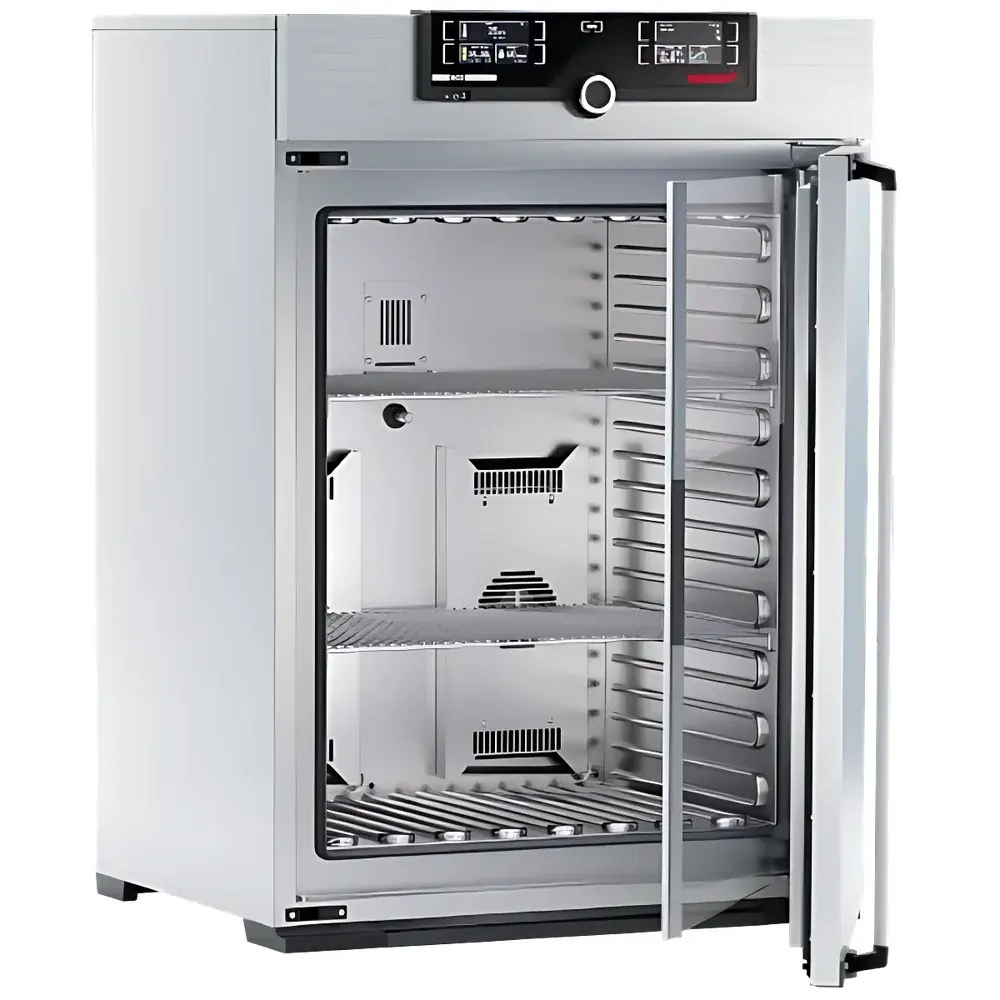
Memmert HPP260eco Environmental Stability Testing Chamber
| Brand | Memmert |
|---|---|
| Origin | Germany |
| Manufacturer | Memmert GmbH & Co. KG |
| Type | Semiconductor-Cooled Stability Chamber |
| Model | HPP260eco |
| Temperature Range | 0 °C to +70 °C |
| Humidity Range | 10 %rh to 90 %rh (dynamic humidification & dehumidification) |
| Control Precision | ±0.1 °C (temp), ±1 %rh (humidity) |
| Cooling Technology | Solid-State Peltier |
| Energy Reduction vs. Compressor-Based Systems | Up to 90 % |
| Compliance | ICH Q1A(R3), ICH Q5C, ISO 14644-1 (Class 8), GLP-ready |
| Calibration Points | User-selectable triple-point calibration (T/RH) on touchscreen interface |
| Optional | Dimmable LED Illumination System (2700 K / 6500 K / Dual-White, 1 % step adjustment) |
Overview
The Memmert HPP260eco Environmental Stability Testing Chamber is an ICH Q1A(R3)-compliant, semiconductor-based climatic chamber engineered specifically for long-term pharmaceutical stability studies under controlled temperature and humidity conditions. Unlike conventional compressor-driven systems, the HPP260eco employs solid-state Peltier technology for both heating and cooling, enabling precise thermal regulation with minimal mechanical vibration, near-silent operation (<35 dB(A)), and exceptional energy efficiency—up to 90% less power consumption during typical stability test profiles (e.g., 25 °C/60 %rh or 30 °C/70 %rh). Its operating range spans 0 °C to +70 °C and 10–90 %rh, covering all ICH-defined storage conditions including accelerated (40 °C/75 %rh), intermediate (30 °C/65 %rh), and long-term (25 °C/60 %rh or 30 °C/65 %rh) testing protocols. The chamber’s uniformity (±0.3 °C at 25 °C; ±2 %rh at 60 %rh) and stability (±0.1 °C over 24 h; ±1 %rh over 24 h) are validated per ISO 14644-1 Class 8 cleanroom-compatible airflow design and double-wall vacuum-insulated construction.
Key Features
- Solid-state Peltier cooling/heating system — eliminates refrigerants, compressors, oil lubrication, and scheduled maintenance
- Energy-optimized operation: achieves <0.8 kWh/day average consumption in standard 25 °C/60 %rh mode
- High-precision microprocessor control with 7-inch capacitive touchscreen interface and real-time graphing
- Triple-point calibration capability: users can select and adjust three independent temperature/humidity setpoints directly on the controller for IQ/OQ/PQ traceability
- Vacuum-insulated double-walled stainless-steel chamber body with seamless interior welds and electro-polished surfaces (Ra < 0.8 µm)
- Integrated data logging (internal SD card + optional Ethernet/Wi-Fi) with timestamped, encrypted CSV export compliant with FDA 21 CFR Part 11 requirements
- Optional dimmable LED illumination module: selectable CCT (2700 K warm white / 6500 K cool white / dual-channel blend), intensity adjustable in 1% increments, photobiologically safe (IEC 62471 Class 1)
Sample Compatibility & Compliance
The HPP260eco accommodates standard ICH-compliant sample racks (including 3-tier universal trays and custom-configurable shelving), supporting vials, blister packs, syringes, and primary packaging formats without airflow obstruction. Its internal volume (260 L net) ensures adequate air exchange (≥15 air changes/hour) while maintaining spatial uniformity across load configurations up to 80% capacity. All operational parameters meet the validation requirements of ICH Q1A(R3), Q5C, and WHO Technical Report Series No. 992 Annex 6. The system supports full GxP compliance: audit trail functionality, electronic signatures, user-level access control (admin/operator/viewer), and configurable alarm thresholds with SMS/email notification via optional gateway. It is routinely qualified per ASTM E2500-13 and ISPE Baseline® Guide Vol. 5 for pharmaceutical environmental chambers.
Software & Data Management
The integrated Memmert eCO software suite enables remote monitoring, multi-chamber synchronization, and automated report generation (PDF/CSV) aligned with ALCOA+ principles. Data integrity safeguards include write-once-read-many (WORM) logging, cyclic redundancy check (CRC) verification, and SHA-256 hash validation for all recorded datasets. Exported files retain full metadata: operator ID, instrument serial number, calibration status, environmental deviations, and event timestamps. For enterprise integration, OPC UA and MQTT protocols support connection to LIMS, MES, and SCADA platforms. All firmware updates are digitally signed and verified prior to installation to ensure cryptographic integrity.
Applications
- ICH-aligned stability studies (long-term, accelerated, stress testing) for APIs, finished dosage forms, and biologics
- Real-time and accelerated shelf-life determination per USP , Ph. Eur. 5.1.3, and JP 17
- Excipient compatibility screening under variable RH conditions
- Photostability pre-screening when equipped with LED illumination module (per ICH Q1B)
- Reference standard storage under GLP-controlled conditions (2–8 °C optional via external chiller interface)
- Environmental simulation for packaging integrity testing (e.g., moisture permeation, seal strength variation)
FAQ
Does the HPP260eco require refrigerant handling or annual compressor servicing?
No. The Peltier-based system contains no volatile refrigerants, oil, or moving mechanical parts—eliminating regulatory reporting obligations under F-Gas Regulation (EU) No 517/2014 and routine maintenance contracts.
Can the chamber be validated for GMP environments?
Yes. It supports full 3Q documentation (IQ/OQ/PQ), includes factory-issued calibration certificates traceable to DKD/DAkkS standards, and provides configurable electronic audit trails meeting FDA 21 CFR Part 11 and EU Annex 11 requirements.
How is temperature/humidity uniformity maintained across varying load conditions?
Adaptive Peltier module modulation adjusts cooling/heating output based on real-time thermal mass feedback from six internal sensors—ensuring consistent performance whether empty or loaded to 80% capacity.
Is the LED illumination module suitable for ICH Q1B photostability testing?
The optional LED system meets ICH Q1B Option 2 (cool white light source) specifications for preliminary assessment; however, formal photostability qualification requires supplemental irradiance mapping per Q1B Annex 1 using calibrated radiometers.
What network security protocols are supported for remote data access?
TLS 1.2 encryption, IEEE 802.1X authentication, VLAN segmentation, and role-based API access control ensure secure integration into regulated IT infrastructures.
Related Products





