
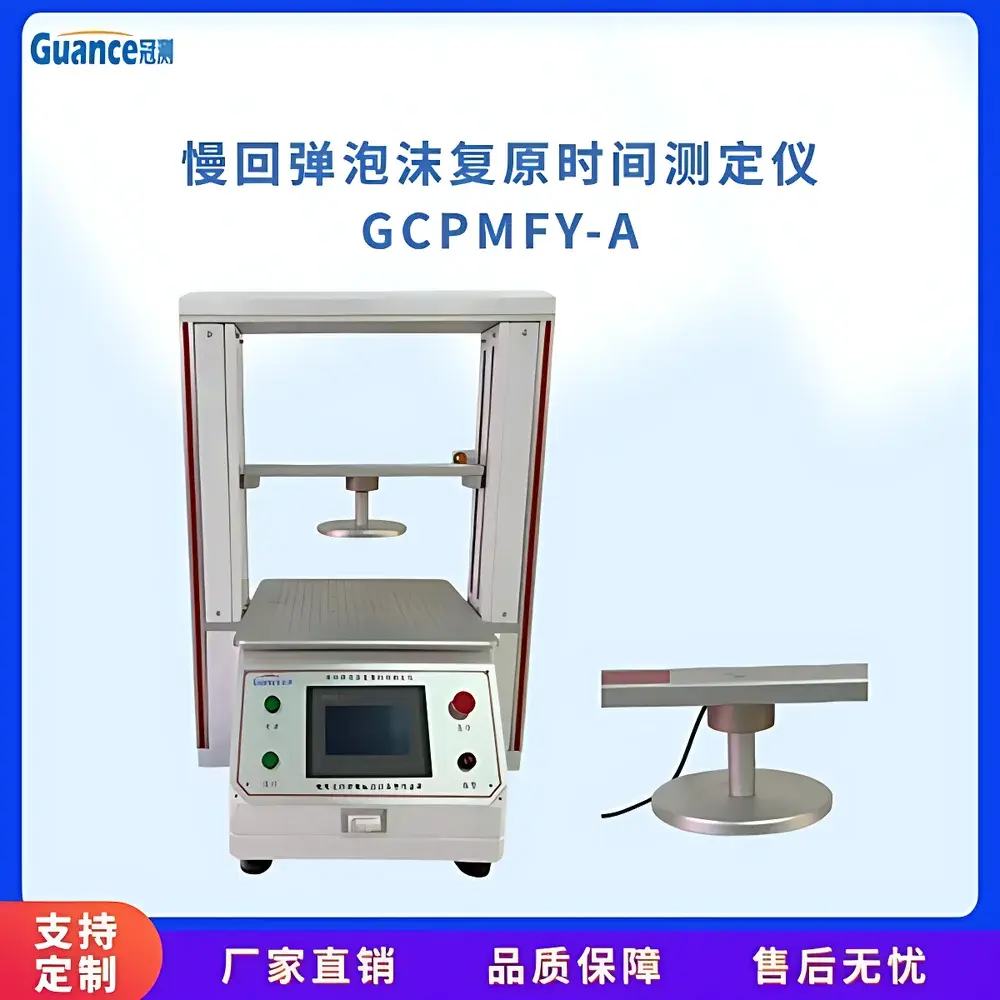
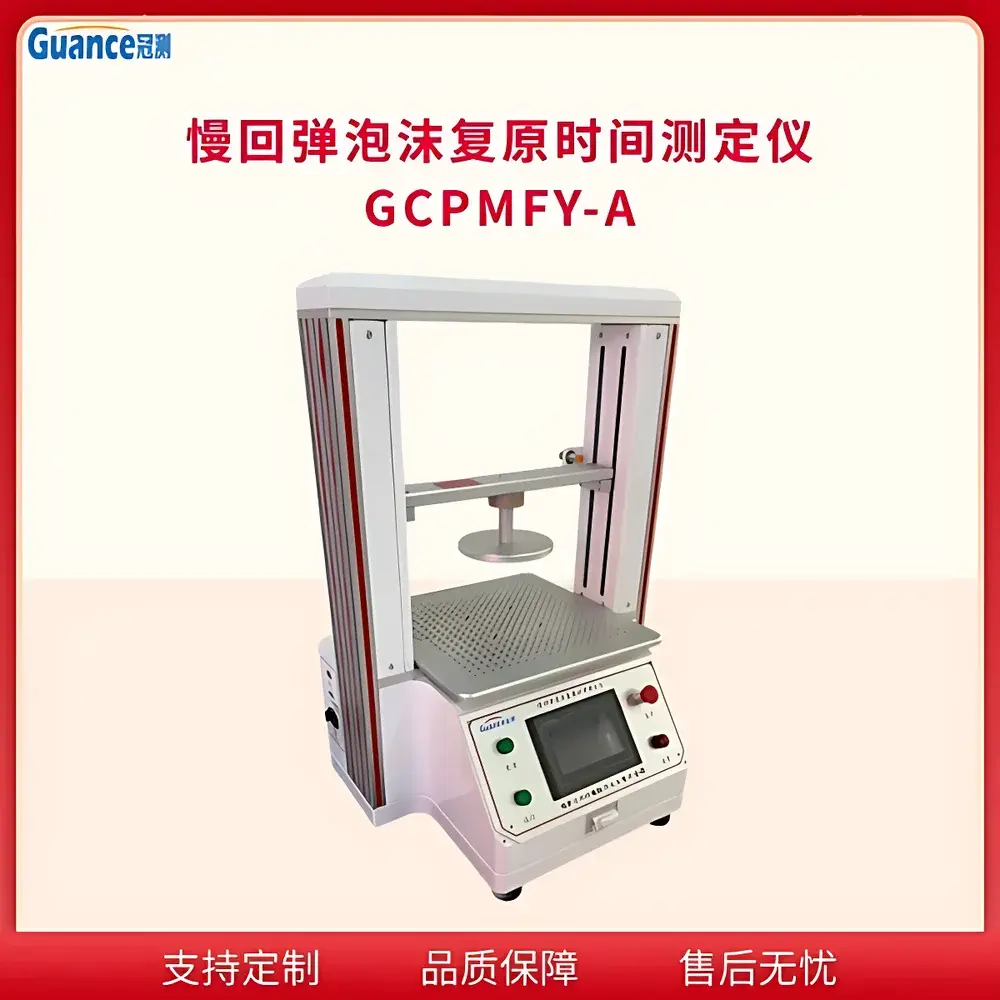
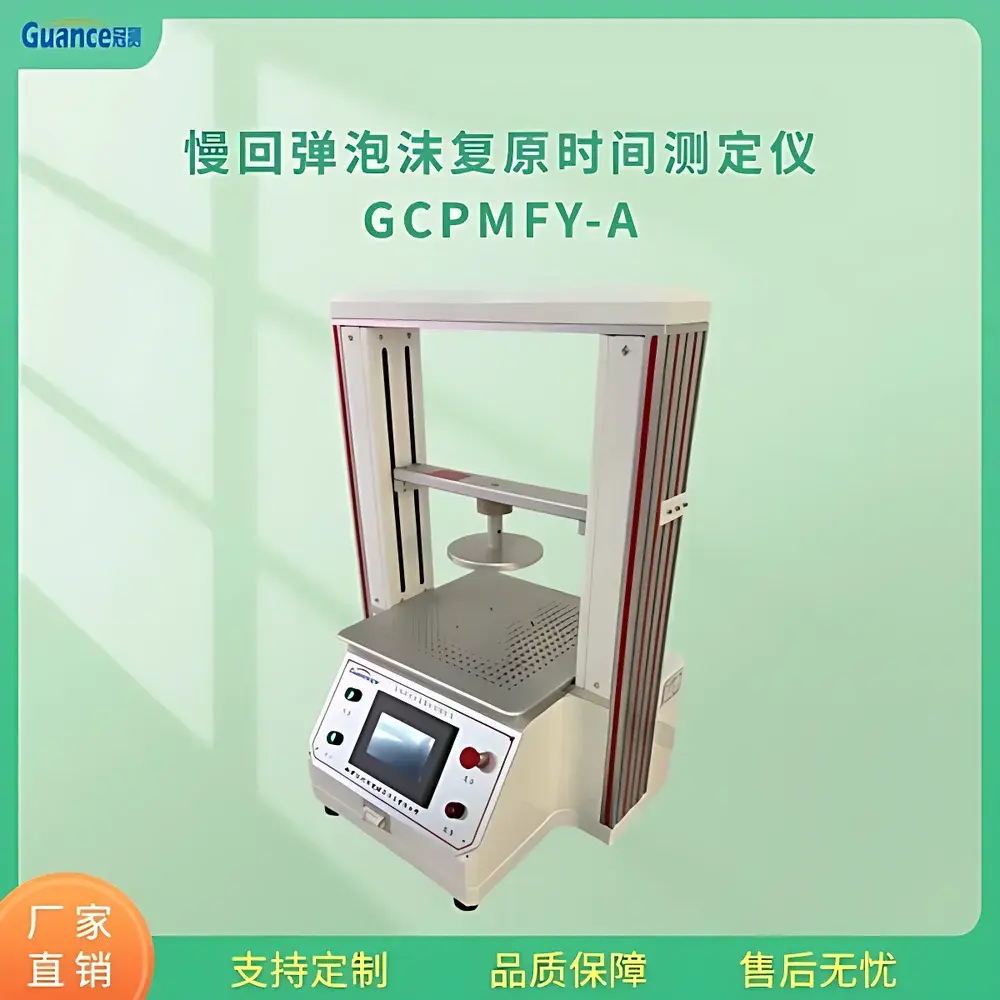
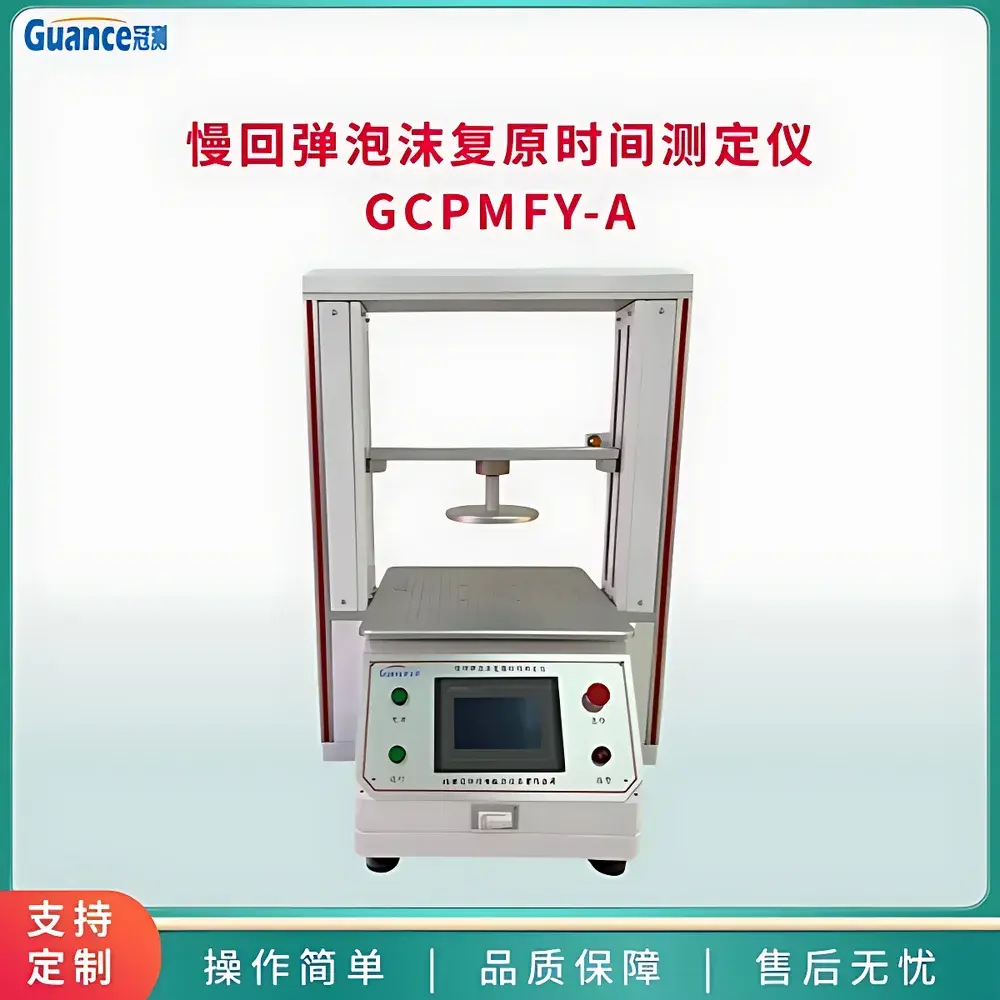
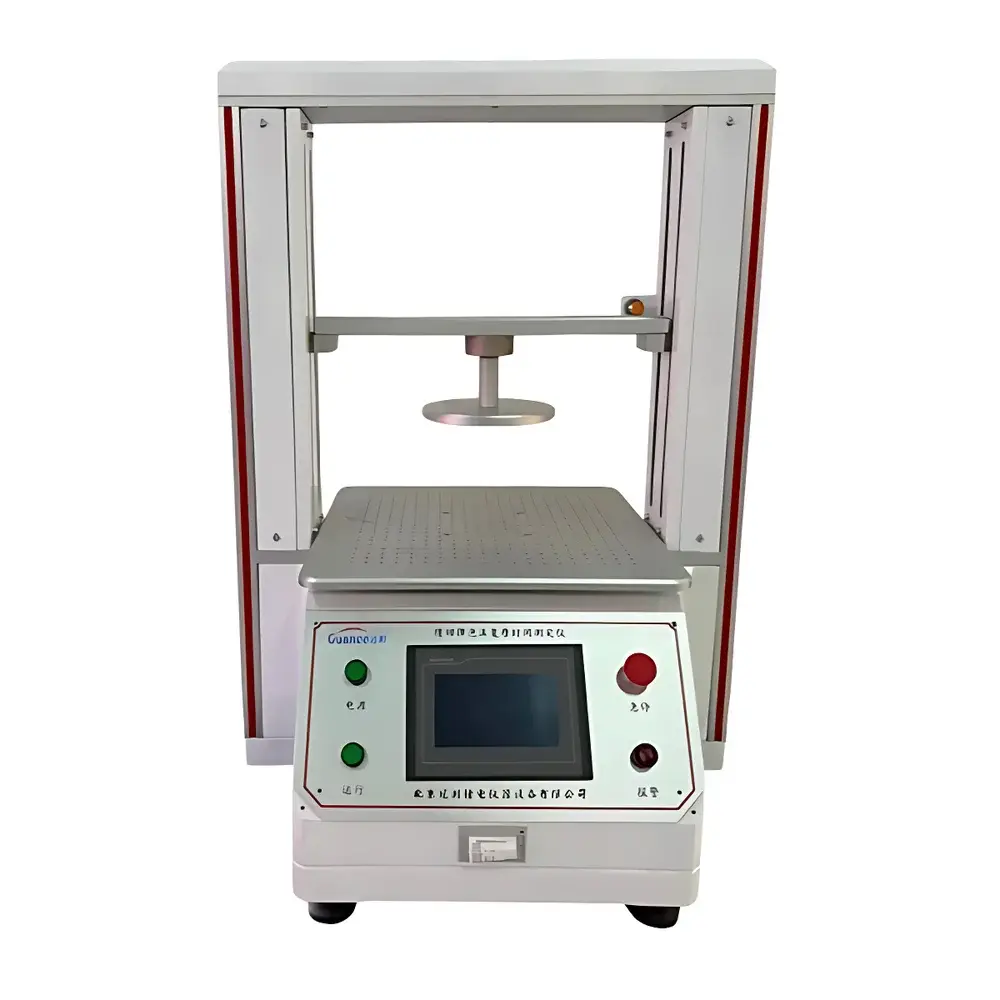
GuanCe GCPMFY-A Automated Slow-Recovery Foam Resilience Time Tester
| Brand | GuanCe Instruments |
|---|---|
| Origin | Beijing, China |
| Manufacturer Type | Authorized Distributor |
| Country of Origin | China |
| Model | GCPMFY-A |
| Price | USD 2,200 (FOB Beijing) |
| Compliance | GB/T 26392–2011, ASTM D3574–08 Section 12 |
| Test Principle | Controlled indentation–hold–recovery cycle with laser-displacement monitoring and load-synchronized timing |
| Indentor | 203 mm diameter flat circular plate |
| Indentation Speed | (1000 ± 100) mm/min |
| Support Plate | Perforated (6.5 mm holes, 20 mm pitch) |
| Specimen Dimensions | 380 × 380 × 100 mm |
| Initial Preload | 4.5 N |
| Indentation Depth | 75% of initial thickness |
| Hold Duration | 60 s |
| Recovery Threshold | Re-engagement of 4.5 N preload force |
| Thickness Measurement | Integrated laser displacement sensor (±1 mm accuracy) |
| Time Resolution | 0.01 s |
| Load Cell Range | 1000 N |
| Control Interface | 7-inch industrial capacitive touchscreen (HMI) |
Overview
The GuanCe GCPMFY-A Automated Slow-Recovery Foam Resilience Time Tester is a precision-engineered instrument designed to quantify the viscoelastic recovery kinetics of polyurethane-based slow-rebound (memory) foams. It operates on the standardized indentation–hold–recovery principle defined in GB/T 26392–2011 and ASTM D3574–08 (Section 12), where a calibrated flat indenter applies a controlled compressive strain at a defined rate, holds the deformation for a fixed duration, and then retracts while precisely measuring the time required for the specimen to re-establish mechanical contact under a specified preload force (4.5 N). Unlike manual or semi-automated alternatives, the GCPMFY-A integrates synchronized force, displacement, and time acquisition—enabling traceable, repeatable resilience time measurements critical for QC/QA laboratories, R&D centers, and foam manufacturing facilities complying with ISO 9001 and IATF 16949 quality management systems.
Key Features
- 7-inch high-brightness industrial touchscreen HMI with intuitive test workflow navigation and real-time parameter visualization
- Laser displacement sensor (±1 mm accuracy) for non-contact, wear-free measurement of specimen thickness and recovery displacement
- Automated thickness detection prior to each test cycle—eliminating manual caliper input and operator-induced variability
- High-resolution timing system with 0.01 s resolution, triggered synchronously with indenter retraction initiation and terminated upon re-engagement of 4.5 N preload
- Programmable test sequencing: users may define custom indentation depths, hold durations, preload forces, and recovery thresholds beyond standard protocols
- Integrated 1000 N load cell with digital signal conditioning, ensuring stable force feedback throughout compression and recovery phases
- Thermal-stable aluminum frame and guided linear motion system minimize mechanical hysteresis and ensure long-term repeatability
Sample Compatibility & Compliance
The GCPMFY-A accommodates standard test specimens per GB/T 26392–2011 and ASTM D3574–08: rectangular slabs measuring 380 mm × 380 mm × 100 mm, suitable for slabstock, molded, and laminated slow-rebound polyurethane foams. The perforated support plate (6.5 mm diameter holes, 20 mm center-to-center spacing) ensures uniform air venting during compression, preventing pneumatic resistance artifacts. All test parameters—including indentation speed (1000 ± 100 mm/min), dwell time (60 s), and recovery threshold criteria—are fully aligned with regulatory requirements for foam resilience certification. Data outputs comply with GLP documentation standards, supporting audit readiness for internal quality audits and third-party certification bodies.
Software & Data Management
The embedded firmware supports CSV export of full test logs—including timestamped force, displacement, and elapsed time arrays—for post-processing in MATLAB, Excel, or LIMS environments. Each test record includes metadata: operator ID, sample ID, environmental temperature/humidity (optional external sensor input), calibration status, and firmware version. Audit trails are maintained for all parameter modifications and test executions. While the device does not implement FDA 21 CFR Part 11 electronic signature functionality, its deterministic control architecture and immutable data logging meet baseline requirements for ISO/IEC 17025-accredited testing laboratories conducting non-regulated but method-validated resilience assessments.
Applications
- Quality conformance testing of memory foam mattresses, pillows, and seating components against OEM specifications
- R&D evaluation of polymer formulation changes (e.g., polyol selection, catalyst concentration, blowing agent ratio) on recovery kinetics
- Batch-to-batch consistency verification in high-volume foam production lines
- Comparative analysis of aging effects (thermal, UV, compression set) on viscoelastic recovery behavior
- Technical documentation support for CE marking, CCC certification, and export compliance dossiers
FAQ
What standards does the GCPMFY-A explicitly support?
GB/T 26392–2011 and ASTM D3574–08 (Section 12) are natively implemented; all default test parameters match these methods.
Can the instrument measure foams thinner than 100 mm?
Yes—custom test programs allow adjustment of specimen height limits and preload compensation; however, results must be interpreted with reference to standard-compliant geometry.
Is calibration traceability provided?
The system ships with a factory calibration certificate referencing national metrology standards; annual recalibration using certified weights and displacement gauges is recommended.
Does the device require external PC connectivity for operation?
No—fully autonomous operation via touchscreen; USB port enables data export only, not real-time control.
How is environmental temperature monitored during testing?
An optional RS-485–enabled ambient sensor module can be integrated to log temperature/humidity alongside test data.




