
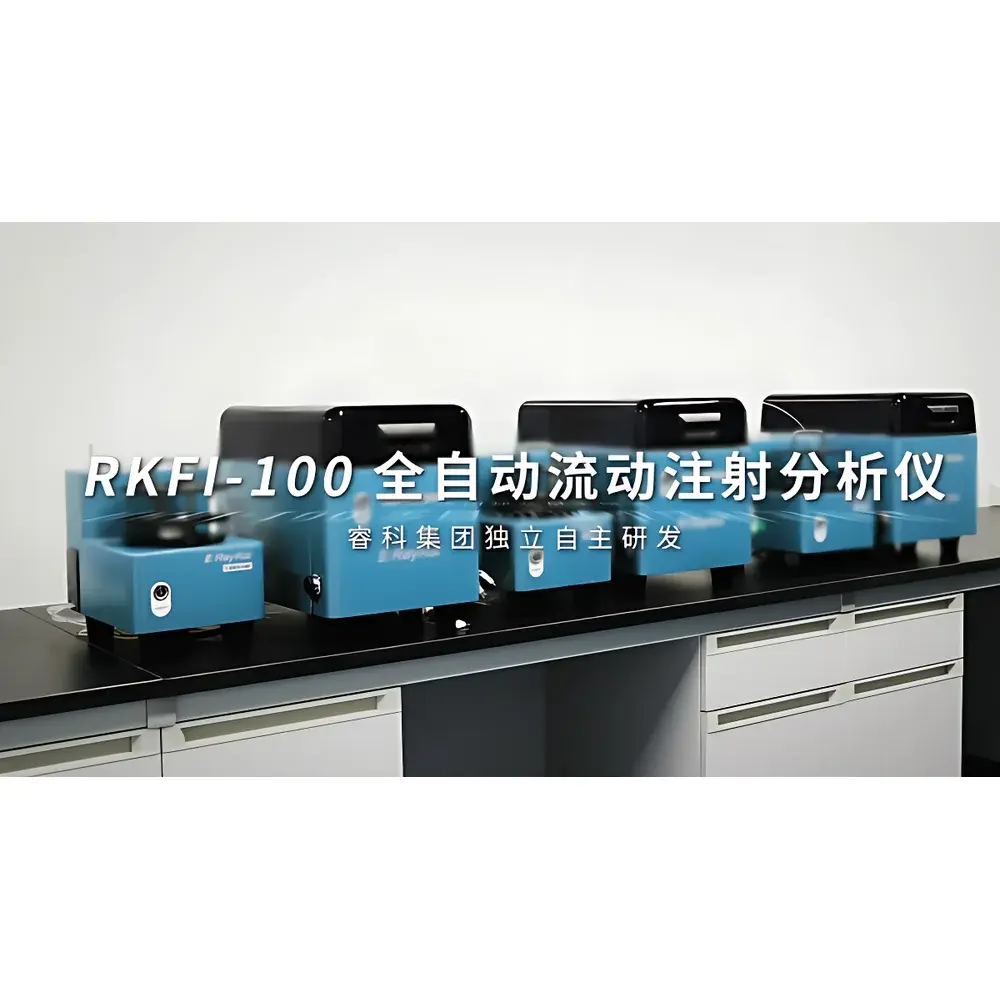
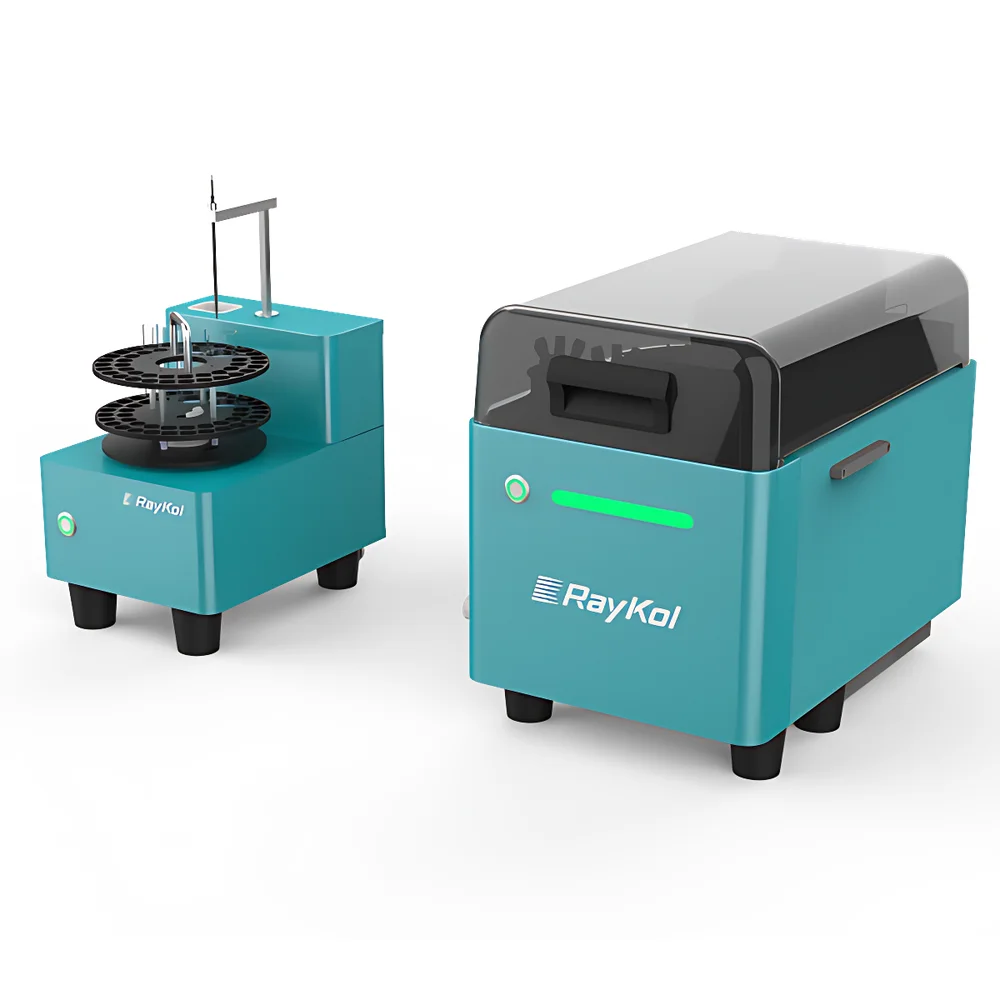
Raykol RKFI-100 Fully Automated Flow Injection Analyzer
| Brand | Raykol |
|---|---|
| Origin | Fujian, China |
| Manufacturer Type | Manufacturer |
| Origin Category | Domestic |
| Model | RKFI-100 |
| Price Range | USD 11,200 – 25,200 (based on exchange rate of ¥1 = USD 0.14) |
| Product Type | Flow Injection Analyzer |
| Wavelength Range | 340–1050 nm |
| Sample Capacity | 42 positions / 79 cups |
| Reagent Positions | 12 |
| Flow Cell Path Lengths | 10 mm / 20 mm / 30 mm |
| Light Source | LED |
Overview
The Raykol RKFI-100 Fully Automated Flow Injection Analyzer is a precision-engineered platform integrating flow injection analysis (FIA) with online sample pretreatment and UV-Vis spectrophotometric detection. Based on the fundamental principles of controlled dispersion, reproducible zone formation, and kinetic reaction timing in segmented carrier streams, the RKFI-100 enables quantitative determination of multiple water quality parameters—including total phosphorus, total nitrogen, ammonia nitrogen, hexavalent chromium, sulfide, volatile phenols, cyanide, and anionic surfactants—under strictly defined hydrodynamic and chemical conditions. Designed for high-throughput routine analysis in regulated environments, the system operates without manual intervention from sampling to report generation, ensuring analytical continuity, traceability, and compliance with method-defined protocols.
Key Features
- Modular architecture comprising peristaltic pumping units, chemically inert PTFE/PFA reaction manifolds, dual-beam LED-based photometric detectors, and integrated online dilution modules.
- Automated standard preparation and dynamic range extension via programmable serial dilution—enabling accurate quantification of samples exceeding upper calibration limits without manual re-runs.
- Dual-beam optical design with stabilized LED light source ensures low baseline drift (<0.002 AU/h), minimal noise (10,000 h), critical for long-duration unattended operation.
- Flexible flow cell configuration supporting interchangeable path lengths (10 mm, 20 mm, 30 mm) to optimize sensitivity and linear dynamic range across analyte concentrations.
- Network-ready interface with dual Ethernet (LAN) and Wi-Fi connectivity, enabling remote monitoring, centralized instrument management, and integration into laboratory information management systems (LIMS).
Sample Compatibility & Compliance
The RKFI-100 accommodates aqueous environmental matrices including surface water, groundwater, drinking water, wastewater effluents, and natural mineral water. Its hardware and software workflows are validated against internationally recognized standard methods, including but not limited to: HJ 823–2017 (Cyanide in water by FIA–UV-Vis), DZ/T 0064.85–2021 and DZ/T 0064.86–2021 (Volatile phenols and cyanide in groundwater by FIA with online distillation), and GB/T 5750.4–2023 and GB/T 5750.5–2023 (Drinking water testing for volatile phenols, anionic surfactants, cyanide, and ammonia-nitrogen). The system supports audit-trail-enabled operation, user access control, and electronic signature functionality—aligning with GLP and GMP documentation requirements where applicable.
Software & Data Management
The RKFI-100 is operated via a dedicated Windows-based control application featuring intuitive graphical workflow configuration, real-time chromatogram visualization, and multi-channel synchronization. A single software instance can manage up to eight independent FIA channels simultaneously, each with isolated method parameters, calibration curves, and data acquisition settings. All spectral and temporal data are stored in vendor-neutral formats (CSV, PDF, XML) with embedded metadata (operator ID, timestamp, method version, instrument serial number). Report generation follows ISO/IEC 17025-compliant templates, including uncertainty estimation placeholders, QC flagging (e.g., blank deviation, calibration drift), and automatic export to LIMS or enterprise databases via ODBC or RESTful API.
Applications
The RKFI-100 serves laboratories engaged in environmental monitoring, public health surveillance, food safety testing, and geological resource assessment. Typical use cases include: continuous monitoring of nutrient loads in watershed management programs; regulatory compliance testing for municipal water utilities under national drinking water standards; rapid screening of industrial discharge for priority pollutants such as Cr(VI) and CN⁻; and high-volume analysis of cyanide in food extracts per GB 5009.36–2023. Its robust fluidic design minimizes carryover (200 injections per day with consistent inter-run precision (RSD <1.8% for mid-range standards).
FAQ
What sample matrices are compatible with the RKFI-100?
Aqueous samples only—including raw and treated drinking water, surface and groundwater, wastewater, and food extract solutions—provided they meet filtration specifications (≤0.45 µm) and pH stability requirements for downstream chemistry.
Does the system support method validation according to ISO/IEC 17025?
Yes—the software provides full audit trails, electronic signatures, calibration history logs, and QC result tracking, enabling laboratories to demonstrate technical competence and data integrity during accreditation assessments.
Can the RKFI-100 be integrated into an existing LIMS environment?
Yes—via standardized database connectivity (ODBC) or HTTP-based APIs, allowing automated transfer of raw data, processed results, and QA/QC metrics without manual file handling.
Is the LED light source field-replaceable without recalibration?
Yes—the optical module is designed for hot-swap replacement; factory calibration coefficients are retained in non-volatile memory, eliminating the need for user-performed recalibration after lamp exchange.
What maintenance intervals are recommended for routine operation?
Peristaltic pump tubing should be replaced every 3–6 months depending on usage intensity; flow cells require quarterly cleaning with dilute nitric acid; and system performance verification using NIST-traceable standards is advised prior to each analytical batch.




