
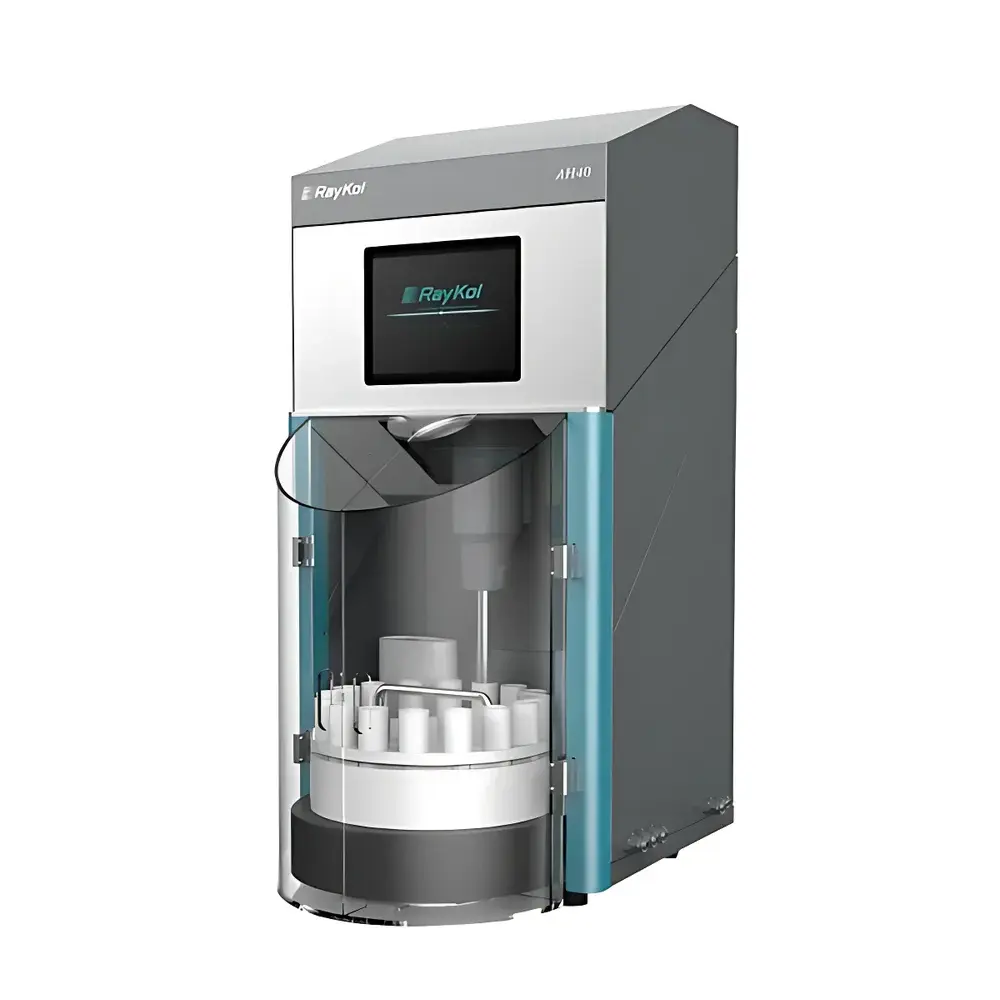
Raykol AH-40 Automated Probe Homogenizer
| Brand | Raykol |
|---|---|
| Origin | Fujian, China |
| Manufacturer Type | Direct Manufacturer |
| Regional Classification | Domestic (China) |
| Model | AH-40 |
| Price Range | USD 14,000 – 28,000 |
| Instrument Type | Rotating Blade Probe Homogenizer |
| Dimensions (W×D×H) | 520 × 350 × 780 mm |
| Sample Volume Capacity | 10–200 mL per tube |
| Maximum Throughput | 32 samples per run |
| Enclosure | Fully Sealed with Active Exhaust Ventilation |
| Safety Features | Overheat Protection, Overload Detection, Real-time Motor Monitoring |
| User Interface | Graphical Touchscreen, Chinese Language Default (Multi-language Firmware Upgradeable) |
| Cleaning Modes | Programmable Rinse Cycles (Solvent Flush, Air Dry, Dual-Solvent Sequential Wash) |
| Tube Compatibility | Standard 15 mL & 50 mL Conical Centrifuge Tubes (Falcon-type), Optional Custom Racks Available |
Overview
The Raykol AH-40 Automated Probe Homogenizer is an engineered solution for high-throughput, reproducible sample disruption in regulated analytical laboratories. It operates on the principle of high-speed rotating blade probe homogenization—utilizing controlled mechanical shear forces to uniformly disrupt biological and food matrices while preserving analyte integrity. Designed specifically for pre-analytical processing in food safety, veterinary drug residue testing, pesticide multiresidue analysis, and mycotoxin quantification, the AH-40 replaces manual homogenization workflows that are prone to operator variability, cross-contamination, and occupational exposure risks. Its fully enclosed architecture integrates active exhaust ventilation to capture volatile organic solvents (e.g., acetonitrile, ethyl acetate, hexane) at the source—reducing ambient VOC concentrations and minimizing reliance on fume hood infrastructure. The system supports unattended batch processing of up to 32 samples per cycle, making it suitable for laboratories adhering to ISO/IEC 17025, GLP, and FDA-regulated workflows where traceability, consistency, and personnel safety are non-negotiable.
Key Features
- Automated dual-phase operation: Simultaneous homogenization and integrated probe cleaning within a single run—eliminating manual intervention between samples.
- Programmable cleaning protocols: Three-stage solvent rinse sequences (pre-wash, main wash, post-rinse) with configurable dwell time, flow rate, and air-dry duration to minimize carryover risk.
- Real-time motor diagnostics: Embedded thermal sensors and current monitoring detect abnormal load conditions; automatic shutdown triggers upon overheating or mechanical overload.
- Optical process visibility: Full-height transparent polycarbonate front door with integrated LED illumination enables continuous visual verification of probe immersion depth, tube positioning, and homogenization dynamics.
- Modular rack system: Interchangeable tube holders accommodate 15 mL and 50 mL conical centrifuge tubes (including common brands such as Corning, Eppendorf, and Thermo Fisher); optional racks support custom vessel geometries.
- Touchscreen HMI with method library: Intuitive graphical interface stores ≥50 user-defined homogenization methods—including speed ramping profiles, pulse durations, rest intervals, and cleaning parameters—ensuring method transferability across shifts and operators.
Sample Compatibility & Compliance
The AH-40 demonstrates robust performance across heterogeneous sample types critical to regulatory testing: high-moisture plant tissues (e.g., spinach, celery, leeks), lipid-rich animal matrices (muscle, liver, sausage, fish fillet), and fibrous feedstuffs (alfalfa hay, corn silage, compound feed). Its probe geometry and torque control prevent emulsion over-processing or analyte degradation during extraction prep for LC-MS/MS, GC-MS, and HPLC-UV workflows. The instrument aligns with method requirements specified in multiple pharmacopoeial and national standards, including Chinese Pharmacopoeia (ChP) 2020 Vol. IV General Chapters 2341 (Pesticide Residues, Method V), 2351 (Mycotoxins), Ministry of Agriculture Announcements No. 236, 781, 958, and SN/T 1864–2007. While not certified to IEC 61000-6-2/6-4 or UL 61010-1 out-of-the-box, its electrical design conforms to Class I protection principles and CE-marked components meet RoHS 2011/65/EU directives.
Software & Data Management
The embedded firmware supports audit-trail-enabled operation: every homogenization event logs timestamp, operator ID (via optional RFID badge integration), selected method name, actual RPM profile, total runtime, and cleaning cycle completion status. Raw log files export via USB to CSV format for integration into LIMS or ELN systems. Though native software does not yet comply with FDA 21 CFR Part 11 electronic signature requirements, the platform provides foundational data integrity features—including immutable event logging, password-protected method editing, and user-level access control (Guest, Technician, Administrator). Firmware updates are delivered via secure HTTPS download and verified using SHA-256 checksums.
Applications
The AH-40 serves as a core front-end tool in accredited laboratories performing residue analysis across food and feed supply chains. Typical use cases include: preparation of homogenized tissue slurries prior to QuEChERS extraction; generation of uniform suspensions from powdered herbal matrices for alkaloid profiling; dispersion of dairy-based fortified foods for vitamin A/D quantification; and mechanical lysis of microbial pellets in environmental water testing. Its throughput advantage is especially pronounced in contract testing labs handling >200 samples/week under tight turnaround deadlines—where reduction in hands-on time directly improves capacity utilization and lowers cost-per-sample.
FAQ
What tube formats are supported without adapter modification?
Standard 15 mL and 50 mL conical-bottom polypropylene centrifuge tubes meeting ISO 8573-1 dimensional tolerances.
Can the AH-40 be integrated into robotic liquid handling workcells?
Yes—RS-232 and optional Ethernet TCP/IP interfaces enable external trigger commands and status polling for synchronization with third-party automation platforms.
Is validation documentation (IQ/OQ/PQ) provided?
Raykol supplies a Factory Acceptance Test (FAT) report and basic OQ protocol templates; site-specific PQ must be executed by the end user per ISO/IEC 17025 Clause 6.4.3.
What maintenance intervals are recommended?
Probe shaft lubrication every 6 months; full gasket inspection and replacement every 12 months; annual calibration of motor speed feedback loop using NIST-traceable tachometer.
Does the system support solvent-resistant probe materials beyond stainless steel?
Titanium alloy probes are available as optional accessories for aggressive solvent applications (e.g., chlorinated hydrocarbons, DMSO), subject to lead-time and qualification testing.



