
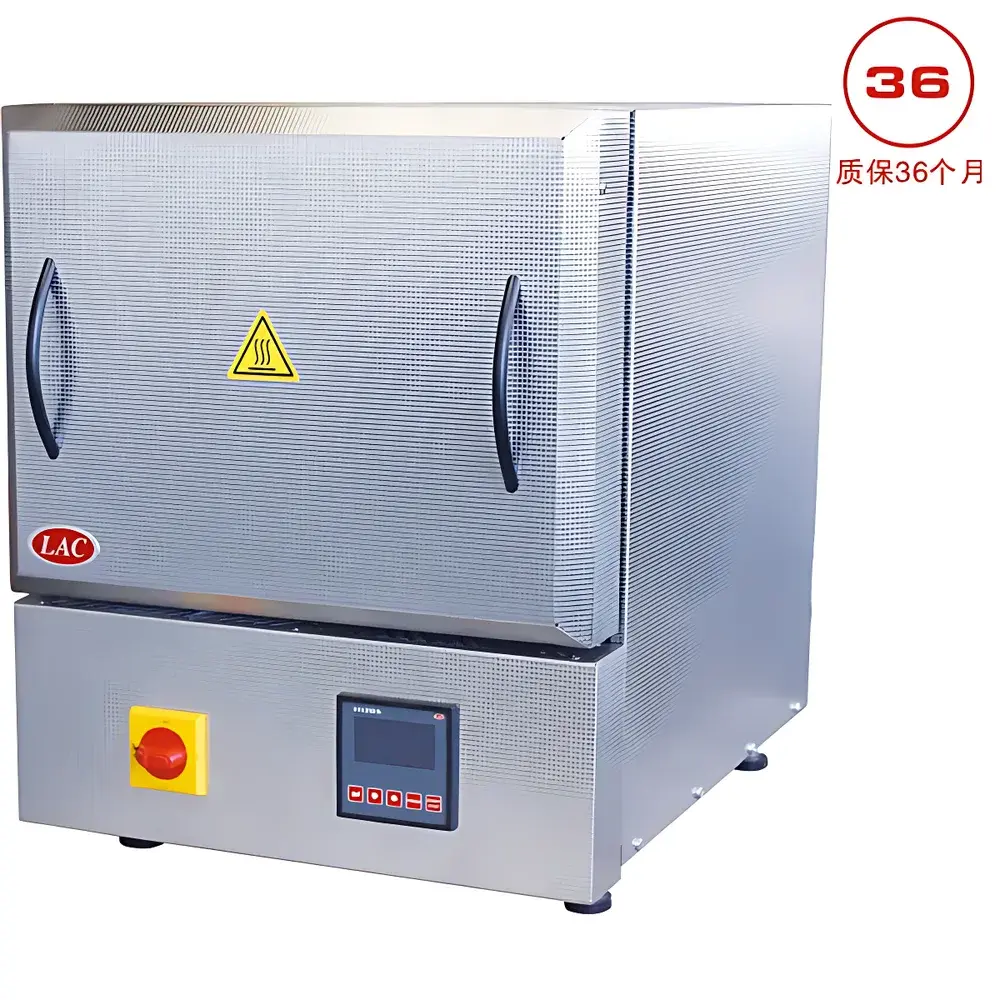
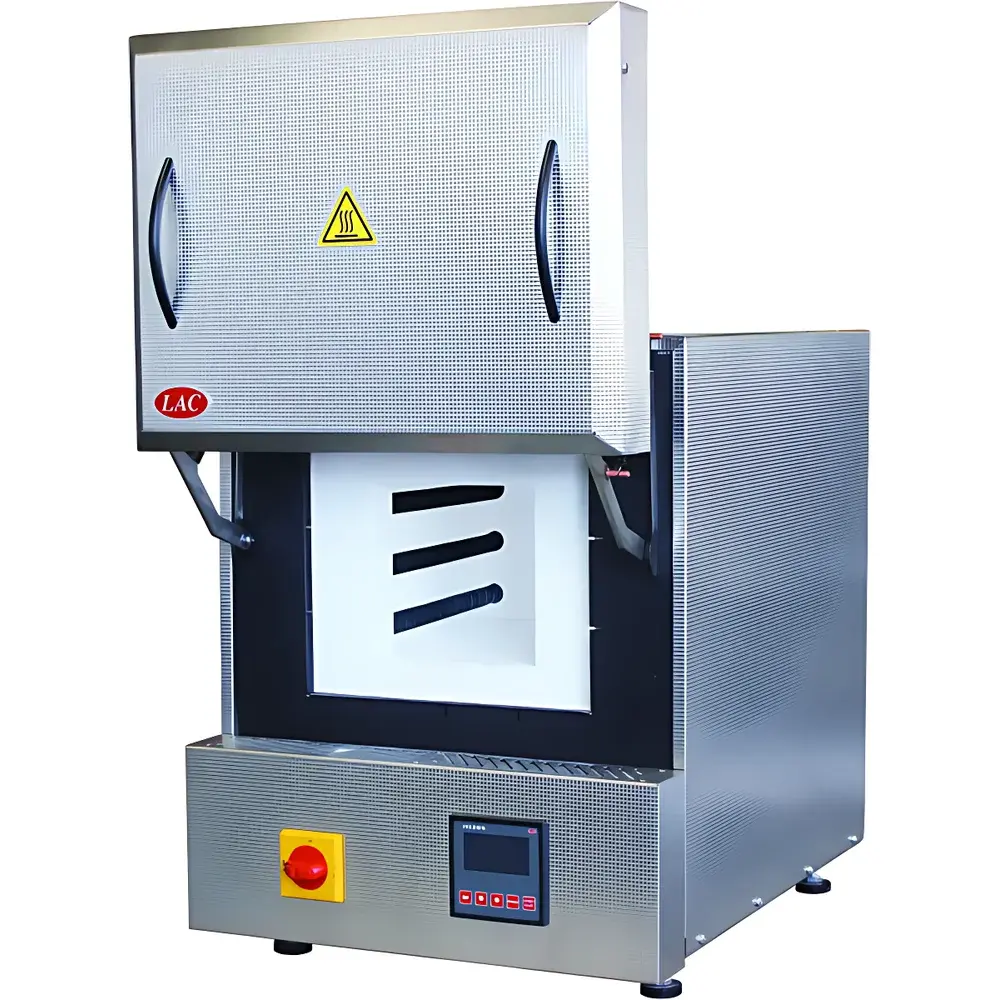
LAC LHS03/14 High-Density Silicon Carbide Rod Laboratory Muffle Furnace
| Brand | LAC |
|---|---|
| Origin | Czech Republic |
| Model | LHS03/14 |
| Type | Box-Type Muffle Furnace |
| Max Temperature | 1400 °C |
| Temperature Uniformity | ±1 °C |
| Max Power | 4.5 kW |
| Ramp Time to 1400 °C | 40 min |
| Heating Element | Silicon Carbide (SiC) Rods |
| Internal Chamber Dimensions | 440 × 565 × 600 mm (W × H × D) |
| Controller | HT205 (30 programs, 15 steps each, LAN interface) |
| Thermocouple Type | Type B |
| Cooling | Forced-air cabinet cooling |
| Safety | Interlocked door switch, manual upward-opening door, desktop configuration optional |
Overview
The LAC LHS03/14 is a precision-engineered box-type muffle furnace designed for laboratory environments requiring reliable, repeatable thermal processing up to 1400 °C. Unlike conventional molybdenum disilicide (MoSi₂)-heated furnaces—such as the LAC VP series—the LHS03/14 employs high-density silicon carbide (SiC) heating rods arranged in an optimized geometric configuration. This architecture delivers superior thermal shock resistance, extended service life under cyclic operation, and lower total cost of ownership without compromising temperature stability or uniformity. The furnace operates on resistive Joule heating principles, where SiC rods generate heat upon current passage, enabling rapid thermal response and minimal thermal inertia. Its compact footprint and reduced mass relative to comparable VP-series models facilitate integration into space-constrained labs while maintaining structural rigidity and thermal integrity across repeated heating–cooling cycles.
Key Features
- High-density silicon carbide rod array engineered for mechanical robustness and thermal shock resilience—particularly advantageous for applications involving frequent ramp-hold-cool sequences.
- Precise temperature control with ±1 °C accuracy over the full 100–1400 °C operating range, verified per ASTM E220 and ISO/IEC 17025 calibration traceability protocols.
- HT205 digital controller with 30 programmable profiles, each supporting up to 15 independent ramp/soak steps; LAN interface enables remote monitoring and integration into lab-wide SCADA or LIMS infrastructure.
- Forced-air external cabinet cooling system maintains ambient surface temperatures below 50 °C during continuous operation at maximum setpoint.
- Interlocked safety door switch automatically de-energizes heating elements when the manually operated upward-lifting door is opened—compliant with EN 61000-6-4 and IEC 61010-1 requirements for electrical safety in laboratory equipment.
- Standard Type B thermocouple (PtRh30/PtRh6) with cold-junction compensation ensures long-term stability and low drift in high-temperature measurement.
- Non-contact solid-state relays eliminate mechanical wear and provide silent, zero-arcing switching—critical for GLP/GMP environments requiring audit-trail integrity.
Sample Compatibility & Compliance
The LHS03/14 accommodates crucibles, boats, and sintering trays made from alumina, silicon carbide, graphite, or molybdenum—compatible with inert, reducing, and mildly oxidizing atmospheres. Optional gas inlet ports support nitrogen, argon, or forming gas purging (up to 0.2 bar overpressure), enabling controlled-atmosphere treatments such as oxide reduction or carbon-free sintering. The furnace meets CE marking requirements under the EU Machinery Directive 2006/42/EC and Electromagnetic Compatibility Directive 2014/30/EU. All electrical insulation and grounding provisions conform to IEC 61010-1:2010 for measurement, control, and laboratory use. Documentation includes factory calibration certificates traceable to national standards (Czech Metrology Institute), supporting compliance with ISO/IEC 17025-accredited testing laboratories.
Software & Data Management
The HT205 controller supports data logging via its built-in LAN port, allowing direct connection to institutional networks. Optional HTMonit software provides real-time graphing, event-triggered alarms, and export of time-stamped temperature profiles in CSV or XML format. When configured with RS-232 or EIA-485 interfaces (available as accessories), the furnace integrates seamlessly with third-party data acquisition systems compliant with IEEE 1394 or Modbus RTU protocols. Audit trail functionality—including user login timestamps, parameter changes, and alarm acknowledgments—is available under HTMonit’s GLP-compliant mode, satisfying FDA 21 CFR Part 11 requirements for electronic records and signatures in regulated research and quality control settings.
Applications
- Thermal gravimetric analysis (TGA) sample pre-treatment and residue ashing per ASTM E1131 and ISO 11358.
- Ceramic sintering and densification studies in materials science research laboratories.
- Calibration of high-temperature reference standards used in metrology institutes.
- Heat treatment of metal alloys, including stress-relief annealing and homogenization below 1400 °C.
- Preparation of catalyst supports and battery electrode materials under controlled oxidative or inert conditions.
- Residue determination in pharmaceutical excipients per USP and EP 2.2.30.
FAQ
What heating technology does the LHS03/14 employ, and how does it differ from MoSi₂-based furnaces?
It uses high-density silicon carbide (SiC) rods, offering greater thermal shock resistance and longer service life under rapid cycling than MoSi₂ elements—especially beneficial in academic and QC labs with variable usage patterns.
Is the furnace suitable for use under protective atmospheres?
Yes—optional gas inlet fittings enable connection to inert or reducing gas supplies; however, continuous operation above 1350 °C under hydrogen requires additional quartz or alumina tube liners to prevent SiC oxidation.
Can the HT205 controller be integrated into a centralized lab automation system?
Yes—via standard LAN, RS-232, or EIA-485 interfaces, supporting TCP/IP, Modbus TCP, or ASCII command protocols for bidirectional communication and scheduling.
What is the expected service life of the SiC heating rods under typical lab usage?
Under normal cycling (≤3 cycles/day, max 1400 °C), SiC rods typically exceed 2,000 hours of cumulative operation before resistance drift exceeds specification limits—verified through accelerated lifetime testing per IEC 60068-2-2.
Does the furnace include documentation required for ISO/IEC 17025 accreditation?
Yes—factory calibration reports, uncertainty budgets, traceability statements, and electrical safety test records are supplied with each unit to support laboratory accreditation audits.



