
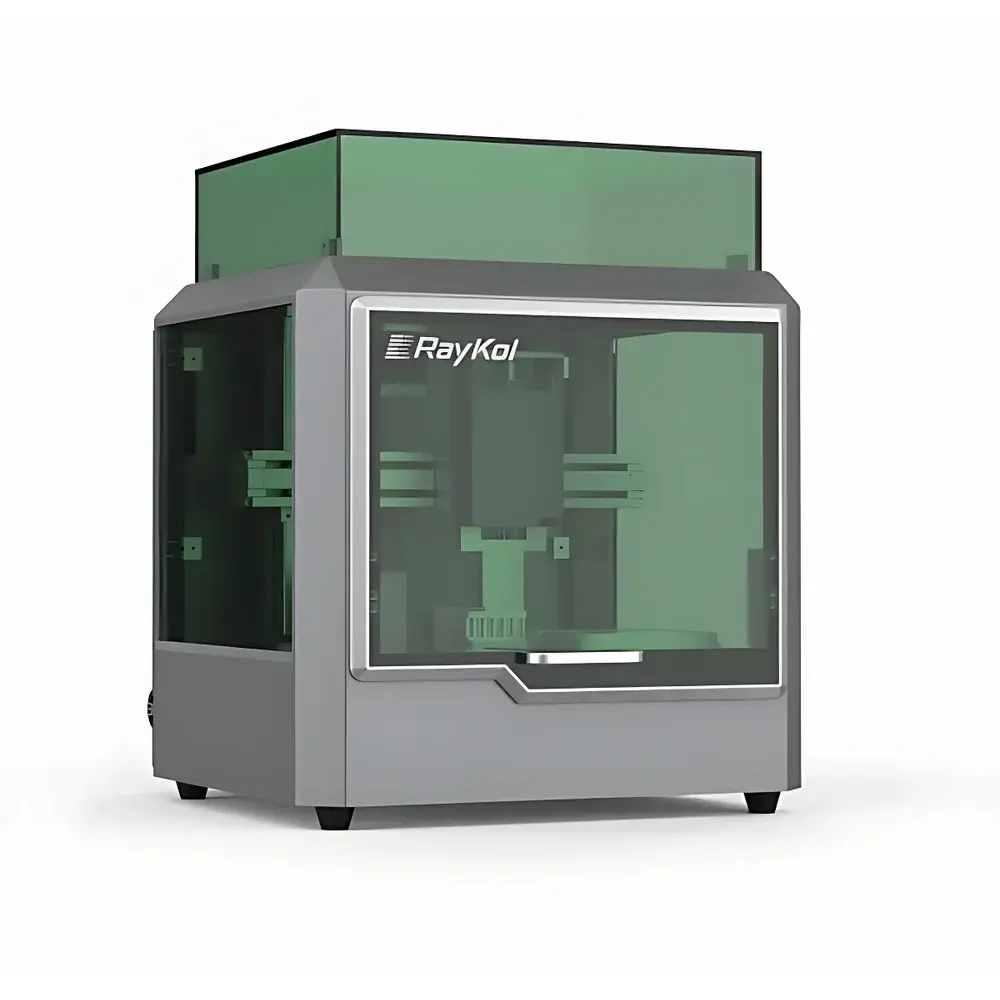
Raykol Vitae SPOTTER Microarray Spotting Instrument
| Brand | Raykol |
|---|---|
| Origin | Fujian, China |
| Manufacturer Type | Authorized Distributor |
| Country of Origin | China |
| Model | Vitae SPOTTER |
| Spotting Method | Contact-based (Pin-based) |
| Spot Spacing | 2.75 mm |
| Spot Volume Range | 300 nL – 10 µL |
| Pin Configuration | 1–40 solid pins (configurable) |
| Substrate Capacity | 8–24–96 standard microscope slides or microtiter plates |
| Repeatability Accuracy | ±0.05 mm |
| Compliance | Designed for GLP-compliant lab environments |
Overview
The Raykol Vitae SPOTTER Microarray Spotting Instrument is a precision-engineered, contact-based pin deposition system designed for the automated fabrication of high-density biological microarrays on planar substrates—including standard glass microscope slides, nitrocellulose membranes, and 96-well microtiter plates. Operating on the principle of robotic capillary pin transfer, the Vitae SPOTTER utilizes solid stainless-steel or quartz pins to aspirate and deposit nanoliter-to-microliter volumes of biomolecular solutions with deterministic spatial control. Its modular gantry architecture enables reproducible spot placement at defined pitch intervals (2.75 mm standard), supporting both single-pin serial spotting and parallel multi-pin array printing. The system is optimized for applications requiring stringent positional fidelity and volumetric consistency—particularly in preparation workflows for downstream analytical platforms such as MALDI-TOF MS, fluorescence scanning, and label-free surface plasmon resonance (SPR) detection.
Key Features
- Configurable pin array support for 1–40 solid pins, enabling scalable throughput from R&D prototyping to small-batch production
- Programmable spot volume delivery across a dynamic range of 300 nL to 10 µL per deposition event, calibrated via gravimetric validation protocols
- Substrate handling flexibility: accommodates 8-, 24-, and 96-format slide racks or plate carriers without mechanical reconfiguration
- High positional repeatability of ±0.05 mm (3σ), verified using NIST-traceable coordinate metrology standards
- Integrated environmental enclosure option with HEPA filtration and humidity control (optional), minimizing evaporation-induced spot morphology variation
- Tool-free pin exchange mechanism compatible with industry-standard 33-gauge stainless-steel, siliconized glass, or non-contact quill pins
Sample Compatibility & Compliance
The Vitae SPOTTER supports a broad spectrum of biological and synthetic sample types—including purified proteins, monoclonal antibodies, oligonucleotides, cDNA libraries, bacterial lysates, glycoproteins, and functionalized nanoparticles. All fluidic pathways are chemically inert (PFA-lined tubing, ceramic valve manifolds) and compatible with aqueous buffers, DMSO-containing formulations, and low-surface-tension solvents. The system adheres to ISO 13485 design principles for in vitro diagnostic (IVD) device manufacturing support and meets essential requirements for GLP-compliant microarray production under 21 CFR Part 58. While not an FDA-cleared instrument, its operational logs, parameter audit trails, and user-access controls align with ALCOA+ data integrity criteria for regulated research environments.
Software & Data Management
Controlled via Raykol’s proprietary VitaeSpot™ software suite (Windows 10/11 compatible), the system provides intuitive graphical layout definition for custom grid patterns, sub-array tiling, and variable-volume zoning. All spotting protocols—including wash cycles, humidity ramping, and pin priming sequences—are saved as versioned XML configuration files. Software enforces electronic signature authentication for method changes and maintains immutable timestamped records of every spotting run, including environmental sensor readings (temperature, relative humidity), pin usage counters, and volumetric calibration history. Export formats include CSV, TIFF (for alignment reference), and MIAME-compliant MAGE-TAB metadata templates to facilitate integration with public repositories such as GEO or PRIDE.
Applications
- Development and QC of DNA, peptide, and antibody microarrays for genomic profiling and serological screening
- Preparation of immobilized enzyme arrays for high-throughput kinetic assays and inhibitor profiling
- Generation of 3D bioprinted microstructures via iterative layer-by-layer spotting of hydrogel precursors and cell suspensions
- On-chip sample preparation for MALDI-TOF MS—enabling direct crystallization of analytes onto conductive targets with minimal matrix interference
- Nanomaterial patterning for biosensor development, including gold nanoparticle-labeled probes and graphene oxide composites
- Food pathogen detection arrays incorporating multiplexed immunoassays targeting Salmonella, Listeria, and E. coli O157:H7 antigens
FAQ
Is the Vitae SPOTTER compatible with third-party microarray substrates?
Yes—the system accepts any commercially available activated glass slides (e.g., epoxy-, aldehyde-, or NHS-ester-coated), as well as polymer-based membranes and functionalized silicon wafers meeting ANSI/SBS standard dimensions.
Can spot volume be adjusted dynamically within a single print job?
Yes. VitaeSpot™ supports per-spot volume mapping via spreadsheet import, allowing differential dispensing across a single array—for example, titrating antibody concentrations in a checkerboard format.
What maintenance is required for long-term pin performance?
Daily ultrasonic cleaning in ethanol/water (70:30 v/v) is recommended; quarterly inspection of pin tip geometry using optical profilometry ensures consistent meniscus formation and release behavior.
Does the system support environmental monitoring during spotting?
Standard configuration includes integrated temperature and relative humidity sensors; optional upgrade adds real-time dew point tracking and closed-loop chamber climate stabilization.



