
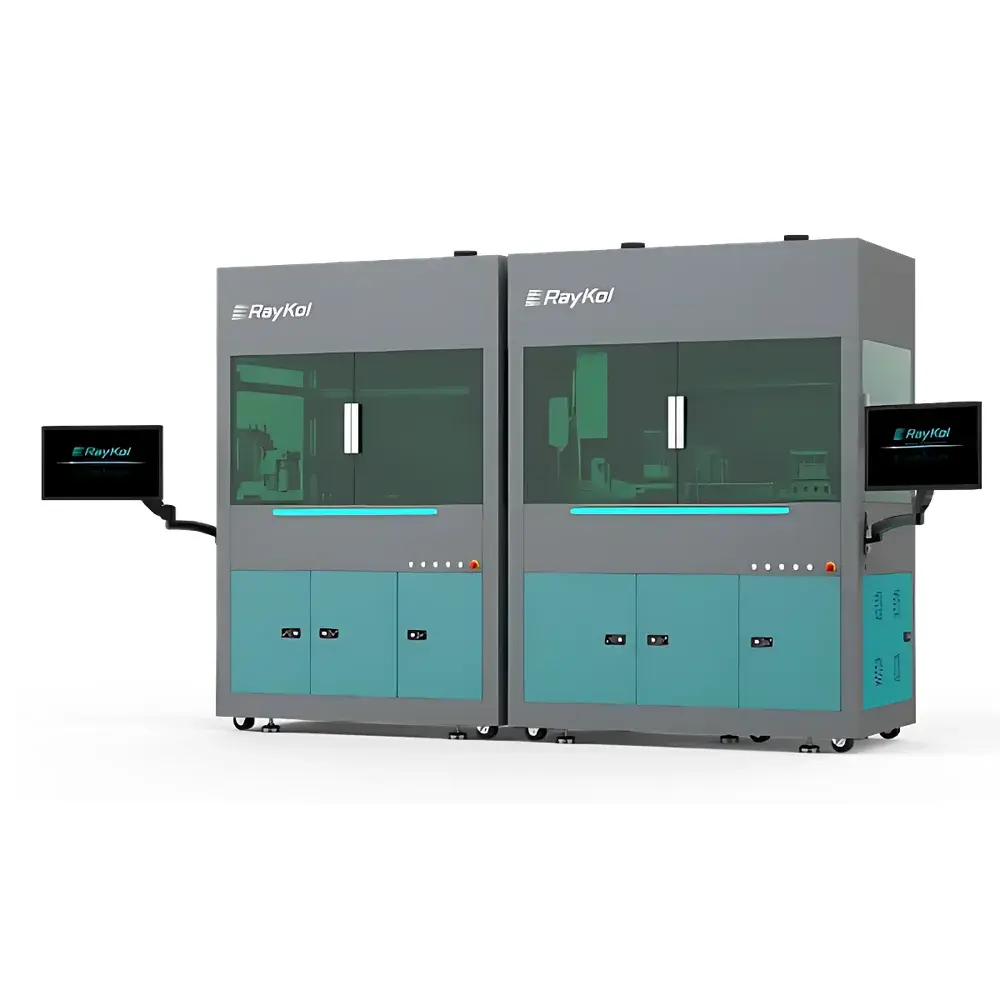
Raykol DRQ A+B Automated QuEChERS Sample Preparation Workstation
| Brand | Raykol |
|---|---|
| Model | DRQ A+B |
| Origin | Guangdong, China |
| Manufacturer | Raykol Group |
| Equipment Type | Automated QuEChERS Processing Platform |
| Sample Throughput | Up to 24 samples per run |
| Homogenization Bead Dispensing | Programmable by sample matrix |
| Liquid Handling Accuracy | ≤1% CV at 100–1000 µL |
| Liquid Level Detection | Capacitive + optical dual-mode |
| Spike Addition Module | Precision syringe-based, traceable volume delivery |
| Vortex Mixing | 0–3000 rpm, programmable duration and acceleration profile |
| Nitrogen Concentration | Vision-guided endpoint detection (meniscus recognition at 0.5 mL, 1.0 mL, or custom刻度) |
| Sample Cooling | Peltier-cooled vial chamber (4–12 °C adjustable) |
| Filtration | Auto-loaded 0.22 µm / 0.45 µm PVDF or nylon membranes with real-time clogging/breakage detection |
| Centrifugation | Horizontal rotor accommodating both 15 mL and 50 mL conical tubes |
| Extraction Salt Management | Independent salt dispensing channels per sample position |
Overview
The Raykol DRQ A+B Automated QuEChERS Sample Preparation Workstation is an integrated, walk-away solution engineered for high-throughput, reproducible execution of the QuEChERS (Quick, Easy, Cheap, Effective, Rugged, Safe) method in pesticide residue, veterinary drug, and environmental contaminant analysis. Based on standardized solvent extraction followed by dispersive solid-phase extraction (d-SPE), the system automates all critical steps—homogenization bead addition, solvent and buffer delivery, internal standard spiking, vortex-assisted mixing, centrifugation, nitrogen-assisted concentration, membrane filtration, and temperature-controlled storage—within a single platform. Its architecture adheres to ISO/IEC 17025-aligned laboratory workflow principles, supporting GLP-compliant documentation requirements through full audit-trail logging of all liquid handling events, centrifuge parameters, temperature setpoints, and filtration status.
Key Features
- Matrix-Adaptive Homogenization Bead Dispensing: Independent bead-count control per sample position enables optimization for heterogeneous matrices (e.g., leafy greens vs. fatty tissues), improving extraction homogeneity and recovery consistency.
- Dual-Mode Liquid Level Sensing: Capacitive sensing combined with optical meniscus detection prevents aspiration of particulates during supernatant transfer, minimizing cross-contamination and pipette tip clogging.
- Traceable Spike Addition: Syringe-driven spiking module delivers certified reference standards with volumetric precision (±0.5 µL at 50 µL), supporting USP and FDA 21 CFR Part 11-compliant calibration and verification protocols.
- Vision-Guided Nitrogen Concentration: High-resolution camera system monitors solvent meniscus in GC/HPLC vials in real time, terminating evaporation precisely at user-defined endpoints (e.g., 0.5 mL, 1.0 mL), eliminating over-concentration and analyte degradation.
- Peltier-Controlled Vial Storage: Maintains post-processing sample integrity at 4–12 °C, reducing solvent volatility and preventing thermal degradation of thermolabile compounds (e.g., organophosphates, carbamates).
- Intelligent Filtration Monitoring: Integrated pressure and optical feedback detects membrane rupture or pore blockage, triggering automatic abort and alert—ensuring only filtrate meeting ISO 17025 filtration validation criteria proceeds to instrumental analysis.
Sample Compatibility & Compliance
The DRQ A+B supports diverse food, feed, soil, and biological matrices compliant with AOAC Official Method 2007.01, EN 15662:2018, and USDA AMS guidelines. Its horizontal centrifuge accommodates both 15 mL and 50 mL polypropylene conical tubes without adapter changes, while water-jacketed cooling limits temperature rise to ≤10 °C during exothermic salt dissolution—critical for preserving heat-sensitive analytes. Independent salt dispensing channels allow concurrent use of MgSO₄/NaOAc (for acidic analytes) and MgSO₄/NaCl (for neutral/basic compounds) within one batch, satisfying multi-residue method flexibility requirements under SANTE/11813/2021.
Software & Data Management
Controlled via Raykol’s LIMS-integrated SmartPrep™ software (v3.2+), the workstation logs timestamped metadata for every step—including bead count, delivered volumes, centrifuge RCF values, vortex acceleration profiles, nitrogen flow rate, and filtration success/failure flags. All data are stored in encrypted SQLite databases with SHA-256 hashing; export formats include CSV, PDF analytical reports, and XML for direct ingestion into Thermo Fisher Chromeleon, Agilent OpenLab, or Waters Empower systems. Audit trails comply with FDA 21 CFR Part 11 Annex 11 and EU GMP Annex 11 requirements, including electronic signatures, role-based access control, and immutable event history.
Applications
Primary use cases include multi-residue pesticide screening in fruits, vegetables, cereals, and animal-derived foods; veterinary drug residue quantification in milk, muscle, and honey; mycotoxin analysis in grains and nuts; and emerging contaminant workflows (e.g., PFAS, microplastics digestion support). The platform is validated for routine QC/QA applications—daily system suitability testing, spike recovery assessment, and blank monitoring—with built-in statistical reporting for %RSD, mean recovery, and LOD/LOQ verification per SANTE/11312/2021.
FAQ
Does the DRQ A+B support method customization beyond standard QuEChERS protocols?
Yes—users can define custom bead counts, solvent ratios, centrifugation RCF/time profiles, vortex sequences, and salt combinations via SmartPrep™ method editor, enabling adaptation to non-standard matrices such as high-fat dairy or fibrous botanicals.
Is the filtration module compatible with alternative membrane chemistries (e.g., PTFE, GHP)?
The hardware accepts standard 13 mm and 25 mm diameter membranes; however, only 0.22 µm and 0.45 µm PVDF/nylon configurations are factory-validated for automated clog detection and pressure calibration.
How is instrument performance verified during routine operation?
Built-in liquid handling verification routines use gravimetric checks at three volume points (50 µL, 200 µL, 1000 µL); centrifuge calibration includes tachometer and temperature probe validation per ISO 13691.
Can the system interface with enterprise LIMS or ELN platforms?
Yes—via HL7 v2.5 and ASTM E1384-compliant API, supporting bidirectional sample ID exchange, result push, and instrument status polling.
What maintenance intervals are recommended for optimal long-term precision?
Daily: Tip waste bin and filter replacement; Weekly: Centrifuge rotor balance check and vortex cup calibration; Quarterly: Liquid level sensor recalibration and nitrogen flow meter verification per manufacturer SOP-DRQ-MNT-04.



