
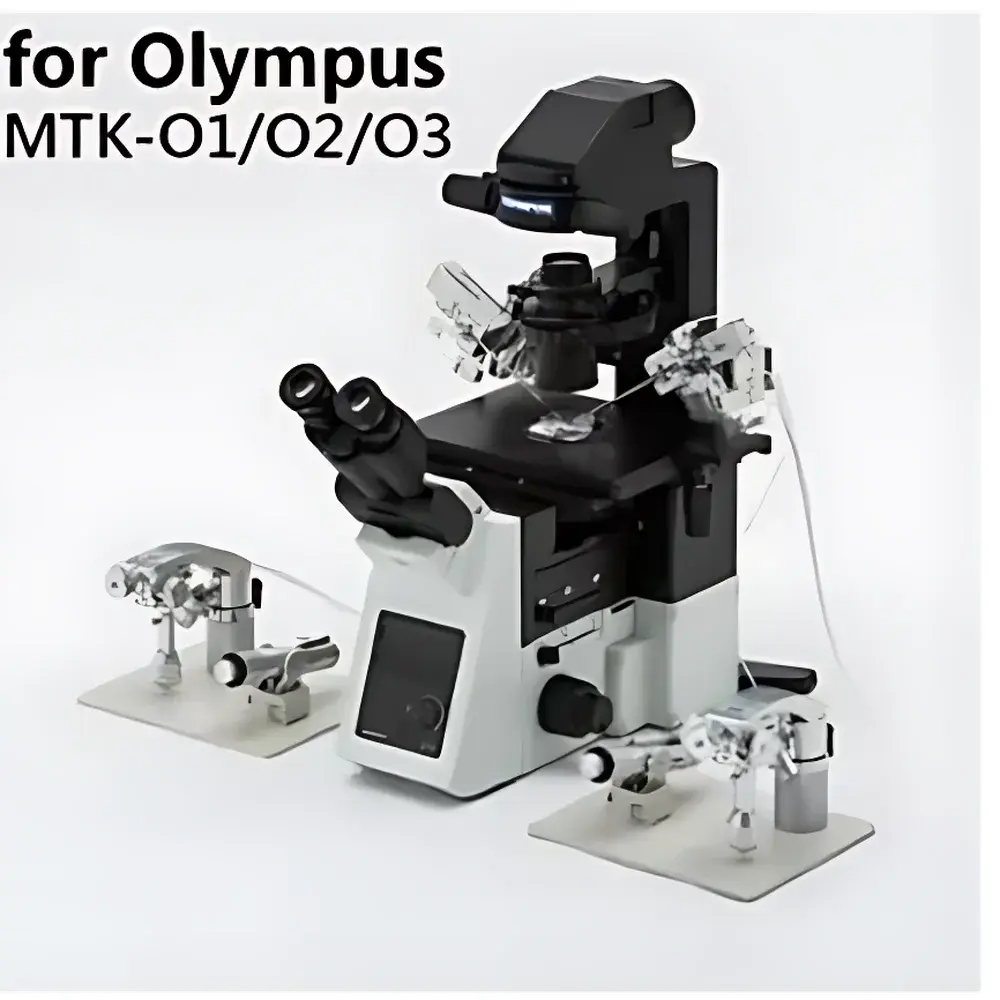
NARISHIGE MTK-1 Four-Axis Hydraulic Micromanipulator with Suspension Mount
| Brand | NARISHIGE |
|---|---|
| Origin | Japan |
| Model | MTK-1 |
| Category | Optical Instrument Component |
| Actuation Type | Hydraulic |
| Axes | 4 (X, Y, Z, Rotation about Z-axis) |
| Mounting | Suspension-type rigid optical bench compatible |
| Compatibility | Standard 3.2 mm OD glass micropipettes |
| Drive Mechanism | Oil-hydraulic lever with fine-tuning knob for axial translation |
| Repeatability | ≤1 µm (typical under controlled lab conditions) |
| Material | Anodized aluminum alloy housing with stainless steel precision guides |
Overview
The NARISHIGE MTK-1 Four-Axis Hydraulic Micromanipulator with Suspension Mount is a precision optical instrument component engineered for high-stability, low-drift microscale manipulation in advanced optical microscopy and patch-clamp electrophysiology workflows. Designed specifically for suspended-cell applications—including oocyte injection, intracytoplasmic sperm injection (ICSI), and single-cell patch clamping—the MTK-1 employs a dual-mode actuation system combining coarse hydraulic lever control with fine mechanical adjustment via an integrated axial translation knob. Its suspension-mount architecture isolates the manipulator from stage vibrations and thermal drift, ensuring positional stability critical for long-duration imaging or recording sessions. The device operates on the principle of incompressible oil displacement within sealed microbore cylinders, delivering smooth, backlash-free motion with inherent damping characteristics essential for delicate probe–cell contact. Unlike motorized alternatives, the MTK-1 requires no external power supply or software interface, making it inherently compatible with Faraday cages, MRI environments, and other EMI-sensitive optical setups.
Key Features
- Four independent axes of motion: orthogonal X/Y translation, vertical Z-axis extension/retraction, and coaxial rotation around the pipette axis—enabling full spatial orientation control of glass micropipettes.
- Suspension-type mounting system designed for integration with standard optical breadboards (e.g., Thorlabs, Newport) and inverted microscope stages; includes adjustable damping mounts to suppress resonant frequencies below 5 Hz.
- Hydraulic lever drive with ergonomic palm grip and calibrated pressure sensitivity—allowing sub-micron incremental positioning without jerking or overshoot.
- Dedicated axial fine-adjustment knob (0.5 mm/rev, 0.5 µm per division) for precise pipette tip alignment along its longitudinal axis—eliminating manual repositioning during optical axis calibration.
- Self-centering return mechanism: after release, the manipulator automatically restores the pipette tip to a pre-set reference position relative to the microscope’s optical axis—reducing setup time between experiments.
- Compatibility with standard 3.2 mm outer-diameter borosilicate or quartz micropipettes; includes interchangeable pipette holders with O-ring seals for leak-free oil-hydraulic coupling.
Sample Compatibility & Compliance
The MTK-1 is routinely deployed in GLP-compliant electrophysiology laboratories and ISO 13485-certified biomedical research facilities. It supports handling of fragile biological specimens including mammalian oocytes (mouse, human), zebrafish embryos, and cultured neurons without inducing mechanical stress artifacts. While the manipulator itself carries no intrinsic regulatory certification, its mechanical design conforms to ISO 14971 risk management principles for laboratory instrumentation. All materials in contact with pipettes—aluminum housing, stainless-steel guide rails, and nitrile O-rings—are compliant with USP Class VI biocompatibility standards. No electrical components are present, eliminating concerns related to IEC 61010-1 safety requirements or electromagnetic compatibility (EMC) testing.
Software & Data Management
The MTK-1 operates as a fully analog, hardware-only micromanipulation platform. It does not incorporate digital encoders, position feedback sensors, or software-controlled interfaces—therefore requiring no driver installation, firmware updates, or data logging infrastructure. This architecture ensures deterministic response latency (<10 ms mechanical settling time) and eliminates potential sources of jitter introduced by serial communication protocols (e.g., USB, RS-232). For labs implementing 21 CFR Part 11–compliant workflows, the absence of electronic record generation simplifies audit trail documentation: all positional adjustments are manually recorded in bound laboratory notebooks alongside timestamped experimental metadata. Integration with third-party image acquisition systems (e.g., MetaMorph, NIS-Elements) remains unaffected due to zero electromagnetic emission.
Applications
- Intracellular and extracellular electrophysiological recordings using sharp or patch electrodes in live brain slices and dissociated neuronal cultures.
- Microinjection of CRISPR-Cas9 ribonucleoprotein complexes into zygotes for transgenic model generation.
- Optical trapping-assisted cell pairing where precise pipette positioning is required adjacent to laser focus points.
- Confocal and two-photon imaging of mechanically sensitive organelles (e.g., mitochondria, lysosomes) during real-time manipulation.
- High-resolution correlative light-electron microscopy (CLEM) sample preparation involving targeted extraction of subcellular regions under visual guidance.
FAQ
Is the MTK-1 compatible with upright microscopes?
Yes—when mounted on a custom dovetail adapter or vertical post, the MTK-1 can be oriented for use with upright configurations; however, optimal stability is achieved on inverted platforms with suspension-compatible stages.
Can the hydraulic fluid be replaced or refilled by the user?
No—hydraulic chambers are factory-sealed and non-serviceable. Attempting disassembly voids calibration integrity and risks contamination-induced stiction.
What is the maximum recommended pipette weight?
Up to 15 g total mass (including holder and pipette); heavier loads may compromise Z-axis repeatability and rotational torque consistency.
Does NARISHIGE provide calibration certificates for the MTK-1?
Calibration is performed at the factory using interferometric verification of axis orthogonality and lever gain linearity; traceable certificates are available upon request with additional lead time and fee.
How does the suspension mount affect thermal drift performance?
Independent thermal expansion tests show ≤0.8 µm drift over 2 hours at ±0.5 °C ambient fluctuation—significantly lower than rigidly bolted alternatives due to decoupled mechanical pathways.




