
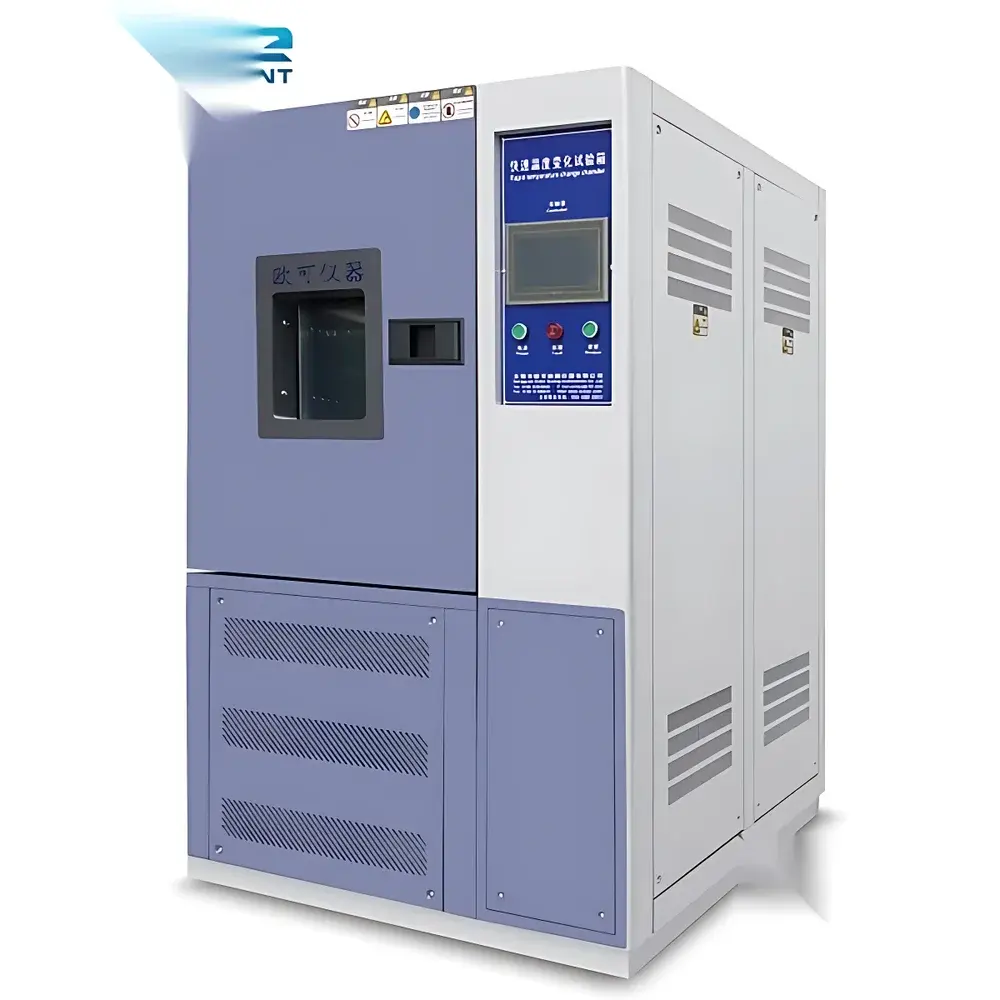
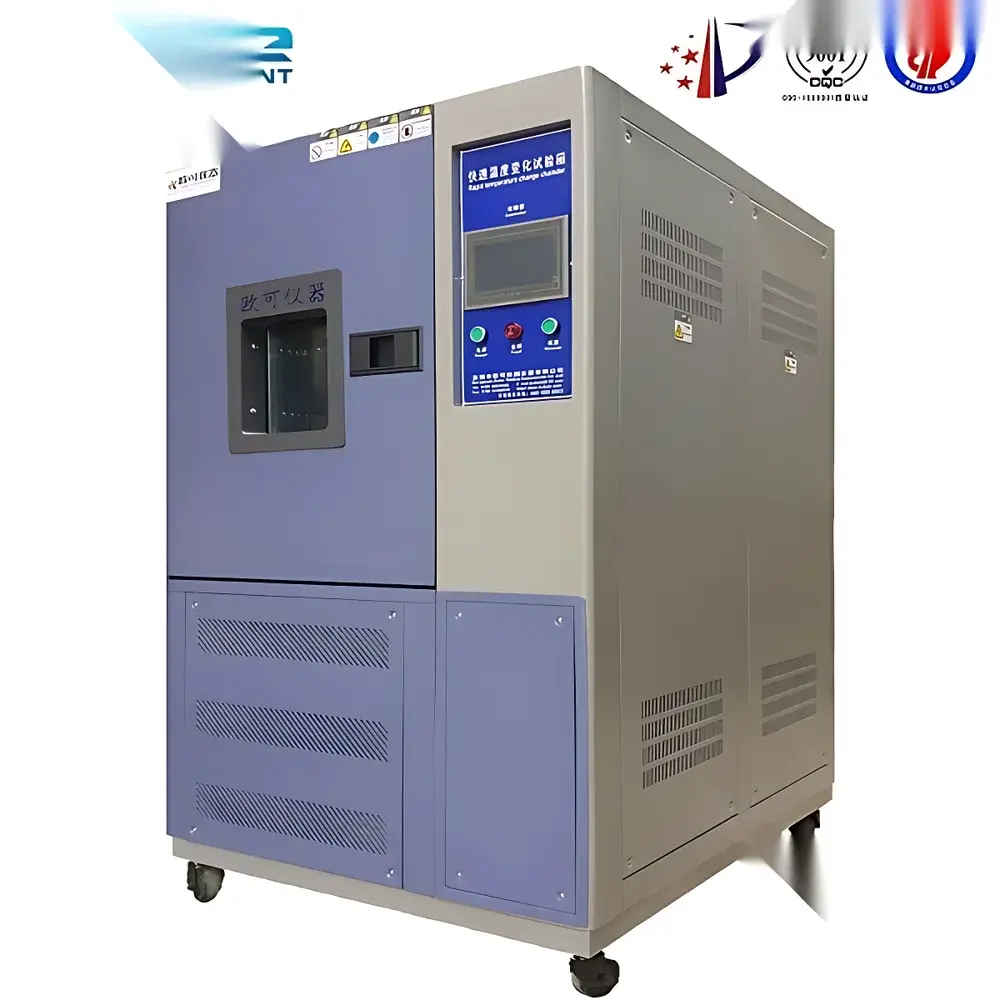
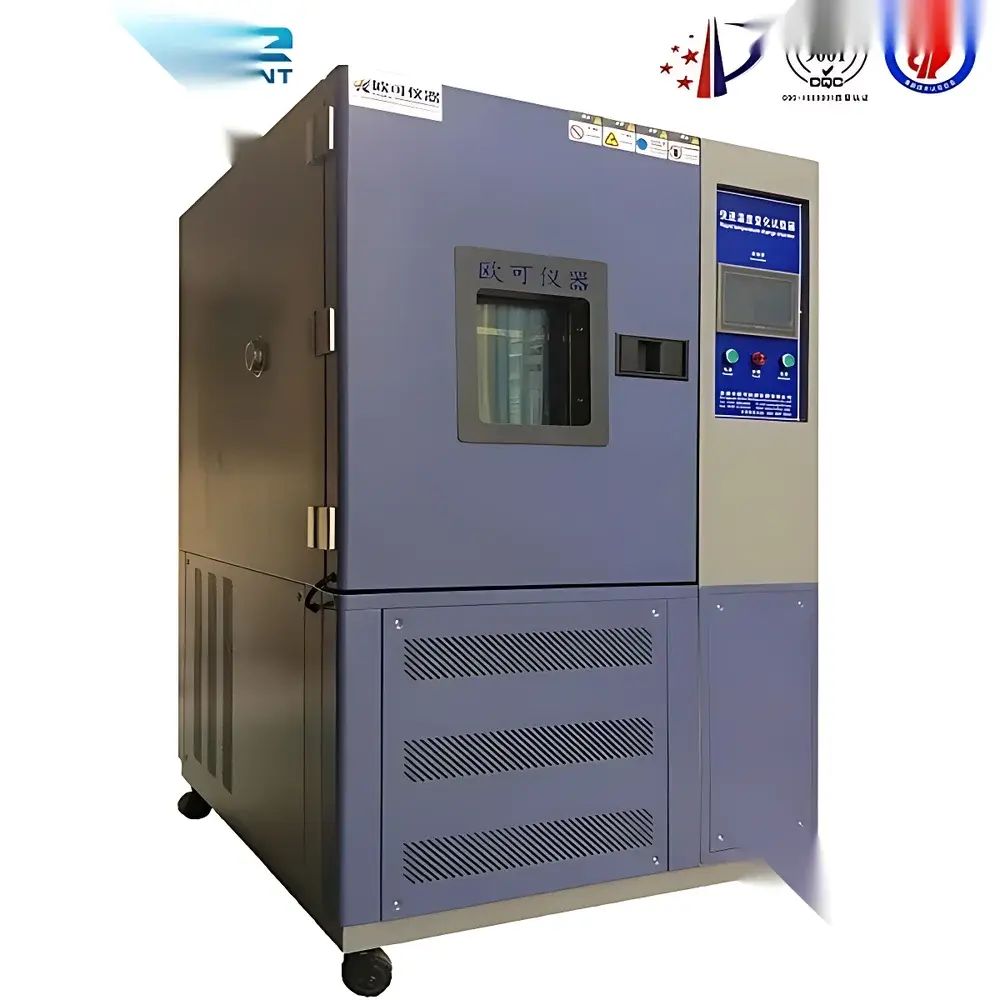
Nonlinear Rapid Temperature Cycling Chamber – Industrial-Grade Environmental Test Equipment
| Key | Brand: OEM / Custom-Built |
|---|---|
| Origin | Imported (Global Sourcing) |
| Manufacturer Type | Authorized Distributor |
| Price | USD 2,650 (FOB) |
| Control System Options | TIME880 Color Touchscreen Controller (Korea), TIME300 Digital Film-Button Controller (Korea), OYO 8227 PID Touch Controller (Japan) |
| Sensor | PT100 Platinum Resistance Thermometer |
| Refrigeration | Hermetic Tecumseh or Semi-Hermetic Copeland Scroll Compressor |
| Heating | Independent Ni-Cr Alloy Sheathed Heater |
| Insulation | 80–100 mm High-Density Glass Fiber Blanket |
| Viewing Window | 300 × 400 mm Tempered Double-Glazed with Integrated Heating Element |
| Test Port | Ø50 mm Left-Side Penetration Port |
| Sealing | Dual-Layer High-Tensile Silicone Gasket (–70°C to +150°C Operational Range) |
| Compliance | Designed to Support ASTM D3418, IEC 60068-2-14, MIL-STD-810H Method 503.7 Protocols |
Overview
The Nonlinear Rapid Temperature Cycling Chamber is an industrial-grade environmental stress screening (ESS) system engineered for precise, repeatable, and accelerated thermal cycling across wide temperature ranges. Unlike linear ramp-rate chambers, this unit implements nonlinear temperature profiles—enabling programmable dwell times, variable ramp rates (e.g., 10°C/min up to 25°C/min), and asymmetric heating/cooling kinetics—to replicate real-world operational transients encountered in automotive ECUs, aerospace avionics, power electronics, and high-reliability PCB assemblies. Its robust architecture integrates a dual-stage refrigeration loop (for sub-zero operation down to –70°C), independent resistive heating, and high-velocity laminar airflow distribution—ensuring ±0.5°C temperature uniformity (at 100 L load) per IEC 60068-3-5 and stable thermal inertia control during rapid transitions.
Key Features
- Structural integrity via CNC-machined SUS304 stainless steel inner chamber (mirror finish) and outer housing (brushed SUS304 or electrostatically coated cold-rolled steel)
- Optically clear, heated double-glazed observation window (300 × 400 mm) with integrated LED illumination for real-time visual monitoring without thermal distortion
- Dual-layer high-tensile silicone door gasket rated for continuous operation from –70°C to +150°C, minimizing leakage and condensation ingress
- 80–100 mm thick high-density glass fiber insulation with low thermal conductivity (40% versus standard mineral wool
- Ø50 mm left-side test port with removable brass collar and silicone plug—compatible with thermocouple feedthroughs, signal cables, and DC power lines
- Independent over-temperature cut-off circuit with mechanical bimetallic switch backup—certified to UL 61010-1 and IEC 61000-6-2 immunity standards
- Microprocessor-based controller with auto-tuning PID algorithm, real-time deviation compensation, and password-protected parameter locking
Sample Compatibility & Compliance
This chamber accommodates samples up to 500 mm × 500 mm × 500 mm (standard 100 L internal volume), with optional custom cavity configurations available. It supports mounting fixtures, DUT support trays, and non-conductive sample racks compatible with MIL-STD-810H Clause 503.7 (Temperature Shock) and IEC 60068-2-14 (Change of Temperature). All controllers meet EMC Class B requirements and include traceable calibration certificates compliant with ISO/IEC 17025-accredited laboratories. The system architecture supports GLP/GMP audit readiness through optional data logging modules with time-stamped, tamper-evident records aligned with FDA 21 CFR Part 11 electronic signature requirements.
Software & Data Management
Standard RS-232/RS-485 serial interface enables integration with LabVIEW, MATLAB, or custom SCADA platforms. Optional Ethernet-enabled controllers support Modbus TCP and OPC UA protocols for centralized fleet monitoring. The embedded firmware logs all setpoints, actual temperatures, alarm events, and compressor duty cycles at user-defined intervals (1 s to 60 min resolution). Optional thermal printout module produces ANSI/A4-format hardcopy reports with embedded calibration ID, operator tag, and cycle signature—fully compliant with ASME PTC 19.3TW and ISO 17025 documentation chains.
Applications
- Thermal shock validation of solder joints, conformal coatings, and MEMS packaging per JESD22-A104E
- Accelerated life testing of lithium-ion battery modules under dynamic charge/discharge thermal coupling
- Qualification of automotive ADAS sensors (radar, LiDAR) per AEC-Q200 Grade 0/1 thermal endurance protocols
- Material coefficient-of-thermal-expansion (CTE) mismatch analysis in multi-layer ceramic capacitors (MLCCs)
- Reliability screening of medical device PCBAs prior to ISO 13485 certification audits
- Validation of hermetic seal integrity in optoelectronic housings using thermal gradient-induced leak detection
FAQ
What is the maximum achievable ramp rate in nonlinear mode?
The system achieves up to 25°C/min between –40°C and +85°C with a 10 kg aluminum mass load, verified per IEC 60068-3-11 Annex B.
Can the chamber be integrated into an automated test cell with PLC-level control?
Yes—digital I/O terminals (8-in/8-out) and analog 4–20 mA feedback channels are standard; EtherCAT and Profibus-DP gateways available as factory options.
Is NIST-traceable calibration included with delivery?
A baseline 5-point PT100 sensor calibration certificate (–70°C, 0°C, 25°C, 100°C, +150°C) is provided; full chamber mapping per ISO/IEC 17025 requires on-site service engagement.
What maintenance intervals are recommended for the refrigeration system?
Compressor oil analysis and filter-drier replacement every 12 months or 4,000 operating hours—whichever occurs first—per ASHRAE Guideline 3-2021.
Does the controller support custom profile scripting beyond built-in templates?
Yes—the TIME880 and OYO 8227 models accept CSV-formatted segment files with time, target temperature, ramp rate, and dwell duration columns for fully arbitrary nonlinear sequencing.



