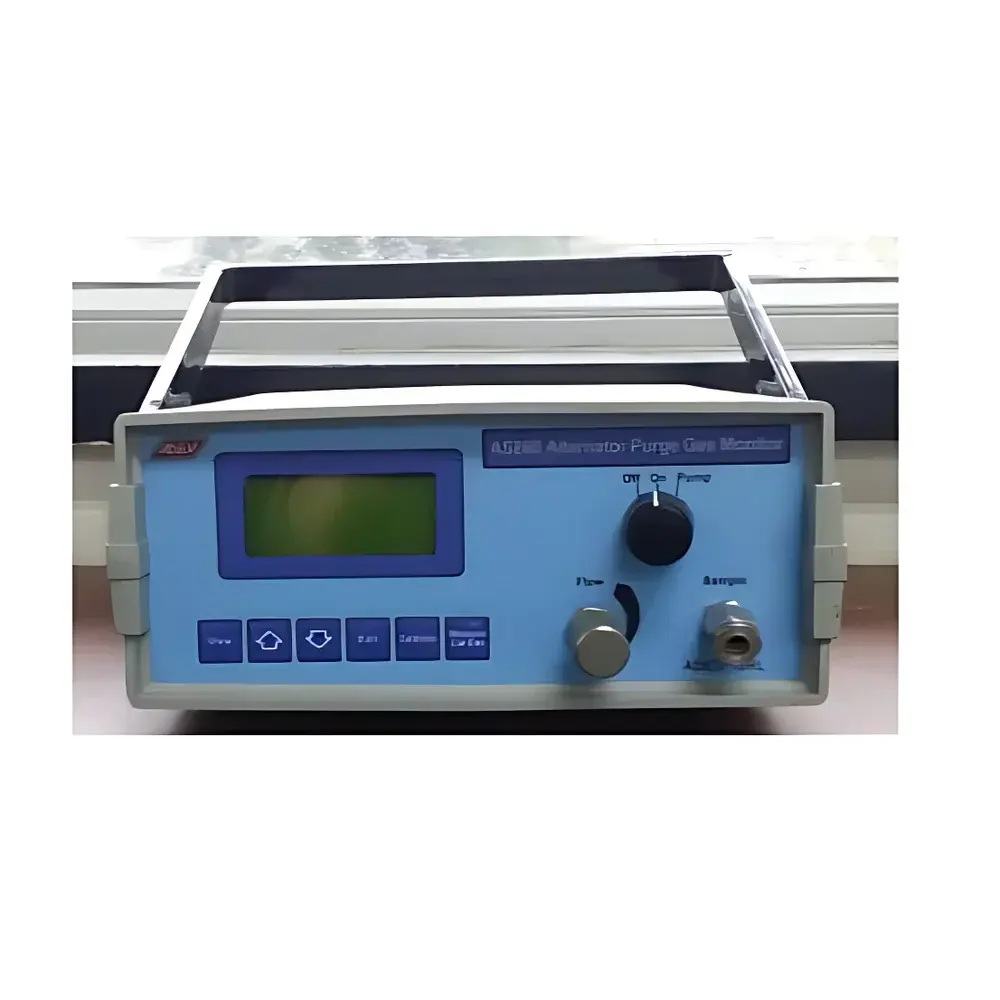
Hitech AS860 Portable Hydrogen Purity Analyzer
| Brand | Hitech |
|---|---|
| Origin | Italy |
| Model | AS860 |
| Measurement Principle | Thermal Conductivity Detection (TCD) |
| Display | 2-line or 4-line dot-matrix LCD |
| H₂ Range in Air | 90–100% vol |
| CO₂ Range in Air | 0–100% vol |
| H₂ Range in CO₂ | 0–100% vol |
| Accuracy | ±1% of full scale |
| H₂ Resolution | 0.1% vol |
| CO₂ Resolution | 0.5% vol |
| Response Time (T90) | 5 s |
| Sample Flow Rate | 100–300 mL/min |
| Sample Pressure (pump off) | up to +5 bar(g) |
| Sample Pressure (pump on) | down to –100 mbar(g) |
| Sample Temperature | –10 °C to +60 °C (non-condensing) |
| Analog Output | 0–1 V |
| Operating Ambient Temperature | –5 °C to +40 °C |
| Battery Life | 6 hours |
| Power Options | 110/240 V AC, 12 V DC automotive adapter |
| Enclosure | Rugged ABS carrying case with integrated handle and adjustable-height support feet |
| Dimensions (w × d × h, handle deployed as feet) | 250 × 255 × 94 mm |
| Weight | ~2 kg |
Overview
The Hitech AS860 Portable Hydrogen Purity Analyzer is an intrinsically safe, field-deployable thermal conductivity-based gas analyzer engineered for precise, real-time monitoring of hydrogen (H₂) purity during turbine generator purging, commissioning, and routine operational verification. Designed specifically for power generation environments, the instrument leverages the significant thermal conductivity differential between hydrogen (≈70.9 mW/m·K at 25 °C) and nitrogen/oxygen (≈25.8 mW/m·K and ≈26.6 mW/m·K respectively) to deliver high-reproducibility measurements without consumables or catalytic elements. Its primary function is to verify gas composition transitions—air → CO₂ → H₂ during initial fill, and H₂ → CO₂ → air during shutdown—ensuring explosive limits (4–75% H₂ in air) are never approached. Unlike optical or electrochemical sensors, the AS860’s TCD architecture provides long-term stability, immunity to poisoning, and minimal calibration drift under variable pressure and flow conditions typical in generator seal systems.
Key Features
- Integrated sample handling system featuring a built-in diaphragm pump, precision needle valve, and laminar-flow calibrated rotameter for consistent 100–300 mL/min sample delivery
- Dual-range measurement capability: high-resolution H₂ quantification (90–100% in air) for leak detection and safety verification, plus full-range H₂ (0–100%) in CO₂ and CO₂ (0–100%) in air for complete purge cycle mapping
- Ruggedized portable form factor: impact-resistant ABS enclosure with ergonomic carry handle that doubles as a height-adjustable support foot for stable benchtop or field deployment
- Low-power operation with rechargeable battery (6 h runtime) and dual-input power: universal 110/240 V AC adapter and 12 V DC automotive interface for mobile use
- Fast T90 response time of 5 seconds enables dynamic tracking of gas front progression during blow-down sequences
- 0–1 V analog output supports integration with PLCs, DCS historians, or portable data loggers for audit-ready trend capture
Sample Compatibility & Compliance
The AS860 accepts dry, non-corrosive, non-particulate gas streams within –10 °C to +60 °C (non-condensing). It is validated for use with compressed air, technical-grade CO₂, and electrolytic or pipeline-grade H₂—common media in IEEE Std 450-2022 and IEC 60034-12 compliant generator maintenance protocols. The instrument meets IP54 ingress protection for dust and water splashes, and its electrical design complies with CE marking requirements per EN 61326-1 (EMC) and EN 61010-1 (safety). While not ATEX-certified, its low-energy circuitry and absence of ignition sources render it suitable for Zone 2/Class I, Division 2 environments when operated outside hazardous boundaries per NFPA 70E guidelines.
Software & Data Management
The AS860 operates as a standalone, firmware-controlled analyzer with no external software dependency. All configuration—including range selection, zero/span calibration offset, and analog output scaling—is performed via intuitive front-panel navigation. Calibration is traceable to NIST-traceable gas standards (e.g., 95% H₂ in N₂, 5% CO₂ in air); factory calibration certificates include uncertainty budgets per ISO/IEC 17025. The 0–1 V analog output enables connection to third-party SCADA systems supporting Modbus RTU or 4–20 mA signal conditioning (via optional converter). For GLP/GMP-aligned operations, users may document calibration events, operator IDs, and ambient conditions manually in accordance with internal SOPs—no electronic audit trail is embedded, consistent with Class II portable instrumentation per FDA 21 CFR Part 11 interpretation.
Applications
- Verification of H₂ purity ≥98.0% vol prior to turbine synchronization, per ANSI/IEEE C50.13-2015 generator startup procedures
- Real-time monitoring of CO₂ displacement efficiency during air-to-CO₂ and CO₂-to-H₂ purge phases
- Leak detection in hydrogen-cooled generator housings by trending sub-98% H₂ readings over time
- Commissioning validation of seal oil systems where dissolved H₂ in oil must remain below 2.5% saturation threshold
- Field audits of on-site H₂ supply quality from electrolyzers or delivery trailers prior to injection into generator manifolds
FAQ
What is the recommended calibration frequency for the AS860 in continuous service?
Calibration is advised before each critical purge event (startup/shutdown) and at minimum every 90 days for routine monitoring; more frequent checks are required if operating in high-humidity or particulate-rich environments.
Can the AS860 measure moisture or oxygen content directly?
No—the AS860 measures only H₂, CO₂, and their binary mixtures via thermal conductivity contrast; dedicated electrochemical O₂ or chilled-mirror dew point analyzers are required for those parameters.
Is the instrument suitable for measuring hydrogen in natural gas pipelines?
Not recommended—natural gas contains hydrocarbons (e.g., CH₄, C₂H₆) with thermal conductivities overlapping H₂, causing cross-sensitivity; use GC-based or laser spectroscopic analyzers for such matrices.
Does the AS860 require carrier gas or zero-air supply?
No—its TCD sensor operates on sample gas alone; no auxiliary gases, filters, or scrubbers are needed, minimizing consumables and maintenance overhead.
How does ambient temperature affect measurement accuracy?
Internal temperature compensation corrects for thermal drift across –5 °C to +40 °C; however, prolonged exposure above 40 °C may induce sensor baseline shift—use shaded or ventilated mounting locations in hot utility areas.