
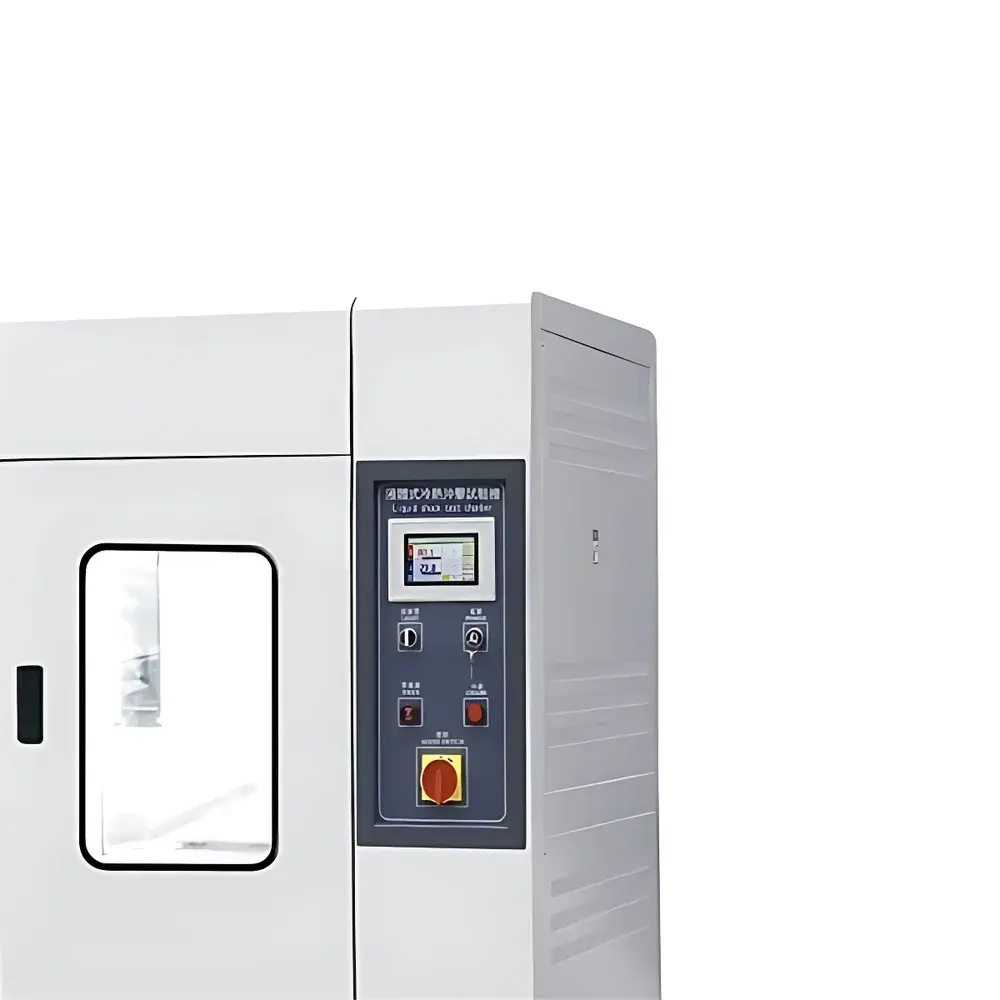
English Product Name
| Brand | OK-YT |
|---|---|
| Origin | Imported |
| Manufacturer Type | Authorized Distributor |
| Temperature Range (Hot Zone) | RT to +200 °C |
| Temperature Range (Cold Zone) | RT to −70 °C |
| Test Zone Temp. Range | +60 °C to +150 °C (Hot Shock) |
| Temperature Uniformity | ±2.0 °C |
| Temperature Control Accuracy | ±0.5 °C |
| Recovery Time | <5 min |
| Preheating Time (RT→150 °C) | ~30 min |
| Precooling Time (RT→−70 °C) | ~85 min |
| Internal Dimensions (W×H×D, cm) | 40×35×30 to 70×60×60 |
| External Dimensions (W×H×D, cm) | 145×180×140 to 190×170×270 |
| Refrigerant | R404A/R23 |
| Construction | Interior – SUS#304 mirror-finish stainless steel |
| Insulation | High-density fire-retardant PU foam |
| Power Supply | AC 380 V ±5%, 50 Hz ±0.5 Hz, 3-phase 5-wire |
| Interface | LAN port for remote monitoring and control |
| Compliance | GB/T 2423.1, GB/T 2423.2, GB/T 2423.22, GJB 150.5, GJB 360.7, GJB 367.2 |
Overview
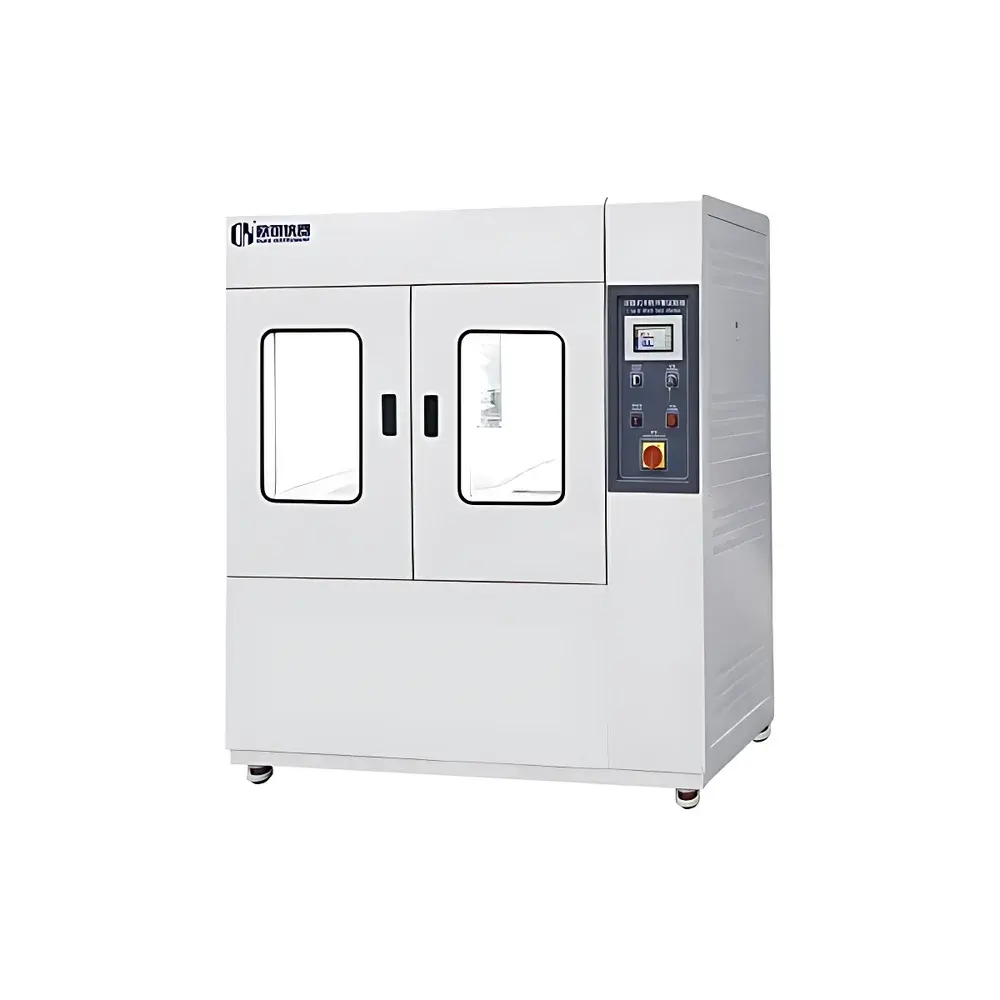
The OK-YT Series Liquid-Based Thermal Shock Test Chamber is an engineered environmental simulation system designed to evaluate material integrity and functional reliability under rapid, repeated transitions between extreme high- and low-temperature conditions. Unlike air-based thermal shock chambers, this system employs a dual-zone liquid-coupled architecture—comprising independent hot and cold reservoirs—with a pneumatically actuated sample carrier that transfers test specimens between zones in under 5 seconds. This design enables true step-change thermal exposure with minimal dwell time, replicating real-world operational stresses encountered by aerospace components, military electronics, medical devices, and automotive subsystems during deployment or mission cycling. The chamber operates on the principle of controlled thermal inertia: heat and cold energy are pre-stored in insulated reservoirs using high-efficiency plate-type heat exchangers and a two-stage cascade refrigeration system. This ensures stable temperature setpoints, high reproducibility across cycles, and minimal thermal lag during transfer—critical for validating failure mechanisms linked to coefficient-of-thermal-expansion (CTE) mismatch, interfacial delamination, solder joint fatigue, or polymer embrittlement.
Key Features
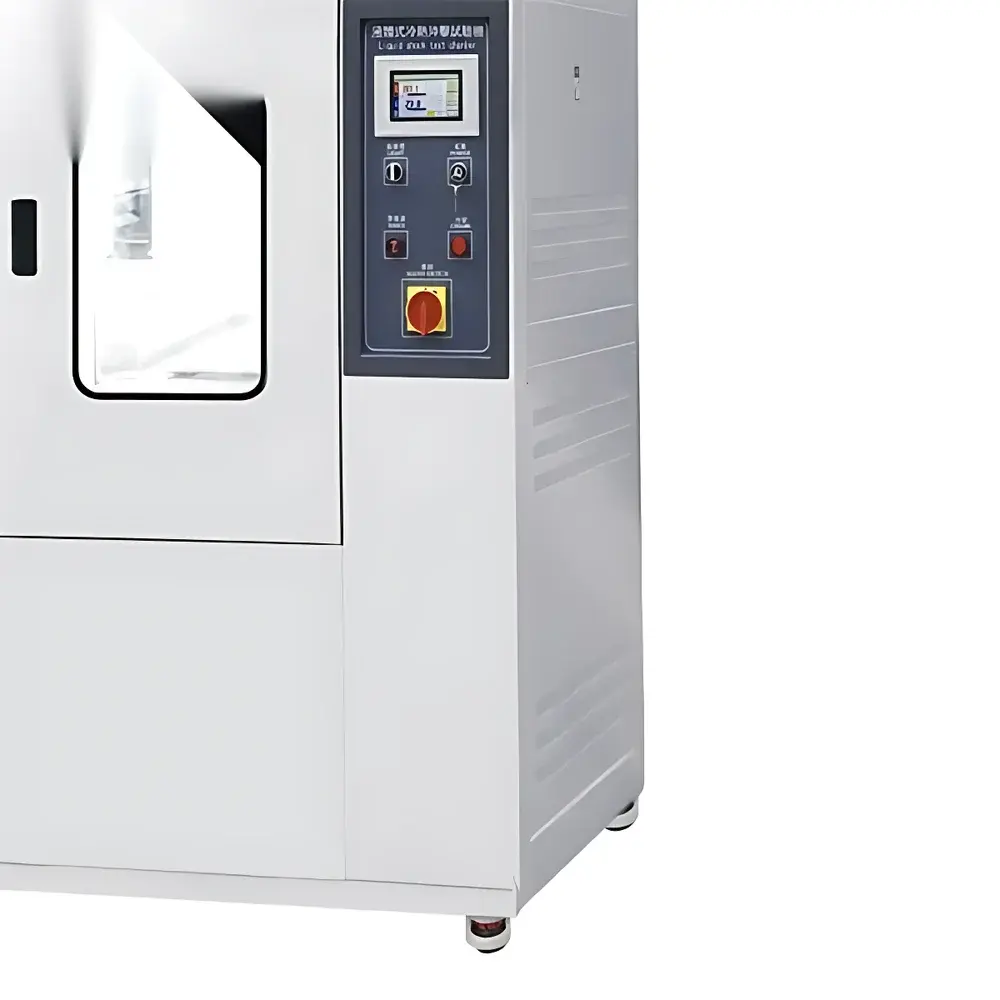
- Large-format color LCD touchscreen controller with intuitive graphical interface, real-time trend display, and multilingual support (English, German, Japanese)
- Dual independent temperature reservoirs: hot zone (RT to +200 °C) and cold zone (RT to −70 °C), each equipped with precision PID-controlled heating/cooling loops
- Two-stage cascade refrigeration system using environmentally compliant refrigerants (R404A/R23), integrated with brazed-plate heat exchangers for enhanced thermal transfer efficiency
- LAN-enabled Ethernet interface supporting TCP/IP communication for integration into centralized lab management systems and remote operation via web browser or dedicated SCADA software
- Flexible test mode selection: independent high-temperature soak, low-temperature soak, or programmable thermal shock sequences—including user-defined dwell times, transition rates, and cycle counts
- Auto-preconditioning function: initiates preheat/precool cycles prior to scheduled test start time to ensure thermal readiness at initiation
- Configurable defrost scheduling (automatic or manual), with cycle-based or time-based triggers to maintain long-term refrigeration performance
- Comprehensive fault diagnostics: on-screen alarm logging, error code mapping, and step-by-step troubleshooting guidance per IEC 61000-4-30 standards
Sample Compatibility & Compliance
The OK-YT chamber accommodates solid-state samples up to 70 cm × 60 cm × 60 cm (W×H×D), including PCB assemblies, sealed enclosures, optical sensors, battery modules, and structural composites. Its stainless-steel interior (SUS#304 mirror finish) and fire-retardant polyurethane insulation meet UL 61010-1 and IEC 61000-6-4 requirements for laboratory safety and EMI immunity. The system complies with internationally recognized test standards for thermal shock evaluation, including GB/T 2423.22 (temperature change testing), GJB 150.5 (military environmental engineering), and GJB 367.2 (electronic equipment qualification). While not certified to ISO/IEC 17025 for accredited calibration, its ±0.5 °C temperature accuracy and ±2.0 °C uniformity across the test volume align with GLP-compliant validation protocols used in R&D labs and QC environments. Optional traceable NIST-calibrated thermocouples (Type T or K) are available for audit-ready data recording.
Software & Data Management
The embedded controller supports native CSV export of time-stamped temperature profiles, alarm events, and cycle completion logs. When connected via LAN, users can deploy third-party data acquisition platforms (e.g., LabVIEW, MATLAB, or custom Python scripts) to ingest live telemetry via Modbus TCP or OPC UA. All test programs are stored with version timestamps and user authentication metadata. Audit trails include operator ID, parameter changes, and manual intervention records—supporting FDA 21 CFR Part 11 compliance when paired with validated electronic signature modules. Data retention is configurable up to 12 months onboard; external storage via USB or network share is supported for long-term archiving aligned with ISO 9001 document control clauses.
Applications
This chamber is routinely deployed in failure analysis labs to accelerate aging of solder joints in avionics control units, assess hermetic seal integrity in implantable medical devices, qualify thermal interface materials (TIMs) for EV battery packs, and validate packaging stability for pharmaceutical diagnostic kits exposed to seasonal logistics extremes. Academic researchers use it to study phase-transition kinetics in shape-memory alloys and glass-transition hysteresis in biodegradable polymers. In manufacturing QA, it serves as a pass/fail screening tool prior to HALT (Highly Accelerated Life Testing) campaigns, reducing field return rates by identifying latent defects related to thermal cycling endurance.
FAQ
What distinguishes liquid-based thermal shock from air-based systems?
Liquid-based systems utilize thermally massive fluid reservoirs for superior temperature stability and faster recovery times—especially critical for tests requiring tight tolerances below −40 °C or above +150 °C.
Can the chamber perform ramp-and-soak profiles, or only step-change shocks?
It supports both modes: independent high-/low-temperature soaks and programmable multi-step shock sequences with variable dwell, transfer, and stabilization phases.
Is remote monitoring compatible with existing enterprise IT infrastructure?
Yes—the LAN interface supports static IP assignment, VLAN tagging, and TLS-secured HTTP(S) access, enabling seamless integration with corporate network policies and SIEM platforms.
How is temperature uniformity verified across the test volume?
Uniformity is validated per IEC 60068-3-5 using nine calibrated thermocouples positioned at defined locations within the test space, with results documented in the factory acceptance test (FAT) report.
Are custom modifications available for specialized applications?
Yes—options include extended low-temperature capability (to −80 °C), additional feedthrough ports (up to four Ø50 mm stainless-steel bushings), and inert gas purge compatibility (N₂ or dry air) for oxidation-sensitive samples.
Related Products



