
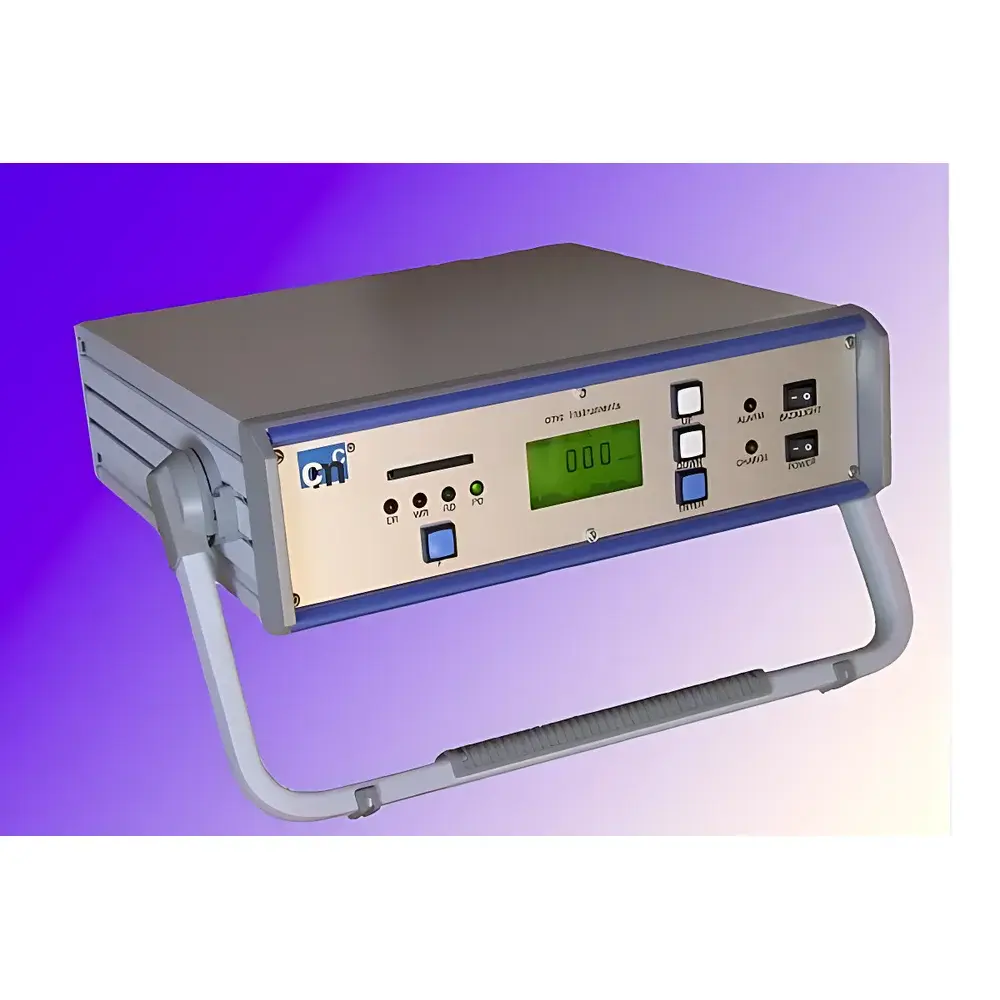
CMC TMA-210-P Portable Electrolytic Trace Moisture Analyzer
| Origin | Germany |
|---|---|
| Manufacturer Type | Authorized Distributor |
| Origin Category | Imported |
| Model | TMA-210-P |
| Product Type | Portable Dew Point Analyzer |
| Measurement Principle | Phosphorus Pentoxide (P₂O₅) Electrolytic Method |
| Operating Temperature | −20 °C to +50 °C |
| Accuracy | ±1 ppm |
| Repeatability | ±0.1 ppm |
| Range | 0–10 / 100 / 1,000 / 2,500 ppm (Auto-ranging) |
| Sensitivity | ±0.1% of full scale |
| Display | Backlit LCD with multilingual interface (including English, German, French, Spanish, Chinese) |
| Alarm Output | 1 relay (SPDT) |
| Analog Output | 4–20 mA or 0–10 V (user-configurable) |
| Power Supply | Rechargeable NiMH battery or 80–230 VAC, 50–60 Hz |
| Power Consumption | 8 W |
| Enclosure Rating | IP20 |
| Dimensions | 363 × 115 × 377 mm (W × H × D) |
| Weight | ~6 kg |
Overview
The CMC TMA-210-P is a portable, microprocessor-controlled trace moisture analyzer engineered for high-precision measurement of water vapor concentration in industrial and laboratory gas streams down to sub-ppm levels. It employs the well-established phosphorus pentoxide (P₂O₅) electrolytic detection principle: moisture in the sample gas is absorbed by a thin film of phosphoric acid (H₃PO₄) coated between two parallel electrodes—typically fabricated from platinum or rhodium—and subsequently electrolyzed into hydrogen and oxygen. The resulting P₂O₅ layer continuously regenerates its hygroscopic capacity, enabling stable, drift-free operation without frequent recalibration. This electrochemical equilibrium yields a current linearly proportional to the water content, which is converted into a digital ppm reading via precision signal conditioning and temperature-compensated amplification. Designed for field-deployable reliability and laboratory-grade repeatability, the TMA-210-P meets stringent requirements for purity verification in semiconductor process gases, specialty chemical synthesis, cryogenic air separation, and high-purity gas distribution networks.
Key Features
- True portable architecture with integrated rechargeable NiMH battery (replacing legacy lead-acid), supporting >8 hours of continuous operation in field environments
- Auto-ranging measurement capability across four dynamic ranges: 0–10, 0–100, 0–1,000, and 0–2,500 ppm — automatically selected based on real-time signal magnitude
- Electrode regeneration function accessible via front-panel menu, restoring sensor sensitivity without disassembly or external tools
- Self-diagnostic startup sequence verifying electrode integrity, power regulation, analog output calibration, and display functionality
- Compliance with NAMUR NE 21 and NE 43 standards for analog signal behavior and fault signaling in process instrumentation
- Backlit multilingual LCD interface (English, German, French, Spanish, Chinese) with intuitive menu navigation and real-time status indicators
- Robust mechanical design with IP20-rated enclosure suitable for controlled indoor environments and cleanroom-adjacent utility areas
Sample Compatibility & Compliance
The TMA-210-P demonstrates broad compatibility with inert, reactive, and corrosive gases—including He, Ar, Kr, Xe, N₂, O₂, H₂, D₂, CO₂, CH₄, natural gas, SF₆, Freon variants, C₂H₂, PH₃, HBr, O₃, and high-purity acid gases such as Cl₂, HCl, SO₂, and H₂S. Its P₂O₅ sensor is chemically inert toward most process gases; exceptions include strong reducing agents or species that react directly with phosphoric acid (e.g., NH₃, amines). All measurements adhere to ISO 8573-8:2019 (compressed air quality — Part 8: Test methods for solid particle, water and oil content) and support GLP/GMP documentation workflows through timestamped data logging and configurable alarm events. While not intrinsically safe, the unit may be deployed in non-hazardous zones per IEC 60079-0 when used with appropriate gas sampling accessories and flow control.
Software & Data Management
Data handling is managed entirely through embedded firmware with no external PC dependency. The device logs up to 10,000 measurement records with date/time stamps, range selection, and alarm status flags. Analog outputs (4–20 mA or 0–10 V) are fully scalable and assignable to any active range segment, facilitating integration with DCS, PLC, or SCADA systems. Relay alarm thresholds are programmable with hysteresis to prevent chatter during transient conditions. Firmware supports user-defined calibration offset correction (±5 ppm) and zero/span validation routines traceable to NIST-certified moisture standards. Audit trail functionality—including operator ID entry (via alphanumeric keypad), parameter change timestamps, and firmware version logging—supports FDA 21 CFR Part 11 readiness when paired with external secure data archiving.
Applications
- Verification of moisture specifications in ultra-high-purity (UHP) bulk and cylinder gases supplied to semiconductor fabs
- In-line monitoring of dry air and nitrogen purge lines in pharmaceutical lyophilization and packaging suites
- Quality assurance testing of SF₆ insulating gas in high-voltage switchgear maintenance
- Trace water quantification in chlorine and hydrogen chloride delivery systems for PVC and titanium dioxide production
- Field validation of desiccant dryer performance in petrochemical and LNG processing facilities
- Research-grade moisture profiling in catalytic reaction effluents and fuel cell feed streams
FAQ
What gases are incompatible with the P₂O₅ sensor in the TMA-210-P?
Ammonia (NH₃), organic amines, and other strongly basic or nucleophilic compounds react irreversibly with the phosphoric acid electrolyte and must be excluded upstream using selective scrubbers.
Does the instrument require periodic calibration with certified moisture standards?
While zero-point stability is excellent due to the self-regenerating P₂O₅ layer, annual span verification using NIST-traceable permeation tubes or chilled-mirror reference analyzers is recommended for ISO/IEC 17025 compliance.
Can the TMA-210-P operate continuously while charging?
Yes—the internal NiMH battery charges seamlessly during AC operation, with automatic switchover ensuring uninterrupted measurement and data logging.
Is the analog output isolated and loop-powered?
The 4–20 mA output is galvanically isolated and compatible with both active (loop-powered) and passive (externally powered) configurations, configurable via setup menu.
How is sensor contamination detected?
Gradual rise in baseline current, failure to auto-zero after regeneration, or persistent deviation beyond ±2 ppm during known-dry gas challenge indicate membrane degradation requiring service or replacement.






