
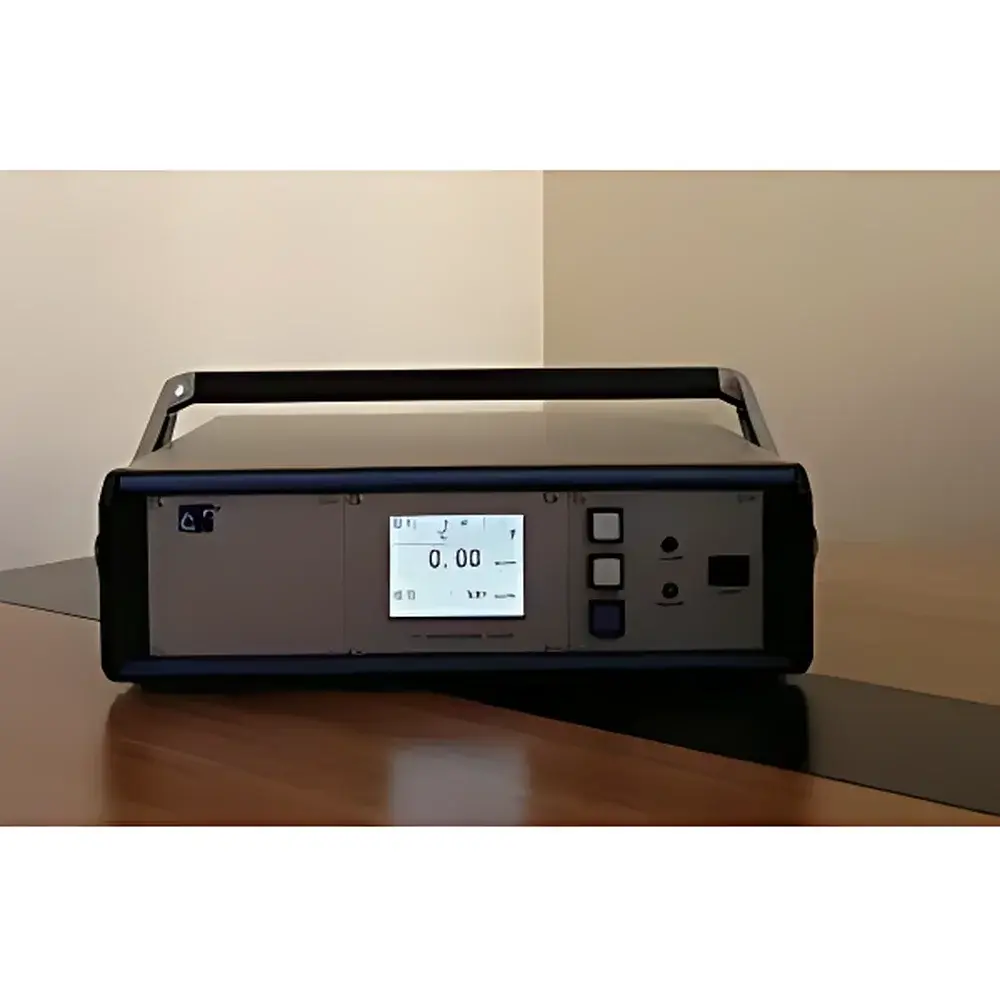
CMC TMA-204-P-EX Portable Electrolytic Dew Point Analyzer for Chlorine Gas
| Brand | CMC |
|---|---|
| Origin | Germany |
| Model | TMA-204-P-EX |
| Product Type | Portable Dew Point Analyzer |
| Measurement Principle | Electrolytic (P₂O₅ sensor) |
| Operating Temperature | -10 to 50 °C |
| Accuracy | ±0.2 °C dew point (equivalent to ±1% of full scale) |
| Repeatability | ±0.1 °C dew point |
| Detection Range | 0–10 / 100 / 1,000 / 2,500 ppmv H₂O (auto-ranging) |
| Display | Backlit LCD |
| Output | 4–20 mA or 0–10 V analog + 1 relay alarm |
| Power | Rechargeable Li-ion battery or 80–230 VAC, 50–60 Hz |
| Power Consumption | 8 W |
| Enclosure Rating | IP20 |
| Dimensions | 363 × 115 × 377 mm |
| Weight | ~6 kg |
Overview
The CMC TMA-204-P-EX is a portable, intrinsically safe electrolytic dew point analyzer engineered for trace moisture measurement in aggressive and hazardous gas streams—particularly chlorine (Cl₂), hydrogen chloride (HCl), sulfur dioxide (SO₂), hydrogen sulfide (H₂S), and other high-purity acid gases. It employs the well-established phosphorus pentoxide (P₂O₅) electrolytic sensing principle: water vapor in the sample gas is absorbed by a thin hygroscopic film of phosphoric acid (H₃PO₄) coated between two parallel electrodes (typically platinum or rhodium wire). Upon application of a DC voltage, the absorbed water undergoes quantitative electrolysis into hydrogen and oxygen; the resulting current is stoichiometrically proportional to the water concentration. This electrochemical equilibrium enables direct, linear, and drift-free quantification of moisture down to sub-ppm levels without routine recalibration. Unlike optical or capacitive methods, the P₂O₅ cell offers inherent immunity to contamination from hydrocarbons, particulates, or condensables—making it uniquely suited for continuous monitoring in chlor-alkali plants, cylinder filling stations, and bulk liquid chlorine handling facilities where compliance with GB/T 5138–2006 and HG/T 3941–3947–2007 is mandatory.
Key Features
- Intrinsically safe design with integrated Zener barrier (certified for use in hazardous areas per ATEX/IECEx requirements)
- Auto-ranging measurement across four selectable spans: 0–10, 0–100, 0–1,000, and 0–2,500 ppmv H₂O
- Full microprocessor control with self-diagnostic boot-up sequence and real-time sensor health monitoring
- Fast response time (<15 seconds to 90% of final reading) and high resolution (0.01 ppmv at lowest range)
- Electrode regeneration capability via user-initiated thermal conditioning—no field replacement required
- Backlit LCD display with intuitive menu navigation and configurable units (ppmv, µg/g, °C dew point, °F dew point)
- Robust mechanical architecture: glass-bodied sensor cell, corrosion-resistant wetted materials, and IP20-rated enclosure
Sample Compatibility & Compliance
The TMA-204-P-EX is validated for use with non-reactive and moderately corrosive process gases—including Cl₂, HCl, SO₂, H₂S, SF₆, N₂, O₂, Ar, He, and natural gas—where moisture content must be verified below 10 ppmv. It excludes gases that chemically attack phosphoric acid (e.g., strong alkaline vapors or ammonia). The analyzer meets NAMUR NE 21 and NE 43 standards for signal output behavior and fault indication. Its measurement methodology aligns with ISO 8573-3 for compressed air purity class verification and supports audit-ready documentation for GLP/GMP environments. While not FDA 21 CFR Part 11–compliant out-of-the-box, its analog output and relay alarm support integration into validated SCADA or DCS systems with appropriate electronic record controls.
Software & Data Management
Data logging is performed locally via internal memory (up to 10,000 timestamped readings) with optional USB export. No proprietary software is required for basic operation; however, CMC’s PC-based configuration utility (TMA-Config v3.2) enables advanced calibration offset adjustment, alarm threshold programming, and sensor regeneration scheduling. All configuration changes are logged with date/time stamps and operator ID fields—supporting traceability under ISO/IEC 17025 and internal QA procedures. Analog outputs are linearized and temperature-compensated in firmware; 4–20 mA signals comply with HART Foundation physical layer specifications for future smart-device integration.
Applications
- Real-time verification of moisture in liquid chlorine prior to packaging (per GB/T 5138–2006 limit: ≤5 ppmw)
- In-line monitoring of Cl₂ feed gas in PVC production reactors
- Quality assurance during cylinder requalification and filling operations
- Leak detection support in dry gas distribution manifolds
- Commissioning validation of desiccant dryers and membrane purifiers used in specialty gas supply chains
- Field verification of moisture removal efficiency in sulfur recovery unit tail gas treatment
FAQ
What gases are incompatible with the P₂O₅ sensor?
Gases containing free ammonia (NH₃), amines, or strong alkalis will neutralize the phosphoric acid film and permanently degrade sensor performance. Halogenated hydrocarbons with active hydrogen (e.g., CHCl₃) may also interfere.
Is recalibration required after sensor regeneration?
No. Regeneration restores baseline electrolytic activity but does not alter the fundamental Faradayic relationship—calibration remains valid unless physical damage or long-term exposure to extreme over-range conditions occurs.
Can the instrument operate continuously on battery power?
Yes. The rechargeable Li-ion pack provides ≥8 hours of uninterrupted operation at 25 °C ambient; runtime decreases to ~5 hours at -10 °C due to reduced battery efficiency.
How is traceability maintained during field use?
Each unit ships with a factory calibration certificate traceable to NIST-standard chilled mirror hygrometers. Field verification can be performed using certified zero-gas (N₂ dried to <0.1 ppmv) and span gas (e.g., 5.0 ± 0.1 ppmv H₂O in N₂) per ISO 6141 guidelines.
Does the analyzer meet explosion protection requirements for chlorine service?
Yes. The integrated Zener barrier limits energy delivered to the sensor head to Class I, Division 1 / Zone 1 levels per EN 60079-11, eliminating ignition risk in chlorine-rich atmospheres where flammability is not the primary hazard—but electrostatic discharge and material compatibility remain critical design considerations.





