
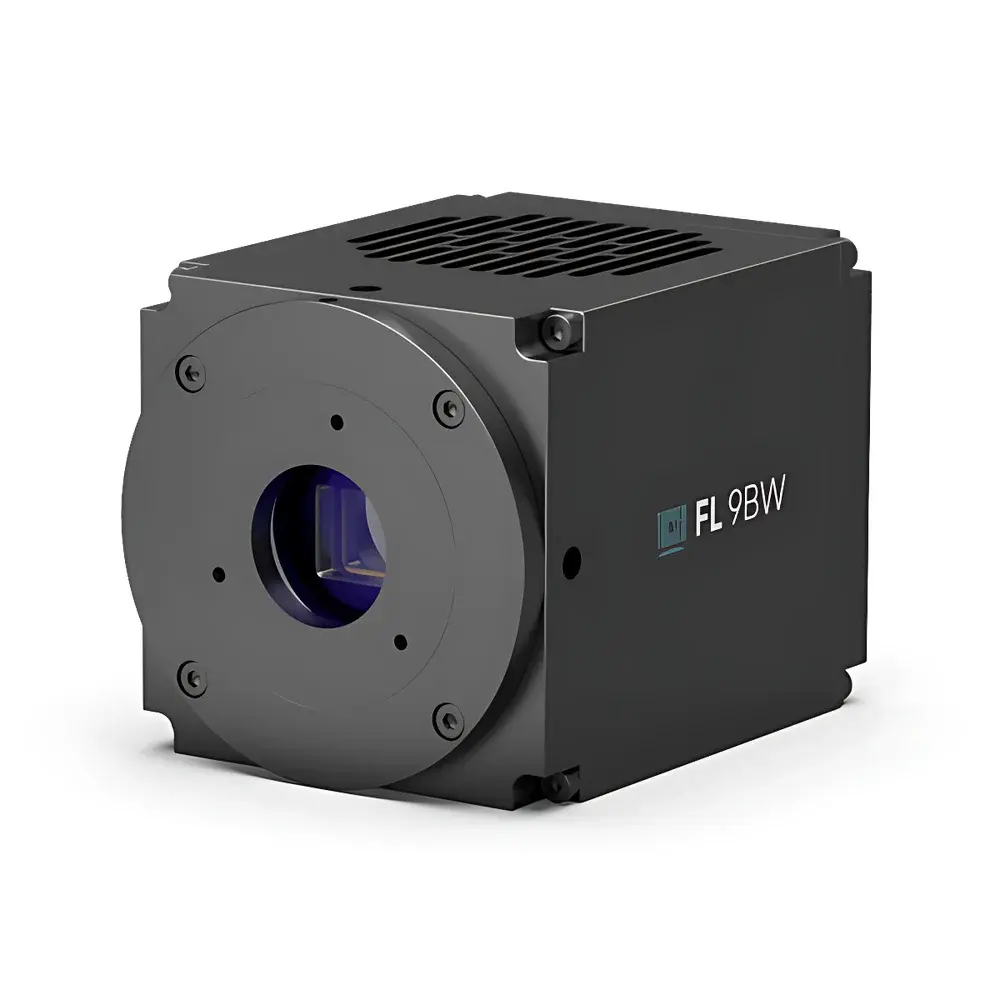
Tucsen FL9BW Scientific CMOS Camera for Chemiluminescence, Bioluminescence, dPCR and Fluorescence Imaging
| Brand | Tucsen |
|---|---|
| Origin | Fujian, China |
| Manufacturer Type | Original Equipment Manufacturer (OEM) |
| Region of Manufacture | Domestic (China) |
| Model | FL9BW |
| Pricing | Upon Request |
| Image Resolution | 3000 (H) × 3000 (V) |
| Pixel Size | 3.75 µm × 3.75 µm |
| Sensor Diagonal | 15.96 mm |
| Quantum Efficiency | 92% @ 530 nm |
Overview
The Tucsen FL9BW is a high-performance, actively cooled scientific CMOS camera engineered for low-light quantitative imaging in demanding life science applications—including chemiluminescence, bioluminescence, digital PCR (dPCR), and multi-channel fluorescence detection. Built around the Sony IMX533CLK-D back-illuminated (BSI) CMOS sensor, the FL9BW delivers CCD-class performance in dark current suppression and long-exposure stability while surpassing traditional CCDs in quantum efficiency, dynamic range, and readout speed. Its thermoelectric cooling system achieves a stable −25 °C sensor temperature (at ambient 22 °C), enabling ultra-low dark current (< 0.0005 e⁻/p/s) critical for exposures up to 60 minutes without significant thermal noise accumulation. This architecture ensures high signal-to-noise ratio (SNR) across both short- and extended-duration acquisitions—making it suitable for rigorous quantitative analysis where pixel-level reproducibility and background uniformity are essential.
Key Features
- Back-illuminated Sony IMX533CLK-D sensor with 9 MP resolution (3000 × 3000), 14-bit native depth (FPGA binning extends to 16-bit), and peak quantum efficiency of 92% at 530 nm
- Ultra-low dark current (< 0.0005 e⁻/p/s) and industry-leading read noise (as low as 0.9 e⁻ in Low-Noise mode at Gain 2), enabling robust single-photon-level detection
- Active air-cooled thermoregulation to −25 °C (ΔT = 47 K below ambient), with real-time temperature monitoring and PID-controlled stabilization
- Multi-gain architecture (Gain 0–2) supporting flexible trade-offs between full-well capacity (up to >180 ke⁻ with binning) and sensitivity (3 ke⁻ full-well at Gain 2)
- Hardware- and software-triggered acquisition with TTL-compatible I/O (exposure start, global reset, readout end, high/low level), ensuring precise synchronization with external light sources or fluidic controllers
- C-mount optical interface with optional custom adapter support; USB 3.0 data interface for high-throughput streaming (18 fps in Standard mode, 12 fps in Low-Noise mode)
Sample Compatibility & Compliance
The FL9BW supports a broad range of biological and biochemical assay formats, including Western blots, ELISA plates, luminescent reporter assays (e.g., luciferase-based gene expression), dPCR droplet imaging, and multiplexed fluorescent gels or microarrays. Its uniform background response—achieved via integrated defect pixel correction (DPC), advanced on-sensor glow suppression, and calibrated flat-field compensation—ensures accurate relative quantification across spatially heterogeneous samples. The camera complies with ISO 15739:2013 for image sensor characterization and meets key requirements for GLP/GMP-aligned workflows, including deterministic exposure control, non-volatile gain/offset calibration storage, and audit-ready metadata embedding (timestamp, temperature, gain, exposure time, binning). While not FDA 21 CFR Part 11-certified out-of-the-box, its SDK supports integration into validated systems with electronic signature and audit trail capabilities.
Software & Data Management
The FL9BW is fully supported by Tucsen’s Horise SDK (C/C++/C#), enabling deep integration into custom acquisition platforms, automated imaging stations, or LIMS-connected QC pipelines. Native drivers are available for Windows and Linux environments, with optional MATLAB and Python bindings (via ctypes or PyTorch-compatible wrappers). Acquisition software includes real-time histogram analysis, region-of-interest (ROI) statistics, multi-frame averaging, and non-uniformity correction presets. All acquired images embed EXIF-compliant metadata—including sensor temperature, gain setting, exposure duration, and firmware version—to ensure traceability and reproducibility. Export formats include TIFF (16-bit linear), HDF5 (for time-series or multi-dimensional stacks), and FITS (for astronomical or cross-platform compatibility).
Applications
- Chemiluminescent Western Blot Imaging: High-SNR detection of HRP- or AP-conjugated antibodies with sub-femtogram sensitivity and linear dynamic range exceeding 4 decades
- dPCR Droplet Analysis: Reliable segmentation and fluorescence intensity quantification of thousands of nanoliter-scale reaction compartments under low-light conditions
- Bioluminescent Reporter Assays: Long-duration kinetic monitoring of circadian gene expression or pathogen load without photobleaching or thermal drift artifacts
- Fluorescence Multiplexing: Simultaneous capture of multiple fluorophores (e.g., Cy3/Cy5/FITC) using narrow-band filter sets and gain-matched acquisition protocols
- Microscopy Integration: Compatible with inverted and upright epifluorescence platforms as a drop-in replacement for legacy CCD systems requiring improved speed and sensitivity
FAQ
What is the maximum usable exposure time for quantitative chemiluminescence imaging?
The FL9BW maintains stable dark current performance up to 60 minutes at −25 °C, enabling reliable quantification in ultra-low-signal assays such as high-dilution Western blots or rare-event dPCR detection.
Does the camera support hardware triggering for synchronized multi-modal imaging?
Yes—dedicated TTL input/output lines support exposure start, global reset, and readout completion signals, allowing tight synchronization with LED excitation, shutter controllers, or peristaltic pumps.
How is sensor uniformity ensured across the field of view?
Each unit undergoes factory calibration for pixel response non-uniformity (PRNU), dark signal non-uniformity (DSNU), and defect pixel mapping; these corrections are applied in real time via firmware.
Can the FL9BW be integrated into an ISO 13485-certified IVD instrument?
As a component-level imaging engine, the FL9BW provides deterministic behavior, versioned firmware, and comprehensive test reports—enabling OEMs to meet design verification requirements under ISO 13485:2016 Annex C.
Is binning performed on-chip or in software?
Binning (2×2 through 8×8) is implemented in FPGA logic prior to ADC conversion, preserving SNR advantages and eliminating interpolation artifacts associated with post-acquisition binning.





